

Why choose orange and lemon pressed olive oil for your restaurant?
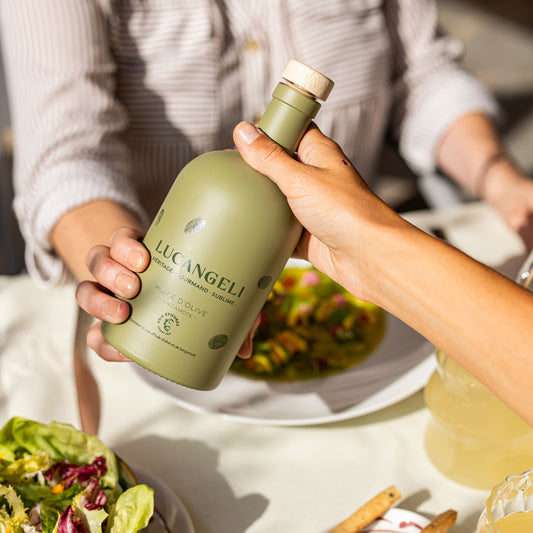
Orange and lemon pressed olive oil, obtained by co-crushing fresh citrus fruits and olives during extraction, adds an original and fresh touch to many dishes. It allows you to differentiate your menu, bring a Mediterranean touch, and surprise customers looking for new experiences. For back to school, offering this type of oil as a finishing touch on fish, late summer salads, or fruity desserts is a true marker of seasonality and identity.
To further personalize your customer experience, discover the page bottle personalization for restaurants and hotels.

Criteria for selecting a suitable supplier for restaurants
Traceability and constant quality
A good supplier must guarantee complete traceability of their orange and lemon pressed oil: origin of the olives, varieties, harvest date, identity of the fruits used for co-crushing. Favor producers who can provide certificates, analyses, and batch history, as for an organic ripe fruity olive oil or a trio of oils.
Formats, packaging, and stock rotation
In restaurants, the 500 ml format, dark bottle, or 5 L canister are preferred to limit oxidation and streamline service. Check the BBD, bottling date, and adjust the order frequency to your usage volume. A professional supplier often offers adapted formats, such as the 5 L canister, and a fast replenishment service.
Logistics, lead times, and minimum order
Anticipate lead times: back to school is a period of high stock tension. Ask for average lead times, delivery days, minimum order (often around 12 to 24 bottles for custom-pressed oils), shipping costs, and payment terms. For custom projects or large volumes, contact the sales department dedicated to professionals.

Checklist for successful procurement
- Request the technical sheet and the batch analysis certificate.
- Verify the origin of the olives and citrus fruits.
- Choose the appropriate format for your use (bottle or canister).
- Anticipate stock rotation and order frequency.
- Confirm delivery times before back to school.
- Ensure the minimum order is compatible with your activity.
- Evaluate the possibility of customizing the bottle with your image.
The distinguishing element: custom co-crushing
Some suppliers offer custom co-crushing, starting from 24 bottles, allowing you to use your own citrus fruits or choose the percentage of orange and lemon. This service, rare in France, allows you to create an exclusive oil for your establishment, thus differentiating your menu from September.
To learn more about customization options or for a specific project, consult the page create the design of my personalized bottle.
Frequently asked questions
How to recognize real orange and lemon pressed olive oil?
Authentic oil is obtained by co-crushing fresh citrus fruits and olives, without added flavor. It is distinguished by its natural aromas and traceability.
Which format should be preferred for restaurants?
The 5 L canister for the kitchen and the 500 ml bottle for the dining room are ideal, limiting oxidation and facilitating service.
What are the supply lead times for back to school?
In September, generally allow 5 to 10 working days, but it is recommended to anticipate to secure your stocks.




 lucangeli.it