

Understanding the Different Categories of Olive Oil
Every year, Earth Day on April 22 invites us to rethink our consumption habits. In our kitchens, this questioning often begins with a simple act: choosing a quality organic olive oil, produced with respect for the soil, olive trees, and artisanal know-how. But with the multitude of labels and mentions on bottles, how do you find your way?
Extra Virgin Olive Oil: The Quality Standard
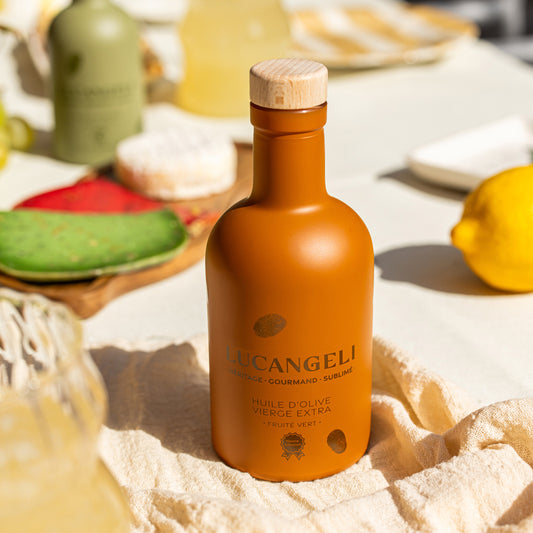
Extra virgin olive oil is the highest category in the official European classification. It is obtained solely by mechanical processes—without chemical treatment—and must have a free acidity of less than 0.8%. This requirement guarantees the purity of the product and the preservation of its natural aromas. For a green fruity organic olive oil, the olives are harvested early in the season, before full maturity, which gives an oil with herbaceous, slightly peppery notes and a beautiful liveliness.

Green Fruity or Ripe Fruity: What's the Difference?
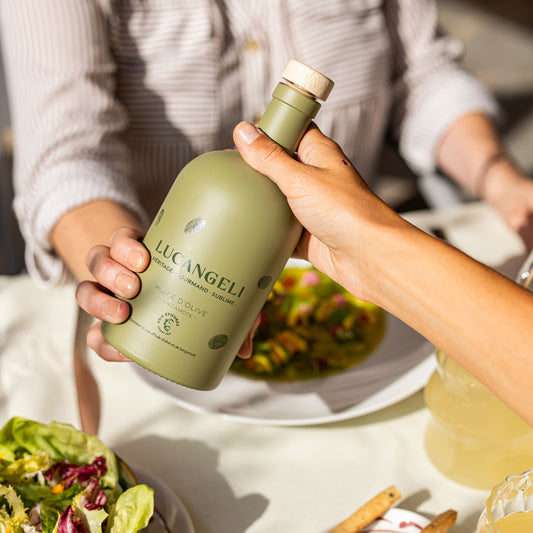
The aromatic profile of an olive oil largely depends on the harvest time. A ripe fruity organic olive oil is obtained from olives harvested at full maturity: it offers rounder, softer, and fruitier aromas, ideal for delicate dishes, fish, or desserts. Green fruity, on the other hand, is perfect for salads, grilled vegetables, or to enhance a dish. To discover both profiles, the trio of organic olive oils is an excellent way to explore the nuances of the Calabrian terroir.
Refined Olive Oil: What to Avoid
In contrast to extra virgin, refined olive oil undergoes industrial treatments that neutralize its flaws but also its taste qualities. It is often sold under the name "olive oil" without further precision. For quality cooking, it is therefore essential to ensure that "extra virgin" is clearly stated on the label. An IGP gold balsamic vinegar combined with a quality extra virgin olive oil transforms the simplest salad into a gastronomic experience.
Labels and Certifications: How to Read Them?

The Organic Farming (AB) Label
The AB label, issued by the European Union, certifies that the olives have been cultivated without synthetic pesticides, chemical fertilizers, and with respect for natural cycles. This is a fundamental guarantee for consumers concerned about the environmental impact of their food. For daily use in large quantities, the 5L organic olive oil container certified organic is a practical and economical option, without compromising on quality.
DOP, IGP: Italian Origin Labels
In Italy, DOP (Denominazione di Origine Protetta) and IGP (Indicazione Geografica Protetta) labels guarantee that a product comes from a specific geographical area and is produced according to controlled traditional methods. These certifications are particularly important for local products like DOP basil pesto, whose quality is directly linked to the origin of the ingredients and compliance with strict specifications.
Checking the Harvest Date
A often overlooked but essential criterion: the harvest date. A quality olive oil must indicate the harvest year on the label, and not just an expiry date. The fresher the oil, the more intense and preserved its aromas. An extra virgin olive oil is ideally consumed within 18 to 24 months of harvest. The 500ml organic olive oil discovery duo is a beautiful way to start exploring the different aromatic profiles of a regional olive oil.
Terroir and Artisanal Know-How: The Criteria That Make the Difference
Geographical Origin, a Guarantee of Character
Olive oil is a living product, deeply linked to its terroir. The soil, climate, altitude, and olive varieties cultivated in a given region give each oil a unique character. Calabria, a southern Italian region bathed in sun and sea, produces olive oils renowned for their aromatic intensity and typicality. A bergamot olive oil—a marriage between Calabrian olive oil and the region's emblematic citrus fruit—perfectly illustrates this richness of the local terroir.
Manual Harvest and Cold Pressing
The harvesting and extraction method directly influences the final quality of the oil. Manual or gentle mechanical harvesting preserves the integrity of the olives and prevents premature oxidation. Cold pressing—carried out at a temperature below 27°C—preserves the aromas and natural characteristics of the fruit. These more demanding artisanal methods are the sign of a producer dedicated to quality rather than yield. For lovers of Mediterranean cuisine, the 500ml organic olive oil discovery duo allows for comparing two expressions of the same terroir.
Pairing Olive Oil with Other Local Products
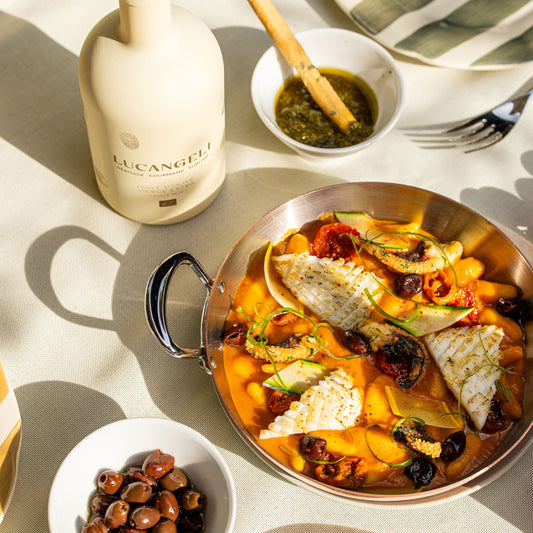
A quality olive oil fully reveals itself when paired with other local products. The black olive tapenade with extra virgin olive oil, for example, concentrates all the generosity of black olives in a simple and tasty preparation. Similarly, a drizzle of extra virgin olive oil on a bruschetta, accompanied by a DOP basil pesto, is enough to transform an ordinary meal into a moment of sincere gastronomy. Choosing a quality organic olive oil also means choosing to support agriculture that respects the earth—a gesture that takes on its full meaning as Earth Day approaches.





 lucangeli.it