


Calabrian bergamot comes in three distinct forms — juice, olive oil and spread — and none of them has to stay confined to the kitchen. Served in the right order, in the right vessels and with the right pairings, they make up a coherent, memorable table experience, at home just as much as in a restaurant or a hotel.
Why bergamot deserves a place of its own in table service

A Calabrian citrus whose uses are still little known
You know bergamot from its fragrance, or from Earl Grey tea. You know it far less at the table, on the plate, inside a properly built fine-dining service. And that is exactly where it gets interesting: Calabrian bergamot, harvested from November to March on the Ionian coast, has an aromatic profile that nothing else reproduces. Its juice is sharp and floral at once, with a light bitterness at the back of the palate. Its oil, obtained by milling the fresh fruit together with the olives at the moment of extraction, leaves a soft citrus note without the cutting acidity of lemon. Its spread, made from the pulp, concentrates those aromas in a creamy texture that works just as well with a starter as with a dessert.
These three forms are not substitutes for one another: they complement each other. And it is precisely that complementarity that lets you build a full table experience around bergamot.
Three forms, three moments in the meal
Before you think about the pairing, think about the moment. Here is how the three forms fall naturally into place across a meal:
- Bergamot juice: to open, diluted in sparkling water or served neat in a very small quantity as a refreshing first taste. Its acidity gets the palate ready.
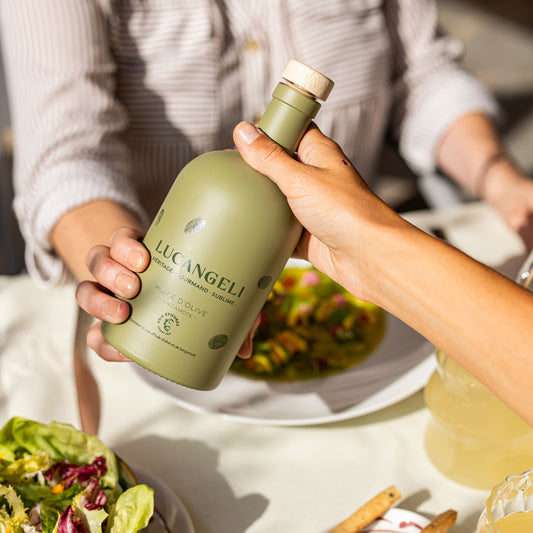
- Bergamot olive oil: during the meal, over fish, burrata, a vegetable carpaccio or a creamy risotto. It brings a discreet floral finish where a neutral oil would leave no trace at all.
- Bergamot spread: at the end of the meal or at breakfast, on brioche bread, on toast, or alongside a lightly tangy fresh cheese. The Épicure d'Or 2024 rewards a recipe that managed to preserve the aroma without weighing it down.
---
How to serve bergamot at the table, step by step
Bergamot juice: opening the meal
The pure organic Calabrian bergamot juice is served in a small liqueur glass or a thick-walled shot glass, at room temperature or slightly cool, never ice-cold. Cold dulls the floral aromas too much.
The right proportion, diluted in sparkling water: between 10 and 15 ml of pure juice per 200 ml of water. The result is a lightly bitter, bright drink that prepares the palate for the dishes to come without saturating it.
If you offer it to your guests, add a short explanation: Calabrian bergamot is one of the only citrus fruits in the world that grows nowhere but this strip of land between the Ionian Sea and the Aspromonte. That single fact, said in one sentence, turns a tasting into a discovery.
Bergamot olive oil: the finishing touch that changes everything
The bergamot olive oil, awarded the Épicure d'Argent 2023, is served as a finishing drizzle, at the last moment, after cooking. Heat alters its aromas: it is not a cooking oil, it is a serving oil.
There are two ways to bring it to the table:
- Pour a few millilitres into a small individual dish, set directly on the plate or beside it, with a piece of toasted bread for dipping. The gesture echoes the art of oil at the table in southern Italy.
- Drizzle it over the dish as you serve, visibly. On a courgette carpaccio, a burrata or a white fish fillet, the citrus note registers immediately without taking over.
Recommended amount at the table: 5 to 8 ml per plate. Beyond that, the fragrance dominates. Below it, it stays so discreet that it goes unnoticed.
Bergamot spread: the pairing at the end of the meal
The bergamot spread can be served in two ways depending on the time of day:
- At the end of the meal, as an alternative to a classic sweet dessert: a spoonful on a small plate, with lightly toasted brioche bread and a knob of mascarpone. The bergamot takes on an almost candied dimension, somewhere between lemon and orange blossom.
- At breakfast or brunch, in place of the usual spreads. Its aromatic profile is more discreet than that of a classic jam, which makes it a perfect fit for hotel service or for an Italian colazione at home.
To take the experience further, pair it with the bergamot preserve and present the two side by side: the spread for bread, the preserve for yoghurt or fromage blanc. The same citrus, two textures, two intensities.
---
Bringing bergamot into professional service
In restaurants and hotels: building a sensory journey
For restaurateurs and hoteliers, bergamot offers a rare advantage: it lets you run a single thread through an entire meal or breakfast without ever becoming repetitive.
An example of a sequence in a restaurant:
- Welcome: sparkling bergamot water, served with the day's chalkboard
- Starter: bergamot olive oil as a finish on a carpaccio or a burrata
- Dessert or petit four: bergamot spread on a small piece of toast
Every stage uses the same aromatic base in a different form. The guest senses the coherence without you having to explain it — and if you do explain it, the service becomes memorable.
For a hotel breakfast, the three forms slot naturally into the buffet: pure juice in a small individual carafe, oil in a table cruet for the toast, spread in a ramekin beside the other spreads. The bergamot sunshine gift box lets you try all three forms before deciding which ones to bring into your offer for good.
You can contact our trade section for supply terms, available formats and delivery times.
Personalisation: making bergamot a table signature
A bottle of bergamot olive oil carrying your establishment's visual identity on the label says something few tables say yet: you chose an exceptional product and you own that choice right down to the design. The minimum order is 24 bottles, and customers design their label directly online through the configurator.
For larger volumes or a bespoke project tailored to your menu, our sales team dedicated to personalisation handles the whole process.
---
Frequently asked questions about bergamot at the table
Can bergamot juice be served as an aperitif?
Yes, diluted in sparkling water or mixed into a non-alcoholic cocktail with ginger and honey. Its floral brightness makes it a natural aperitif that opens the appetite without weighing down the palate. Recommended proportion: 1 part juice to 10 to 15 parts water.
Can bergamot olive oil replace a plain oil in cooking?
It can replace a plain finishing oil on delicate dishes — fish, steamed vegetables, fresh cheeses. It is not suited to cooking, though: heat alters its citrus aromas. For cooking, use a plain extra virgin olive oil.
How do you store bergamot spread once it is opened?
In the fridge, in its closed jar, between 4 and 8 °C. It keeps for several weeks after opening. For dining-room or buffet service, take it out of the fridge at least 15 minutes beforehand so that the aromas come through fully at room temperature.




 lucangeli.it