


Why does bergamot only grow in Calabria?
Bergamot (*Citrus bergamia*) is a hybrid citrus whose botanical origin is still debated. The most credible hypotheses have it born from a cross between the bigarade — the bitter orange — and the sweet lime. What is certain, on the other hand, is that its commercial cultivation is inseparable from a single geographic area: the Ionian coast of the province of Reggio Calabria, between Villa San Giovanni and Brancaleone, along some forty kilometres of shoreline.
Why such a narrow strip? The combination of factors behind Calabrian bergamot is virtually impossible to reproduce elsewhere: mild, frost-free winters, dry summer heat, a precise humidity level carried by the nearby Strait of Messina, and a free-draining clay-limestone soil. Plantations attempted in Côte d'Ivoire, Argentina and Turkey have produced fruit that looks much the same, but with a different aromatic profile: the ratio between the molecules that give bergamot essence its olfactory signature — linalool, linalyl acetate, limonene — never reaches the same balance. The Calabrian terroir remains, to this day, irreplaceable.
This singularity led the bergamot of Reggio Calabria to obtain a Protected Geographical Indication (PGI), which governs both the production area and the methods used to extract the essence.
A demanding tree, one harvest a year
The bergamot tree is a squat tree with glossy leaves and thorns, which comes into flower in spring. Its intensely fragrant white flowers give fruit that develops all through the summer. In September, as the days shorten, the bergamots are still green and firm, somewhere between the size of a tennis ball and an orange. They don't drop on their own: they stay attached to the tree until the harvest, which usually starts between mid-November and the end of December, depending on the altitude of the orchard and the ripeness being sought.
Harvesting is done by hand for fruit destined for quality culinary uses. Each bergamot is picked individually, without damaging the peel, because it is the zest that concentrates most of the essential oils. Growers who supply perfumery and high-end gastronomy refuse machines, too brutal to preserve the integrity of the fruit.
September, the month for watching the orchards
Bergamot isn't harvested in September, yet it is the month when growers watch their trees most closely. The fruit swells, the colour shifts from light green towards a deeper green, and the first aromatic analyses guide the decisions: which lot will go to perfumery, which will be pressed for juice, which will be set aside for cold extraction of essential oil. In cooking and fine food, bergamot harvested between mid-November and January produces the most concentrated juices, with a clean acidity and an intense floral scent you won't find in the late fruit of March.
---
The cultural identity of bergamot in Calabria

In the Reggio Calabria area, bergamot is not a niche product: it is an identity. The city describes itself as the “Bergamot Capital”, and the Bergamot Riviera is the official name for the stretch of coast between Reggio and Melito di Porto Salvo. For decades, most of the crop was absorbed by French and English perfumery: bergamot essence is one of the central components of eau de Cologne and of a considerable number of classic fragrances.
But since the 1990s, a new generation of Calabrian growers and processors has started to bring bergamot onto the plate and into the glass. That shift is no small thing: it represents a deep economic change for a region that had long handed over its raw materials without keeping any of the added value.
From perfume to plate: a recent conversion
Culinary uses of bergamot go back a long way in Calabrian households — bergamot marmalade has been made at home for generations — but their commercial spread is more recent. Pure organic bergamot juice, for example, is a product category that barely existed in shops twenty years ago. Today it is used in the kitchen as a finishing citrus, partly replacing lemon, with a more complex and less acidic aromatic profile.
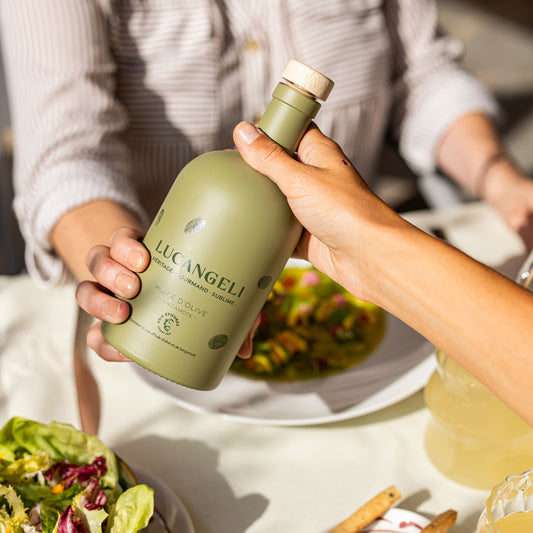
The other notable development is bergamot olive oil, obtained by milling the fresh fruit together with the olives at the moment of extraction — and not by adding flavouring. This technique, which preserves the fruit's natural aromatic molecules, yields an olive oil whose nose carries bergamot's floral signature without ever overpowering the oil itself. This cuvée was recognised at the Épicures d'Argent 2023.
On the sweet side, the bergamot spread — awarded at the Épicures d'Or 2024 — and the bergamot marmalade illustrate the same logic: turning a rare citrus into an accessible gourmet product without distorting it.
Bergamot and tea: a worldwide alliance
Here is something many people don't know: bergamot is the aroma that defines Earl Grey tea. Bergamot essence is added to black tea leaves to give that slightly bitter floral scent that has won the world over since the 19th century. For many people, the first encounter with bergamot is therefore through the nose, in a cup of tea. Moving on to bergamot as food — as juice, oil or marmalade — often comes as a surprise, because the fresh fruit is infinitely more complex than the tea lets you guess.
---
How to use bergamot in autumn cooking

In September and October, before the new fruit is available, products from the previous harvest (November to March of the current year) are at the peak of their usefulness. It's the right moment to work them into autumn cooking.
The juice, a finishing citrus
Organic bergamot juice is used in small quantities, like a condiment. A few drops on a scallop carpaccio, in a vinaigrette for an endive and walnut salad, or to finish a Parmesan risotto: bergamot brings a floral note that cuts against the more direct acidity of lemon. Reckon on about one third bergamot juice to two thirds lemon juice in a recipe that calls for citrus, to find the balance without swamping the dish.
Bergamot olive oil, for raw vegetables and fish
Bergamot olive oil is used only as a finishing oil, never for cooking. On a burrata, on raw sea bream carpaccio, or drizzled over an autumn vegetable soup just before serving: it works anywhere you want aromatic freshness without astringency. Heat, on the other hand, ruins it: bergamot evaporates the moment it is cooked and loses all its point.
The bergamot gift box, to discover it all at once
If you want to explore the full range — juice, oil and spreads — the sunshine bergamot gift box brings the three formats together in a single set. It's also a gift idea for someone who doesn't know the fruit yet: the progression of uses is natural, from the simplest (morning toast with the spread) to the most refined (the oil as a finishing touch on the plate).
Restaurateurs and professionals who would like to add bergamot to their menu can contact the professionals section for information on available formats and supply terms.
---
Frequently asked questions about Calabrian bergamot
Does bergamot grow anywhere other than Calabria?
Technically, the bergamot tree can be grown in other Mediterranean or subtropical regions, but the combination of soil, climate and coastal microclimate specific to the province of Reggio Calabria is not reproduced anywhere else. Attempts to grow it outside this area have given fruit whose aromatic profile differs noticeably. Almost all of the world's PGI bergamot essence still comes from this Calabrian coastal strip.
When is fresh bergamot in season?
Fresh bergamots are harvested between mid-November and March, peaking in December and January for fruit destined for fine food. In September and October, the fruit is still on the trees. Processed products — juice, oil, spreads, marmalade — are available all year round and let you use bergamot outside its harvest window.
Does bergamot taste the same as lemon?
No. Bergamot is more floral, less acidic and more bitter on the finish than lemon. Its aromatic profile recalls orange, lemon and orange blossom all at once, with a slightly resinous note of its own. That complexity is what makes it a sought-after finishing citrus in fine cooking, rather than a simple substitute for lemon.




 lucangeli.it