

Sourcing an olive oil supplier for your restaurant is a decision that commits your kitchen for several months. Here are the criteria to check, the questions to ask, and the formats to be aware of before signing.
Criteria for evaluating an olive oil supplier for restaurants
Traceability and origin
The first question to ask any olive oil supplier is simple: where does the oil come from, and can they prove it? A reputable supplier should be able to provide you with the batch number, the extraction mill, the olive variety used, and the harvest date. This information is not a luxury: it allows you to answer your customers' questions, justify your choice to your team, and comply with your traceability obligations in the kitchen.
For the professionals section, traceability is a non-negotiable selection criterion. Certified organic extra virgin olive oil is subject to annual checks by an independent certification body, which provides an additional guarantee for your establishment.
Among the varieties to know, Carolea is a Calabrian olive that yields an oil with a soft, ripe fruitiness, with notes of ripe tomato and almond. It is particularly suitable as a finishing oil for white meats and fish. Knowing the variety allows you to choose the oil based on its intended use, not just its price.
Available professional formats
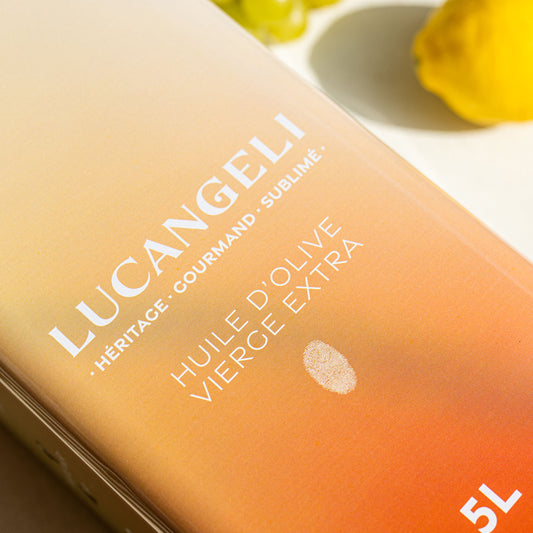
The format directly impacts your material cost and kitchen organization. The 5-liter can for restaurants is the standard for the hospitality sector: it can be handled with one hand, is easy to store, and limits repeated openings that accelerate oxidation.
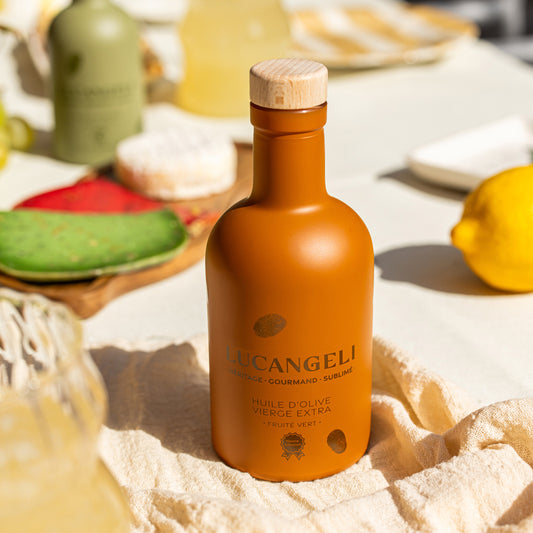
For front-of-house service or guesthouses, smaller formats are preferable. The discovery duo of two 500ml bottles allows you to test two different aromatic profiles before committing to a volume. For establishments that wish to offer a finishing oil at the table in a generous format, the jeroboam of organic extra virgin olive oil provides a distinctive presentation option.
The four formats to know for restaurants:
- 5 L can — cooking, marinating, large quantities: optimized cost per liter, fast rotation.
- 500 ml bottle — table service, finishing: preserved freshness, neat presentation.
- Jeroboam — guesthouse, buffet, event: visual impact, exclusive format.
- 200 ml bottle — tasting, food and oil pairing: aromatic precision, serving format.
Actual commercial terms
Before sourcing a supplier, systematically check four points: minimum order, shipping costs, delivery times, and restocking conditions in case of a shortage. This information is not always available on commercial websites and should be explicitly requested.
A supplier who delivers within 48 to 72 working hours in mainland France allows you to maintain a reduced stock without risking a shortage. A supplier who imposes a high minimum order can unbalance your cash flow if your turnover is low. Compare the total cost of ownership, not just the price per liter.
Questions to ask before sourcing a supplier
Quality and certification
Here are the questions to ask during your first interaction with a potential supplier:
- Is the oil certified extra virgin by an official panel test?
- What is the free acidity of the current batch? It must be less than 0.8% for extra virgin.
- Is the oil filtered or unfiltered? Unfiltered oil has a natural sediment and a shorter shelf life once opened.
- What is the harvest date? An oil harvested in November and bottled in December will be at its best aromatic profile up to 18 months after harvest.
- Does the supplier have verifiable organic certification?
To evaluate two aromatic profiles before committing, you can order an organic green fruity olive oil and an organic ripe fruity olive oil in 200ml formats. These two profiles cover the majority of uses in restaurants: green fruity for raw vegetables, raw fish, and vinaigrettes; ripe fruity for meats, roasted vegetables, and hot finishes.
Logistics and restocking
Logistics is often the weak point of artisan suppliers. Ask these questions before signing:
- What is the standard delivery time for your geographical area?
- How is restocking managed in case of out-of-stock during the season?
- Does the supplier offer online order tracking?
- What are the return conditions for products damaged during delivery?
- Can the supplier accommodate an urgent order in case of a peak in activity?
A supplier who produces in Calabria and ships directly from the mill to your establishment reduces intermediaries and guarantees better freshness. This is a logistical as well as a qualitative argument.
Building a coherent range for your establishment
Cooking oil and finishing oil: two distinct categories
The most common mistake in catering is to use the same oil for everything. A cooking oil and a finishing oil meet different criteria and do not have the same material cost per serving.
For pan-frying, baking, or marinating, an extra virgin oil in a 5-liter can is suitable. It can withstand temperatures up to 180-190 °C, and its less delicate aromatic profile holds up better to heat. For finishing, i.e., the drizzle poured over the plate at the moment of plating, a higher quality oil in a small bottle is justified. This is what the customer directly perceives, and it makes the aromatic difference.
Consult the space dedicated to catering professionals for recommendations tailored to your type of establishment and consumption volume.
Customization as a lever for differentiation
Offering a bottle of olive oil with your logo on your restaurant or hotel tables sends a strong signal to your customers. It indicates that you have selected this product, that you know its origin, and that you stand by it as an editorial choice for your cuisine.
The personalized bottle service for your establishment allows you to create a label in your image, with your logo and visual identity. The minimum order is 24 bottles, and the production time is 10 to 15 working days. For large-scale projects or hotel chains, the sales department handles design and logistics. You can also use the personalized bottle configurator to visualize the result before confirming your order.
Frequently Asked Questions
What is the minimum order for a professional olive oil supplier?
It depends on the supplier. Some wholesalers impose minimums by value or volume. For custom-labeled bottles for an establishment, the minimum is generally 24 bottles. For standard can or bottle orders, there isn't necessarily a minimum imposed, but shipping costs can make small orders unprofitable.
How to choose between a green fruity olive oil and a ripe fruity olive oil for restaurants?
Green fruity, made from early-harvested olives, has herbaceous notes, a distinct bitterness, and a pungency at the finish. It is suitable for raw vegetables, raw fish, and vinaigrettes. Ripe fruity, made from mature-harvested olives, is milder, with notes of ripe fruit and almond. It is suitable for meats, roasted vegetables, and finishing hot dishes.
How to check the quality of an olive oil before sourcing a supplier?
Request the batch analysis sheet: free acidity, peroxide value, and organoleptic panel test result. An extra virgin oil must have an acidity below 0.8% and a peroxide value below 20 meq O2/kg. If the supplier cannot provide this data, it's a red flag.




 lucangeli.it