

What pasta e ceci really is
In Italy, *pasta e ceci* isn't something you order: you make it at home, often on a Sunday, with chickpeas you set to soak the night before. It's a dish that is neither really a soup nor really a pasta, something thick and creamy that fills you up. In Calabrian trattorias it's served in a terracotta bowl with a pool of raw olive oil poured over the top, and that oil is what separates a decent plate from a meal you remember.
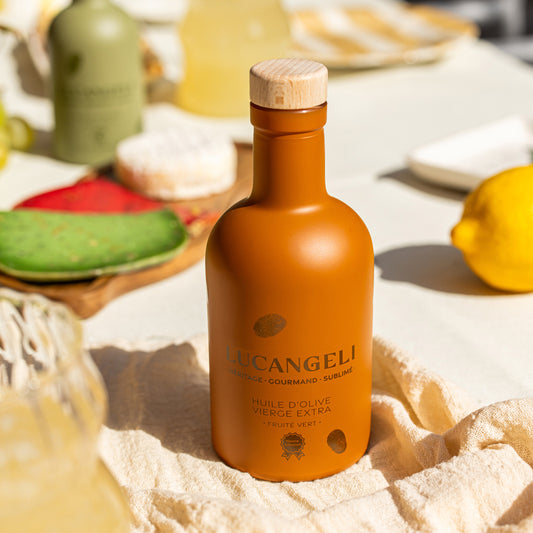
The recipe exists in almost every region of Italy, but the South — Calabria, Campania, Lazio — gives it a place of its own. Down there people often add dried chilli, sometimes a parmesan rind at the end of cooking, and they always finish with an organic green fruity olive oil whose gentle pungency cuts through the sweetness of the chickpeas.
Ingredients for 4 people
- 300 g dried chickpeas (or 600 g drained from a jar, to go faster)
- 150 g short pasta: ditali, tubetti or ditaloni
- 2 garlic cloves
- 1 sprig of fresh rosemary
- 2 bay leaves
- 200 g chopped tomatoes (still perfectly in season in late September)
- 1 litre of vegetable stock or water
- Salt, pepper
- 4 to 6 tablespoons of organic green fruity olive oil — to finish, off the heat
The recipe step by step
- If you use dried chickpeas, soak them for 12 hours in cold water, then rinse them and cook them for 1 hour to 1 hour 30 over low heat in unsalted water until they are tender. Keep the cooking water.
- In a large pan, gently fry the crushed garlic cloves with the rosemary in a tablespoon of olive oil, over medium heat, for 2 minutes. Don't let the garlic colour: it should perfume the oil, not burn.
- Add the chopped tomatoes and let them reduce for 5 minutes.
- Pour in the drained chickpeas and the stock. Take out a third of the chickpeas and mash them roughly with a fork, then return them to the pan: this is what gives the dish its creamy texture without adding any cream.
- Bring to a simmer, add the pasta and cook for the time given on the packet, stirring often so the pasta doesn't stick to the bottom.
- Remove the rosemary and the bay leaves. Adjust the salt.
- Off the heat, pour 1 to 1 and a half tablespoons of green fruity olive oil into each bowl as you serve. Not before, and never during cooking: the heat would destroy the grassy aromas that are the whole point of the gesture.
Why the finishing oil changes everything

There are two distinct uses of olive oil in this recipe. The first, at the start of cooking to fry the garlic, can be a standard cooking oil — the heat erases the nuances. The second, poured raw at the table, is the one you'll choose with care.
For pasta e ceci, the green fruity profile is the best match. An organic green fruity olive oil shows notes of fresh grass, artichoke and green almond, with a slight bitterness on the palate and a pungency at the back of the throat. These characteristics answer the sweetness and the starch of the chickpeas perfectly: they bring tension where the dish would otherwise be a little flat.
Carolea is one of the Calabrian varieties that best illustrates this profile. Harvested at intermediate ripeness — between mid-October and November, depending on the altitude of the grove — it gives an intensely green oil, with a clear bitterness and a frank but short pungency. It's precisely that pungency that keeps pasta e ceci from feeling heavy: it stays lively, even hot.
If you prefer a gentler profile, organic ripe fruity olive oil works too, but the result will be rounder and less contrasted. It's up to you and your palate.
How much olive oil at the table?
One tablespoon per bowl (about 10 to 12 ml) is the right amount. Any less and the gesture becomes invisible. Any more and the dish turns greasy. The oil should form a shiny thread on the surface, not a layer. To pour without waste, a drip-free spout on the bottle helps you control the flow. If you regularly cook large quantities, the 2.5 L jeroboam of organic extra virgin olive oil is a practical format so you're not constantly reordering.
The Calabrian and Neapolitan variations

The Calabrian version with chilli
In the Cosentino, a dried red chilli — the *peperoncino* — goes in at the same time as the garlic. It infuses slowly into the oil and then disappears. The result is a gently spiced base that pairs very well with a fruity finishing oil. If you like chilli, this is the variation to adopt in autumn.
The Roman version with anchovies
Lazio adds one or two anchovy fillets to the garlic at the start of cooking. The anchovies melt away completely and bring an umami depth without making the dish taste of the sea. The finishing oil stays the same: green fruity, raw, at the very last minute.
The quick version with jarred chickpeas
If you don't have time to soak dried chickpeas, jarred chickpeas work very well. Rinse them thoroughly to get rid of the excess salt, then carry on the same way. The texture will be slightly less creamy, but saving the soaking and cooking time is a real argument. You can make up for it by blending a larger share of the chickpeas before you add the pasta back.
Frequently asked questions about pasta e ceci
Can you swap the pasta for rice or another grain?
Yes, some Neapolitan families use rice, others spelt. The result is different but just as satisfying. Spelt in particular goes very well with the grassy notes of a green fruity oil.
Can you make pasta e ceci ahead?
Yes, but without the pasta. The chickpea base keeps for two days in the fridge. Reheat it, then cook the pasta straight in it as you serve: the pasta softens and swells if it sits in the broth. The finishing oil, for its part, always goes in at the very last second.
How do I know if my green fruity olive oil is good quality?
A quality green fruity oil shows a clear bitterness on the palate, a frank pungency and grassy or artichoke aromas. If it's soft and flat, it probably wasn't picked at the ripeness stage known as "green". Look at the harvest date on the label too: an oil from the 2025-2026 season is still at its full aromatic expression in autumn 2026.
To build the selection of olive oils you keep in the kitchen — one for cooking, one for finishing — you can take a look at the professionals area if you work in the restaurant trade, or explore the trio discovery set in a Terracotta box if you want to compare several profiles before choosing.





 lucangeli.it