

An olive oil's vintage is the year the olives were picked and pressed. It is not the bottling date, it is not the use-by date, and yet it is the most useful piece of information you can find on a label. Here is why it changes everything about the quality of what you pour onto your plate.
What the vintage really means on a bottle of olive oil

The harvest year, and nothing else
In the world of wine, the vintage is a regulated, standardised piece of information. For olive oil, things are different: the harvest year is not a mandatory mention on the label. European regulation requires a best-before date, but not the harvest year. Stating it is therefore the producer's own choice, and that choice is a signal in itself.
A producer who prints "2026 harvest" on the bottle is committing to the traceability of the product. They are telling you exactly where the oil comes from in time, not just in space. That is a form of transparency you will not systematically find on supermarket shelves.
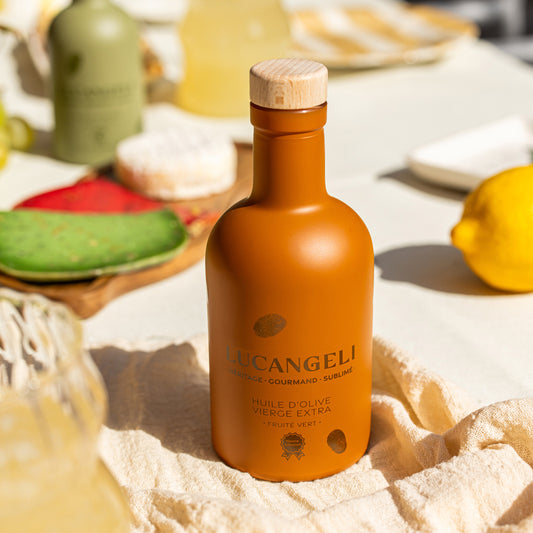
The organic green fruity and ripe fruity oils that display their vintage let you know exactly what you are opening.
Vintage and best-before date: two very different pieces of information
The best-before date tells you how long the producer guarantees the oil will keep its minimum qualities if it is stored in the right conditions. It is generally set at 18 or 24 months after bottling.
The problem is that bottling can happen several months after the harvest. An oil harvested in November 2024, stored until June 2025 and then bottled, will carry a best-before date of June 2027. Seeing it on the shelf in autumn 2026, you might think it is fresh when in fact 18 months have already passed since the harvest. The best-before date alone will not tell you that. The harvest year will.
To compare different bottles with confidence, the discovery duo lets you explore two profiles from the same identified harvest.
Why the freshness of the vintage is a quality criterion, not snobbery
Oxidation gives no warning
Extra virgin olive oil is a fruit juice. Like every fruit juice, it changes over time. Oxidation is a slow but relentless chemical process: unsaturated fatty acids react with oxygen, the aromas fade, the bitterness and pungency — signs of quality in a fresh oil — diminish, and rancid notes eventually appear.
An oil from a recent harvest expresses its aromatic profile in full: cut grass, tomato, artichoke or almond depending on the variety and how ripe the olives were when picked. An oil that is two or three years old, even stored in decent conditions, has lost part of what it had to offer.
The limited edition 1L ripe fruity olive oil is an example of a product where the vintage is a real guide, not a detail.
Photo-oxidation and storage: what the bottle gives away
Light speeds up the degradation of oil — this is known as photo-oxidation. That is why quality bottles are made of dark glass or opaque metal. But even in a dark bottle, time does its work. A recent vintage partly makes up for the ups and downs of storage. An old vintage makes up for nothing.
The practical rule is simple: in normal storage conditions, away from light and heat, an extra virgin oil is at its best within the 12 to 18 months following the harvest. After that it is still usable, but its organoleptic qualities have changed. The 5L tin is ideal for regular use that guarantees fast rotation.
How to read the vintage on a label, and what to do if you cannot find it
Where to look for the harvest year
On bottles that state it, the harvest year is most often found:
- On the main label, often alongside the word "harvest" or "raccolta" in Italian
- On the back label, on the reverse of the bottle
- Sometimes built into the batch number, which you can decode if the producer provides the key on their website
- On the certificate of analysis or the technical sheet for trade purchases
If you cannot find the harvest year and only the best-before date is given, you can roughly estimate the age of the oil by subtracting 18 to 24 months from that date. It is only an estimate, and it stays imprecise if the gap between harvest and bottling was long.
For restaurateurs and trade buyers looking for precise traceability benchmarks on their supply, the trade area gives access to a selection with an identified vintage.
The particular case of the Italian harvest in autumn 2026
The olive harvest in Calabria generally starts between mid-October and the end of November, depending on the variety and the altitude. Carolea, the emblematic variety of northern Calabria, is often picked first, from mid-October. Roggianella, later and grown at higher altitudes, sometimes waits until December. That means right now — the end of September 2026 — the oils still reaching the market are from the 2025 harvest. Oil from the 2026 harvest will only be available from November or December at the earliest.
This window, between the gradual running down of the previous vintage and the arrival of the new one, is the right moment to understand what you are buying. The olive oil trio discovery box lets you put several profiles from the same harvest side by side.
What to do with an oil whose vintage you do not know
If the label does not mention the harvest year, you can:
- Contact the producer or distributor directly and ask the question plainly
- Check whether the producer's website states the harvest for that particular batch
- Trust your senses: a fresh oil has a clean, lively, grassy or fruity smell when you open it; an aged oil smells of cardboard, rancidity, or of nothing at all
- At a comparable price, choose a bottle that states the harvest year over one that does not
The organic extra virgin olive oil in a 2.5L format is a generous size that suits both a busy kitchen and sensible stocking up.
Frequently asked questions about olive oil vintage
Is the harvest year mandatory on an olive oil label?
No. European regulation requires the best-before date, but not the harvest year. Stating it is the producer's choice. That is precisely why its presence on a bottle is a positive signal of transparency and traceability.
How long does olive oil last after the harvest?
In proper storage conditions — away from light, heat and air — an extra virgin oil keeps its aromatic qualities at their best for 12 to 18 months after the harvest. It stays edible until its best-before date, but its flavour profile gradually changes beyond that window.
How can you tell whether an olive oil is still fresh without knowing its vintage?
Smell is the first indicator. A fresh oil gives off a lively, clear aroma when you open it — notes of cut grass, artichoke, tomato or almond depending on the profile. A flat, cardboard-like or rancid smell signals advanced ageing, whatever the best-before date says. When in doubt, serious producers will always answer the question about the harvest if you ask them directly.




 lucangeli.it