

What European regulations say about labelling
In Europe, olive oil labelling is governed by two main texts: EU Regulation No 1308/2013 on the common organisation of agricultural markets, and EU Regulation No 29/2012, which sets the marketing standards specific to olive oil. The latter lists precisely the information that must appear on every bottle sold to consumers.
These rules are not recommendations. They apply to every producer, importer and distributor selling olive oil on the European market. A bottle without this information is a non-compliant bottle, and that should set off alarm bells straight away.
Category: the single most important item of all
The first thing to look for on a label is the oil's category. The regulation requires the sales description to be spelled out in full:
- Extra virgin olive oil: the top category, obtained solely by mechanical means, with no solvent and no chemical treatment, with free acidity below 0.8% and a fault-free sensory profile.
- Virgin olive oil: also mechanically extracted, but with less strict acidity and taste criteria (acidity below 2%).
- Olive oil: a blend of refined oil and virgin oil. It has gone through industrial processing to make it edible.
- Olive pomace oil: extracted with a chemical solvent from the solid residue left after the first pressing. It is not the same thing as olive oil.
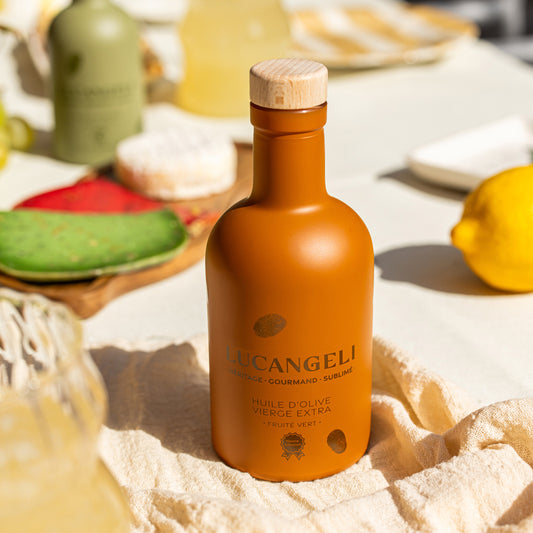
If you are looking for the best quality to dress and finish your dishes, extra virgin is the only starting point. The organic green fruity olive oil and the organic ripe fruity olive oil are two examples of extra virgin with distinct aromatic profiles, useful depending on whether you prefer a lively, grassy oil or a rounder, gentler one.
Origin: an item that sometimes hides a lot
Since EU Regulation No 29/2012, stating the origin has been mandatory. But be careful: there are two very different kinds of origin on a label.
- The origin of the olives: the country or region where the olives were harvested. This is the most useful information for knowing the product's real terroir.
- The bottling location: where the oil was packaged. It can be different from the origin of the olives.
An oil can legally print « Italy » in large letters on the label and have been no more than bottled there, with the olives coming from other countries. The wording to read is the one that goes with a phrase such as *« made from olives harvested in… »* or *« blend of olive oils of EU origin »*. That last formula means the olives come from several member countries without those countries being named.
For a certified Calabrian oil, Olio di Calabria IGP on the label guarantees that the olives were grown, harvested and processed in Calabria, under a set of specifications checked by an independent body. That is concrete protection for the consumer, well beyond a simple statement of origin.
The other mandatory items you should never ignore

The best-before date
Olive oil has no expiry date in the strict sense: it does not become dangerous after that date. But it does degrade. The best-before date, often introduced by the wording *« best before… »*, marks the end of the period during which the producer guarantees the product's optimal characteristics.
A quality extra virgin is ideally used within 18 to 24 months of harvest. A bottle with no visible best-before date is not compliant. A bottle past its best-before date is not necessarily bad, but its aromas have probably faded and its acidity may have risen.
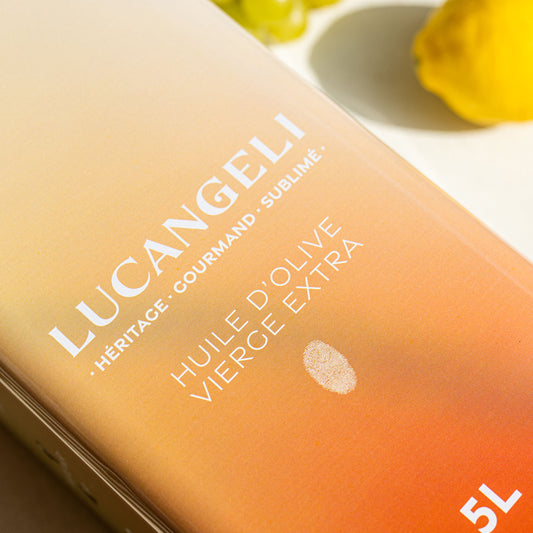
To build a cellar of oils without waste, the 500 ml discovery duo lets you try two aromatic profiles without opening large formats. If you get through a lot, the 2.5 L jeroboam format or the 5 L tin make good economic sense, provided you use the oil within two to three months of opening.
Net volume and batch number
These two items are mandatory on any prepackaged food:
- The net volume lets you compare prices per litre, the only relevant unit of measurement for judging value for money.
- The batch number is essential for traceability. If something goes wrong, it makes it possible to trace back to the date and place of production. A bottle with no batch number is not compliant.
The name and address of the responsible operator
This can be the producer, the bottler or the importer. It gives you someone to turn to with a question or a complaint. It is also a sign of seriousness: a brand that owns its identity and its address has nothing to hide.
What a label may mention, without being required to
The optional items that make the difference
Some information is not imposed by the regulation but shows a commitment to quality when it is there:
- The harvest date (or vintage): it tells you the oil's real age, independently of the best-before date. It is the most reliable information for judging freshness.
- Free acidity: the regulation does not require it to be displayed, but transparent producers often state it. For an extra virgin it must be below 0.8%; the best oils often go below 0.3%.
- The olive variety: stating that an oil comes from the Carolea, Roggianella or Tondina variety, for instance in the case of a Calabrian oil, lets you understand its aromatic profile before you even open it.
- The picking method (by hand or mechanical) and the time before milling: quality markers that demanding producers are happy to share.
- The aromatic profile (green fruity, ripe fruity): useful for guiding the pairing with dishes.
Lucangeli states these details on its bottles because they guide how the oil is used. A restaurateur who wants to go further in their selection can contact the dedicated professional service to access the full technical sheets for each reference. For personal use or a personalised gift, the screen-printed bottle creation page adds a further dimension to the experience.
Frequently asked questions about olive oil labels

Are « extra virgin olive oil » and « olio extravergine di oliva » the same thing?
Yes. They are two versions of the same European regulatory designation (*extra virgin olive oil* in English, *olio extravergine di oliva* in Italian). Both refer to the top category.
Can you trust the « first cold pressing » claim?
The claim has been regulated since 2012. It means that extraction took place at a temperature below 27 °C, by pressing (the traditional method) or by centrifugation. It is a sign of preserved quality, but on its own it does not guarantee excellence: the sensory panel test remains the final judge for the extra virgin designation.
What does « blend of olive oils of EU origin » mean on a label?
It indicates that the olives come from at least two European Union member countries, without those countries necessarily being named. It is a legal statement, but it offers less traceability than an oil with a single, clearly identified origin.




 lucangeli.it