


Why bergamot deserves a place of its own on your table
Calabrian bergamot is grown on a coastal strip of about a hundred kilometres between Reggio di Calabria and Brancaleone. It is one of the most localised crops there is: almost nowhere else in the world does this citrus reach such a precise aromatic profile, at once floral, slightly bitter and with a lingering freshness. The harvest runs from November to March, which means that the processed products — juice, oil, jam, spread — hold a whole short and irreplaceable season within them.
Putting together a tasting board around bergamot means, first of all, telling the story of that singularity. Unlike an oil or cheese tasting, which can be done at any time, bergamot creates a taste territory you recognise immediately. It surprises you, it raises questions, it leaves a mark. That is exactly what a memorable moment at the table should do.
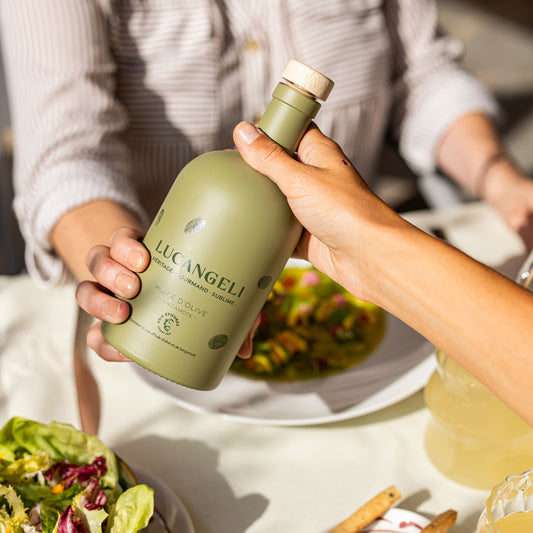
The pure organic bergamot juice is the ideal starting point: served in a small quantity, it lays out the raw aromatic profile of the citrus before you move on to the culinary interpretations. The bergamot olive oil, awarded an Épicures d'Argent in 2023, is made by co-milling fresh zest with the olives at the moment of extraction, not by adding flavouring: that is what explains how perfectly the fragrance is integrated into the oil, with nothing jarring or artificial. The bergamot spread, awarded an Épicures d'Or in 2024, brings the sweet, creamy dimension that rounds off the journey.
How to set up the board step by step

A bergamot tasting board calls for no rare equipment. A few principles are enough to turn the exercise into a real table ritual.
Choosing the containers and the layout
Bergamot has a bright yellow-green colour. Natural materials — slate, pale terracotta, light wood — show it off without overwhelming it. Avoid very dark surfaces, which absorb the light and erase the visual identity of the product.
Lay the elements out in the order they are to be discovered:
- The pure juice — in a small glass or a pipette, on the left. This is the opening taste, the reference point.
- The bergamot olive oil — in a small bowl or dish, in the centre. To be dipped into with a piece of white bread, slightly warm but not yet toasted, so it does not saturate the palate.
- The bergamot spread — on a separate slate, with a small spatula. To be spread on a slice of plain brioche or an unsweetened dry biscuit.
- A fresh zest or a bergamot leaf, if you have one, set to one side: even without eating it, it wakes up your sense of smell and prepares you for the tasting.
Choosing the accompaniments
The board works best when the accompaniments are not trying to compete with the bergamot. A few simple, seasonal ideas:
- Slices of white bread, slightly warmed
- A piece of fresh cheese, ricotta or brousse for instance, to bring out the floral side of the oil
- A few plain hazelnuts, which echo the roundness of the spread
- A square of 70% dark chocolate, to play on the tension between bitterness and blossom
Avoid anything too sharp or heavily spiced, which would short-circuit the nuances of the citrus.
The tasting sequence
Start by smelling each product before you taste it. Bergamot speaks through the nose first. Then taste in order: the pure juice, the oil on bread, the spread. Leave a short pause between each step — thirty seconds is enough — so your palate comes back to neutral. A mouthful of still water between each one helps you start again with a clean slate.
The Coffret Solaire bergamot gift set, which brings together the juice, the olive oil and the spread in a single case, is a simple way to gather the three elements of the board without hunting down the products separately. It also makes a gift idea you can hand over along with the tasting instructions.
If you want to extend the experience with a preserved note, the bergamot sweet preserve can be added to the board as a fifth step, as a marmalade on fresh cheese.
Adapting the experience in a restaurant or hotel

For establishments looking to offer a distinctive moment at the table, the bergamot board can be built as an end-of-meal offering or as an unusual welcome.
At the end of the meal, in place of the classic petits fours
Serving the bergamot board as a partial replacement for petits fours is something few restaurants have tried. It brings together three textures and three intensities, starts a conversation about the Calabrian citrus and leaves a sharper memory than a standard square of chocolate. The bergamot spread, Épicures d'Or 2024, naturally stands out as a signature.
Presenting the board in the dining room
The floor team presents the three products in tasting order, with two sentences of context on Calabrian bergamot and on the difference between a product made by co-milling and a flavoured one. That short, precise piece of information gives weight to the chef's choice and anchors the product in a real terroir.
For hotels, the bergamot board fits into breakfast service as a discovery option alongside the usual spreads: the organic bergamot juice in a small individual bottle, the spread in a little dish, the oil drizzled over fromage blanc. A simple ritual, and immediately memorable.
Establishments that would like to create a personalised version — a bottle of bergamot oil with a label in the house colours — can look at the personalisation service or get in touch directly with the professionals section.
Frequently asked questions
Can bergamot be tasted with anything other than bread?
Yes. Bergamot olive oil goes very well with a fresh cheese such as ricotta, with warm asparagus or with slices of pear. The bergamot spread also works on pancakes, light waffles or a thick plain yoghurt. The juice, diluted in cold lightly sparkling water, becomes an original aperitif drink.
How do you keep the products on the board between two tastings?
Bergamot olive oil keeps away from light and heat, with the cap firmly closed. The spread keeps in the fridge once opened and should be brought back to room temperature twenty minutes before serving so it regains its soft texture. Once opened, the juice goes in the fridge and should be drunk within two to three days.
How much should you allow for a tasting board for four people?
A 200 ml bottle of juice, a 200 ml bottle of oil and one jar of spread are more than enough for four people in tasting mode. If the board accompanies a meal or a brunch, allow double so that everyone can go back to each product freely.




 lucangeli.it