

Why Cannes places particular demands on sourcing
Cannes is not an ordinary restaurant market. Within a compact area, establishments with very different profiles sit side by side: luxury hotels on the Croisette with several in-house restaurants, neighbourhood bistronomy around Forville, beach restaurants operating from March to October, caterers handling banquets at the Palais des Festivals, and four- and five-star hotels serving breakfast, lunch and dinner at the same time with reduced teams out of season.
These establishments share three constraints:
- Brutal seasonality. The number of covers can triple between November and May, particularly during the Festival de Cannes (second half of May), MIPIM (March) or MAPIC (November). Your supplier has to keep up with these peaks without delay.
- An international clientele. Guests in Cannes come from Europe, the United States, the Middle East and Asia. The Italian origin of a product reads as a signal of quality and authenticity, provided it is genuinely traceable.
- Limited storage space. Most addresses in the town centre or on the Croisette have no warehouse. Deliveries have to be frequent, in suitable formats, and products need a long enough shelf life to absorb the peaks without waste.
The September restart: the right time to reassess your suppliers
September marks the return to business after the partial August closure that many establishments in Cannes observe, and the time when autumn menus are put together. This is the strategic window to renegotiate purchasing terms, introduce new products and secure supplies before November. A chef who waits until October to take on a new supplier is systematically too late for the first events at the Palais.
What generalist suppliers do not offer
Food wholesalers cover volume and price. They do not cover fine traceability, harvest seasonality, differentiation on the menu or personalisation. For establishments that work on their identity at the table, fine Italian food follows a different logic: fewer references, but products that are identifiable and carry a story and a territory.
---
Which Italian products to select for your establishment in Cannes

Olive oils: the difference between cooking and finishing
The first mistake establishments in Cannes make is using the same oil for cooking and for finishing on the plate. These are two functions, two products, two formats.
For everyday cooking and volume preparation, the 5 L tin of organic olive oil is the benchmark professional format. It cuts down handling, reduces cost per portion and suits any brigade. Its packaging protects the oil from light and oxidation, the two main enemies in high-heat kitchens.
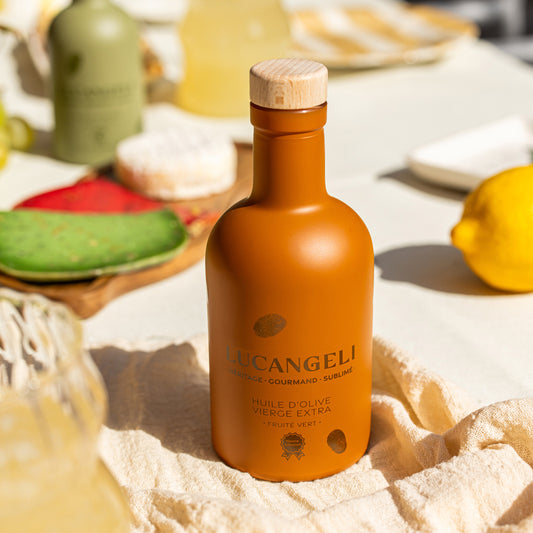
For finishing on the plate and service in the dining room, 200 ml bottles allow fast rotation and a careful presentation. Organic green fruity olive oil in 200 ml suits raw fish, carpaccios and seasonal vegetables. Ripe fruity oil in 200 ml works better with meat, pulses and cooked preparations.
For establishments looking to offer a distinctive experience at the table, pressed oils widen the palette without multiplying references. Lemon-pressed olive oil is obtained by crushing fresh lemons together with the olives at the moment of extraction, which gives it an aromatic freshness that industrial flavouring cannot reproduce. It suits fish, shellfish and raw vegetables, all of which dominate Cannes restaurant menus in season. Garlic and chilli pressed oil completes the range for pizzas, grills and roasted vegetables. Orange and lemon pressed oil finds its place on desserts and citrus salads.
Balsamic vinegars: an asset too often overlooked in the dining room
Balsamic vinegar of Modena PGI is consistently underused in establishments in Cannes. Served as a drizzle over burrata, over figs as a starter or over grilled meat, it justifies a presence in the dining room that few chefs formalise. Two quality levels cover most professional uses:
- The Silver collection, balanced and versatile, for preparations and sauces.
- The Gold collection, denser and rounder, for finishing on the plate and cheese pairings.
For chefs looking for an original reference to put on the menu, red onion PGI balsamic vinegar, awarded at the Épicures 2025, offers an umami note that works just as well on meat as on slow-cooked vegetables.
Spreads and savoury pantry: the amuse-bouche that sets you apart
Italian spreads — black olive tapenade, sun-dried tomato caviar, basil pesto DOP — are the least expensive and most distinctive amuse-bouches an establishment can offer. Served with house bread when the guest sits down, they immediately signal where the house stands.
- Black olive tapenade with olive oil is the understated reference, adaptable to any style of cooking.
- Sun-dried tomato caviar brings a more assertive Mediterranean note.
- Basil pesto DOP is a must for house-made pasta, risottos and vegetarian dishes.
For establishments running an in-house pastry section or a breakfast service, nut butters in 1 kg format — pistachio, Piedmont hazelnut, almond — go straight into production without repackaging.
---
Structuring your sourcing: formats, frequency and stock management
Summary table by range and context of use
The three most common logistical mistakes in Cannes
- Ordering at the last minute before the Festival de Cannes. Delivery times stretch out across the whole Côte d'Azur in May. Place your orders at least two weeks ahead in March and May.
- Storing oils near heat equipment. Heat speeds up oxidation. Even in a well-equipped professional kitchen, oil exposed to an ambient temperature above 20 °C degrades quickly. Choose a closed cupboard, away from ovens and hobs.
- Not separating cooking stock from service stock. The bottle of oil on the cooking line is often the same one that goes out into the dining room. That is not good practice. A 5 L tin in the kitchen, a 200 ml or 500 ml bottle in the dining room: both quality levels make economic sense.
How to contact the professional service
Professional orders — volumes, minimums, delivery terms on the Côte d'Azur, quotes — are handled directly through the professionals area, with no minimum order imposed upfront for a first contact. This is also the channel for any personalised bottles carrying your brand, whether for the table or for client gifts.
---
Personalisation: a lever Cannes establishments underuse
In a hospitality market as competitive as Cannes, the bottle of olive oil on the table is a signal of identity. Many establishments use generic bottles when they could put their name, their logo or a visual of their choice on a personalised production run.
The screen-printing personalisation service lets an establishment create its own bottle from 24 units, with a design built entirely through the online configurator. For hotels that want to give a bottle to VIP guests or mark their reception tables, it is a loyalty tool few local competitors can offer.
---
Frequently asked questions about sourcing Italian products in Cannes
Can you deliver to Cannes and the Côte d'Azur with no minimum order imposed?
Yes. Delivery terms on the Côte d'Azur, including shipping costs and free-shipping thresholds, are set directly with the sales team through the professionals area. The most suitable solution depends on your monthly volume and on how often you want to restock.
Which formats work best for a hotel with room service?
For room service, 200 ml bottles are the most practical: they allow individual service without waste, and their compact format fits easily into an understated, elegant presentation. The 500 ml discovery duo suits suites and welcome trays.
How do you manage sourcing during the big events at the Palais des Festivals?
The rule is to plan at least two weeks ahead. For predictable events such as the Festival de Cannes, MIPIM or MAPIC, a buffer order lets you absorb the peaks without running out. If your establishment handles banquets connected to these events, nut butters in 1 kg format and spreads in large quantities are best ordered in volume through the sales team.




 lucangeli.it