

Listing an Italian olive oil in a fine food store starts with three decisions: choosing a supplier capable of documenting origin batch by batch, selecting formats suited to your turnover, and negotiating purchasing conditions consistent with your volume. This guide details each step, from Italian appellations to shelf storage rules.
Criteria for choosing an Italian olive oil supplier

The Italian olive oil market is vast and heterogeneous. Between large trading brands and direct producers, differences in quality, traceability, and service are considerable. For a fine food store, the choice of supplier directly determines the consistency of your offering and the trust of your customers.
Origin and appellation: PDO, PGI, or monovarietal?
Italy boasts over thirty protected designations of origin for olive oil. Two levels of protection coexist: PDO (Denominazione di Origine Protetta), which requires that production, processing, and packaging all take place within the delimited area, and PGI (Indicazione Geografica Protetta), which requires at least one stage to occur within the area. For a fine food store, the appellation is a clear selling point for knowledgeable customers.
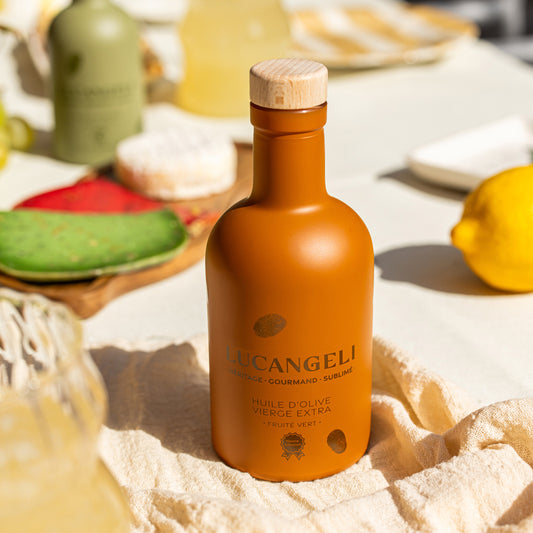
Olio di Calabria PGI deserves special attention. It is produced from local varieties, including Carolea, cultivated in the Calabrian hills between 200 and 600 meters above sea level. Carolea yields a ripe fruity oil with notes of almond and ripe apple, a slight pungency, and a gentle bitterness. Harvesting takes place between October and December, and new oil is available from January. This is a precise and verifiable argument of origin that few suppliers can document as clearly. To discover this profile in practice, the 200 ml organic ripe fruity oil is a suitable demonstration reference for sale in fine food stores.
Monovarietal oils, derived from a single olive variety, offer a more precise aromatic profile and a stronger product narrative. They lend themselves well to in-store promotion, provided the supplier can indicate the variety, production area, and vintage on the label.
Analysis report and batch-by-batch traceability
A reputable supplier provides an analysis report for each delivered batch, indicating at a minimum the free acidity, peroxide value, and the result of the organoleptic panel test. These three data points allow verification that the oil is indeed in the extra virgin category at the time of delivery, and not beginning to degrade.
Batch-by-batch traceability is also a commercial argument: in case of a customer question or a health inspection, you must be able to trace back to the original oil mill. Always request the lot number on the delivery note and keep the corresponding analysis reports. For establishments wishing to go further in their quality approach, the professional area details supply conditions and available documents.
Formats suitable for a fine food store
Format is as much a commercial decision as a logistical one. In a fine food store, four formats cover most needs:
- The small 200 ml bottle: ideal for discovery, tasting, and gifting. Rapid turnover, between two and four weeks.
- The standard 500 ml bottle: the loyalty format, for everyday purchase. Average turnover, between four and eight weeks.
- The large bottle or Jeroboam, from 1 to 3 liters: shelf highlight, premium gift. Slower turnover, between eight and sixteen weeks.
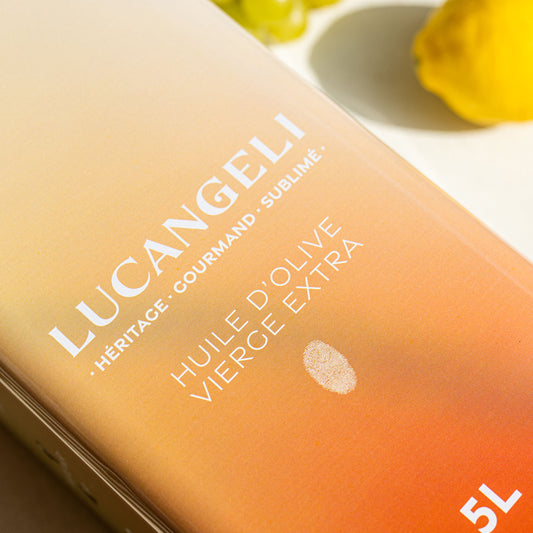
- The professional 5-liter container: internal use, in-store tasting, bulk oil. Variable turnover depending on sales.
The 200 ml bottle is the ideal entry-level format for a customer discovering an oil: the purchase price is accessible, the perceived risk is low. The 200 ml organic green fruity oil and the 200 ml organic ripe fruity oil allow offering two distinct profiles without multiplying references. The 500 ml is the loyalty format: the customer who liked the 200 ml returns with a larger order. The 500 ml discovery duo is an effective promotional option for holiday periods.
For in-store events or tastings, the 5-liter container allows for tasting without opening bottles intended for sale. It is also the most economical format for grocery stores offering oil by the cut or in bulk.
Purchase conditions and minimum order: what to negotiate
Purchase conditions vary greatly from one supplier to another. Before listing a new oil, it is useful to clarify four points: the minimum order, shipping costs, delivery times, and restocking conditions.
Minimum order and shipping costs
Most quality Italian olive oil suppliers work with a minimum order of between 6 and 24 bottles per reference. Below this threshold, shipping costs can represent a significant portion of the purchase cost. For a fine food store starting with a new reference, it is reasonable to negotiate an initial test shipment at a preferential rate, with a commitment to restock conditioned by sales.
Shipping costs are often free above a certain order amount. This threshold varies depending on suppliers but is generally between 150 and 300 euros excluding tax for delivery in metropolitan France. Also check the conditions for Corsica and deliveries in Europe if your clientele is international.
Delivery times and restocking
A delivery time of 48 to 72 business hours is the norm for a supplier based in France or with stock in France. For suppliers shipping directly from Italy, allow 5 to 10 business days. This lead time must be integrated into your inventory management: a stockout on a flagship reference can cost several sales and harm customer loyalty.
Restocking should be possible on order, without a minimum imposed on already listed references. Some suppliers offer automatic delivery at a defined frequency: this is an option to consider for high-turnover references, provided that delivery times are reliable.
Personalization, a lever for differentiation
A fine food store can differentiate itself from supermarkets by offering bottles with its own name or featuring a local event. Label personalization is accessible starting from 24 bottles, with a production time of two to three weeks depending on the complexity of the design. The personalization service allows you to create an exclusive bottle for your store, gift sets, or seasonal events. For larger projects, the personalized bottle configurator allows you to visualize the result before validating the order.
Managing olive oil stock rotation in a fine food store
Olive oil is a living product. Its quality evolves over time, and poor stock management can lead to selling a degraded product, which harms your store's reputation.
The real shelf life of an extra virgin olive oil
The minimum durability date indicated on bottles is generally set at 18 or 24 months after bottling. But this date is a legal limit, not a guarantee of quality until the last day. In practice, a well-preserved extra virgin oil is at its best within the first 12 months after harvest. Beyond that, the aromas gradually fade, even if the oil remains fit for consumption.
For a fine food store, this means it is better to order volumes adapted to an 8 to 12-week turnover rather than storing large quantities. The Jeroboam of organic extra virgin olive oil is an exception: its consumer-friendly format and gift positioning give it rapid turnover during holiday periods, justifying a larger stock in October and November.
Store and present without degrading quality
Four rules are sufficient to maintain the quality of olive oil on the shelf:
- Store away from direct light: dark glass or metal bottles are less sensitive, but none resist indefinitely to prolonged exposure to store spotlights.
- Maintain a stable temperature, ideally between 14 and 18 degrees Celsius: avoid shelves near refrigerated displays or heat sources.
- Apply the first-in, first-out rule: new deliveries go to the back of the shelf, older bottles remain at the front.
- Never transfer into an uncleaned container: residues of oxidized oil contaminate the new content.
In a store, presentation plays a role in the perception of quality. A well-lit shelf, but without direct exposure to spotlights, with legible labels and product sheets indicating the variety and origin, reassures the customer and justifies the price positioning.
Frequently asked questions
What is the minimum order to list an Italian olive oil in a fine food store?
The minimum order varies by supplier, but is generally between 6 and 24 bottles per reference for an initial shipment. Some suppliers offer specific conditions for fine food stores, with an initial test shipment at a preferential rate. It is recommended to negotiate this point before signing a listing agreement.
How to verify the quality of an Italian olive oil before listing it?
Always request a sample and the corresponding batch analysis report. The report must indicate the free acidity (less than 0.8 g per 100 g for extra virgin), the peroxide value (less than 20 meq O2 per kg), and the result of the organoleptic panel test. A supplier who cannot provide these documents does not guarantee the extra virgin category at the time of delivery.
How long can extra virgin olive oil be kept on the shelf in a fine food store?
The legal shelf life is 18 to 24 months according to the minimum durability date indicated on the bottle. In practice, to maintain aromatic quality, it is preferable to sell the oil within 12 months of harvest. An 8 to 12-week turnover per reference is a reasonable goal for a high-volume fine food store.





 lucangeli.it