


What Calabrian bergamot really is, and why Grasse only half knows it
Grasse is the world capital of perfume. The perfume industry there has long used bergamot essence as a top note in eaux de Cologne and fougère compositions. That is where the fruit's reputation in the region comes from — and it is also what confined bergamot for so long to scent alone, far from the plate.
Yet bergamot (*Citrus bergamia*) is a citrus fruit in its own right, grown almost exclusively on a narrow strip of land between Reggio Calabria and Locri, on the Ionian coast of Calabria. It accounts for between 80 and 95% of world production. Its season runs from November to March. Outside that window, the only products available are processed ones: juice, co-milled olive oil, spread, jam, essential oil.
Its flavour is unique: more floral and less acidic than lemon, with a fine, lingering bitterness close to grapefruit without being it. That singularity is exactly what interests Riviera cooks today, as they look for a citrus that is local in memory and rare in practice.
The difference between Calabrian bergamot and bergamot flavouring
Many products labelled “bergamot” are flavoured with extract or synthetic essence. The result is often too loud, one-dimensional, artificial. A quality bergamot product uses the whole fruit — or its juice, or its zest — with no added flavouring. That is what you taste: real bergamot brings several aromatic layers at once, where flavouring brings only one.
Bergamot olive oil: co-milling as a guarantee
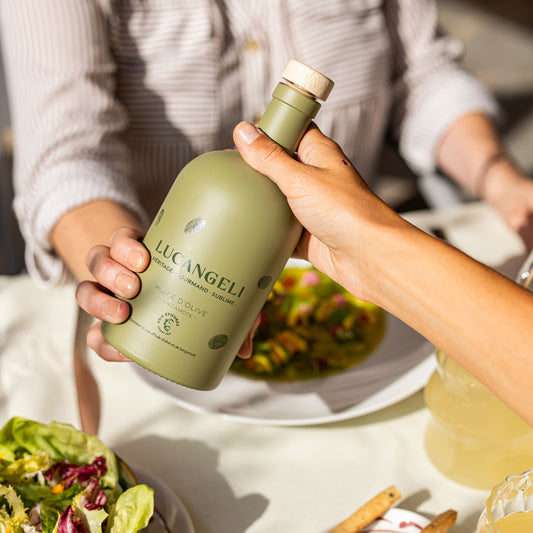
In the case of the bergamot olive oil awarded a Silver Épicure in 2023, the fresh fruit is co-milled with the olives at the moment of extraction — not added afterwards as a flavouring. This process, known as co-milling or co-crushing, lets the bergamot blend into the oil cold, with no heat, which preserves all its aromatic nuances. It is the same logic as for oils pressed with lemon or garlic: the fusion happens at the mill, not in a factory.
Culinary uses: what bergamot brings to the kitchen

Bergamot is still rare in French cooking, including on the French Riviera. That is both a limit (you rarely find it) and an opportunity (it sets a dish or a menu apart immediately). Here are the most relevant uses depending on the product.
With bergamot juice
The pure organic Calabrian bergamot juice is used like any citrus in the kitchen, but with a lighter hand than lemon. A few concrete applications:
- Light vinaigrette: one tablespoon to two of olive oil, over rocket or endive salads. The bitterness of each balances the other.
- Marinade for fish: brushed onto sea bream or sea bass before cooking, the juice perfumes without cooking or altering the flesh.
- Sauce for cold pasta: mixed with olive oil and fresh herbs, it replaces lemon with a more distinctive signature.
- Drinks and alcohol-free cocktails: diluted in sparkling water with honey, it gives a refreshing citrus that is a world away from squeezed lemon.
- Finishing a risotto: a few drops as a final touch, exactly as you would with lemon zest. The result is more floral, less acidic.
The pure organic bergamot juice in the 200 ml size is handy for trying the ingredient out before moving to a larger format.
With bergamot spread
The bergamot spread awarded a Gold Épicure in 2024 is the most approachable way to discover bergamot in food. It works just as well sweet — on a slice of brioche, alongside fromage blanc, on a crêpe — as it does cooked, stirred into a sauce for game or used to fill a mille-feuille or a citrus tart.
In Grasse and along the French Riviera, where Mediterranean pastry happily works with bitter citrus, it is a filling that finds its place naturally.
With bergamot jam and bergamot conserve
The bergamot conserve makes for a more classic introduction: paired with fresh goat's cheese or a brie, it creates a sweet-and-sour match that recalls British citrus chutneys, but with an aromatic finesse they do not have.
What Riviera professionals can do with bergamot
Grasse, Mougins, Valbonne, Antibes: the density of fine-dining and bistronomic restaurants in the Riviera hinterland is among the highest in France. Bergamot is still rare on menus there, which makes it a credible point of difference for cooks looking for a citrus with Mediterranean roots without falling back on the routine of lemon.
On a menu, bergamot needs only two words
Unlike other rare ingredients that call for a long explanation, bergamot enjoys immediate recognition: customers know it from Earl Grey tea, from perfume, from sweets. Putting it on the menu sparks curiosity without causing confusion. That is a rare advantage for an out-of-the-ordinary ingredient.
The professional formats available
| Format | Product | Reference |
|---|
For regular supply or larger volumes, the area dedicated to professionals lets you contact the sales team directly, with no minimum order imposed up front.
Bergamot on the hotel breakfast tray
On the French Riviera, four-star hotels and boutique hotels are looking for products that tell the story of a place without tipping into folklore. Calabrian bergamot — a Mediterranean citrus, grown a few hundred kilometres from Nice, part of Grasse's own perfume tradition — answers that exactly. A bergamot jam or a bergamot spread on the morning buffet is the kind of detail that catches attention and starts a conversation.
For properties that want to go further, a bergamot selection can also be offered as a bergamot gift box to hand to guests on arrival or to sell in the hotel shop.
Frequently asked questions about Calabrian bergamot
Where can you buy Calabrian bergamot on the French Riviera?
Fresh bergamot is almost impossible to find outside its season (November to March) and its growing region. Outside Calabria, processed products — juice, co-milled olive oil, spread, jam — are the only way to get to this citrus all year round. Ordering online with home or pickup-point delivery remains the most reliable channel for the Riviera.
Is Grasse bergamot the same as Calabrian bergamot?
No. The bergamot historically grown in Grasse was grown purely for perfume, and that cultivation has all but disappeared. Calabrian bergamot (*Citrus bergamia* Risso) is the world reference variety for culinary uses as much as for perfumery. It grows on the Calabrian Ionian coast in very specific soil and climate conditions that the Riviera does not reproduce.
Can bergamot juice replace lemon in every recipe?
Partly. Bergamot juice is less acidic and more floral than lemon. It can replace lemon in vinaigrettes, marinades and some sauces, but its bitterness is more pronounced. On delicate dishes — raw fish, carpaccio, fresh salad — it brings a different signature rather than a straight swap. Start with small amounts to calibrate the taste before adjusting the recipe.




 lucangeli.it