

April 22nd is Earth Day. A day that reminds us of the importance of taking care of our planet and the environment around us. And what better way to celebrate this day than by talking about sustainable food and local produce? Two intimately linked subjects, at the heart of the concerns of all those who wish to consume better, without sacrificing taste and authenticity.
What is sustainable food?
Sustainable food is a concept that encompasses the quality of food, its environmental impact, and its production method. It advocates responsible and reasoned consumption, prioritizing local and seasonal products and limiting food waste. The objective is to minimize our ecological footprint while eating healthily and balancedly. Choosing an organic green fruity olive oil from certified agriculture is already a concrete step in this direction.
Criteria for responsible food
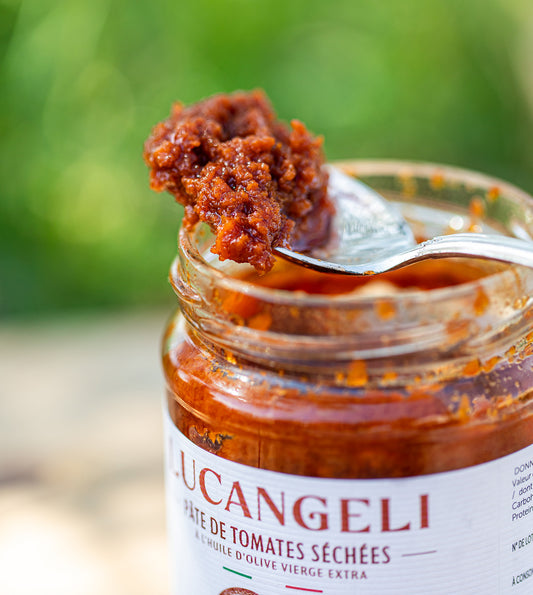
To be considered sustainable, food must meet several criteria. Firstly, it must be environmentally friendly by promoting organic farming and limiting greenhouse gas emissions. It must also be socially equitable, guaranteeing access to healthy food for all and ensuring decent working conditions for producers. Finally, it must be economically viable, by encouraging short supply chains and fairly compensating producers. Products like sun-dried tomato tapenade or black olive tapenade, made from simple and traceable ingredients, illustrate these principles well.
The impact of our food choices on the environment

Our food choices have a direct impact on the environment. By consuming local and seasonal products, we reduce CO2 emissions related to transportation and support the local economy. By prioritizing products from organic farming, we limit the use of pesticides and harmful chemicals for ecosystems. Furthermore, by reducing food waste, we contribute to the preservation of natural resources. Opting for a 5L organic olive oil canister for daily use is also choosing a more economical format that generates less packaging.
Why local produce is at the heart of responsible consumption
Local produce is a key element of sustainable food. It refers to all the geographical, climatic, cultural, and human characteristics that influence the production of a food. By consuming local products, we value the savoir-faire of local producers and preserve biodiversity. Moreover, by choosing local products, we are assured of consuming quality food, from environmentally friendly agriculture. DOP basil pesto is a prime example: a protected designation of origin that guarantees strong territorial roots.
The link between local produce and sustainable agriculture
Local produce is closely linked to sustainable agriculture. Local producers have a deep knowledge of their environment and its specificities. They are therefore able to cultivate products best suited to their soil, without resorting to intensive methods harmful to ecosystems. The pitted black olives in extra virgin olive oil from Calabria, for example, are the result of traditional cultivation passed down from generation to generation, respecting natural cycles.
Labels and certifications that guarantee authenticity
To guarantee the authenticity of local products, there are recognized labels and certifications. In Italy, DOP (Denominazione di Origine Protetta) and IGP (Indicazione Geografica Protetta) guarantee the origin and quality of a food product. The Modena IGP Balsamic Vinegar Gold collection is an emblematic example: a product whose production is governed by strict specifications, rooted in a specific territory. Organic certification, meanwhile, ensures that agricultural practices respect natural balances.
How to choose committed artisanal products daily
Today, it is possible to consume responsibly by choosing artisanal products, from respectful agriculture and authentic local produce. A few simple guidelines allow you to make the right choices, without getting lost in the complexity of the aisles.
Prioritize products with short ingredient lists
Generally, the shorter a product's ingredient list, the more natural and less processed it is. By favoring products with a reduced composition, we limit the consumption of ultra-processed products and promote raw foods. This is the case for organic ripe fruity olive oil, whose composition is limited to a single ingredient: carefully selected olives. This criterion of simplicity is one of the most reliable for identifying a quality artisanal product.
Concrete examples for a more responsible table

To create a more responsible table, sometimes a few well-chosen products are enough. The 200ml olive oil trio, for example, allows you to discover different aromatic profiles from the same organic agriculture, while limiting unnecessary purchases. For those who wish to give or treat themselves thoughtfully, the customizable gift box allows you to select local products according to your tastes and values. Every choice, however small, contributes to supporting a committed artisanal sector and preserving the know-how of an exceptional region.
On this Earth Day, let's remember that sustainable eating doesn't require changing everything overnight. It simply invites us to take a closer look at what we put on our plate: where does this product come from, how was it grown, who made it? These simple questions are the starting point for more conscious, fairer, and often tastier consumption.




 lucangeli.it