


The smoke point of extra virgin olive oil is between 160 °C and 210 °C, depending on the quality of the oil. Contrary to popular belief, a good quality extra virgin olive oil can perfectly withstand pan-frying and baking. It all depends on a single parameter: its free acidity.
What the smoke point really is
The exact definition
The smoke point is the temperature at which an oil begins to break down and emit visible smoke. Beyond this threshold, free fatty acids degrade and produce undesirable compounds that alter the taste of the dish. It is not a cooking limit, but a degradation limit.
What makes this threshold vary
Two main factors influence the smoke point of an olive oil:
- Free acidity: the lower it is, the higher the smoke point. An extra virgin oil with an acidity below 0.4% is much more heat-stable than an ordinary oil at 1.5%.
- Filtration: an unfiltered oil contains microscopic vegetable residues that burn before the oil itself, lowering the apparent threshold. A filtered oil is therefore more stable for cooking.
Reference smoke points
Here are the approximate values for the most common oils:
- Extra virgin olive oil (acidity below 0.4%): 190 °C to 210 °C
- Extra virgin olive oil (acidity above 0.8%): 160 °C to 175 °C
- Refined olive oil: 220 °C to 240 °C
- Refined sunflower oil: 225 °C to 230 °C
- Clarified butter: 250 °C
- Regular butter: 120 °C to 150 °C
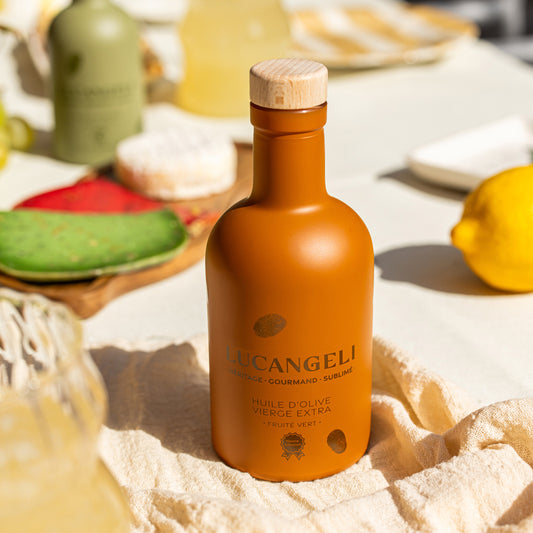
These figures show that a high-quality organic green fruity oil, with very low acidity, is in the same stability range as many common vegetable oils.
When and how to cook with extra virgin olive oil

Suitable cooking methods
Pan-frying over medium heat generally does not exceed 160 °C to 170 °C. Baking at 180 °C is perfectly within the tolerance range of a good extra virgin olive oil. Quick stir-fries over high heat can reach 180 °C to 190 °C, which remains within the limits of a quality oil.
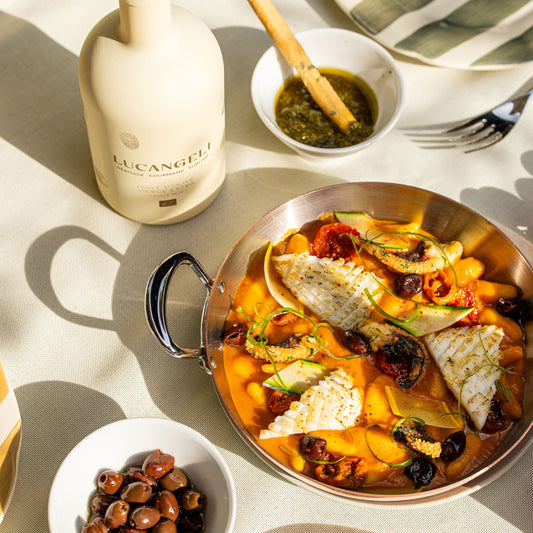
For long oven cooking, such as a summer vegetable gratin or a zucchini and tomato tian, the organic ripe fruity oil is a wise choice: its mild and rounded profile withstands heat well while adding roundness to the dish.
Frying: another matter
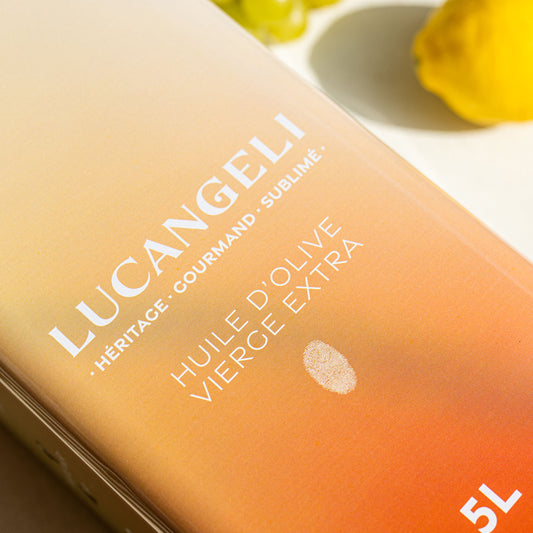
Deep frying is done between 170 °C and 180 °C. A good quality extra virgin oil can technically be used, but it is not the most economical use. For daily frying in large quantities, the 5L organic olive oil container offers a quality-volume ratio suitable for this intensive use.
Variety makes the difference
The Carolea variety, grown in Calabria on the hills between Cosenza and Catanzaro, often has a free acidity below 0.3%. It is one of the lowest among Italian varieties. This characteristic gives it a naturally high smoke point and remarkable heat stability, making it an oil particularly suitable for cooking, not just for finishing. This is the variety found in Lucangeli's oils.
To explore the two available profiles, green fruity and ripe fruity, the trio of 200 ml oils allows you to compare the two expressions of Carolea in the same box.
Common mistakes to avoid
Confusing smoke and degradation
A slight vapor when pouring oil into a hot pan is not degradation smoke: it is simply residual moisture evaporating. Real degradation smoke is persistent, acrid, and accompanied by a burnt smell. If you see a slight mist disappear in a few seconds, the oil is still perfectly stable.
Using poor quality oil for cooking
The most common mistake is to buy a low-end olive oil for cooking, thinking of saving money. An oil with high acidity has a lower smoke point, degrades faster and gives a bitter taste to the dish. It is better to use a quality oil in reasonable quantity. The 500 ml discovery duo is a good starting point to test two different profiles before choosing the one that best suits your cooking.
Storing oil near heat
The smoke point concerns cooking, but degradation begins much earlier, during storage. Oil exposed to light or heat sees its acidity gradually increase, which lowers its smoke point even before it is used. Store it in a closed cupboard, away from the hob.
For professional kitchens looking to optimize their supply of quality oil, the professional area offers formats and conditions adapted to the volumes of the catering industry.
Frequently asked questions
Can extra virgin olive oil be used for frying?
Yes, provided its acidity is below 0.5% and it is filtered. Its smoke point then reaches 190 °C to 210 °C, which is sufficient for frying at 175 °C. It is not the most economical for this use, but it is technically well suited.
At what temperature does olive oil start to smoke?
It depends on its quality. A high-quality extra virgin olive oil (acidity below 0.4%) starts to smoke around 190 °C to 210 °C. An ordinary or poorly stored oil can smoke from 160 °C. The quality of the oil is the primary factor, not the category.
Is it better to use refined olive oil for cooking?
Not necessarily. Refined oil has a higher smoke point, but it has lost a large part of its aromas during refining. For common pan-frying or baking, a quality extra virgin olive oil is perfectly suitable and adds much more flavor to the dish.





 lucangeli.it