


The smoke point of extra virgin olive oil is between 175 °C and 210 °C, depending on its actual quality. Contrary to what is often heard, a good extra virgin oil withstands everyday cooking very well—provided you know which one to choose and at what temperature.
What the smoke point really measures
The exact definition
The smoke point is the temperature at which an oil begins to decompose and emit visible smoke. At this stage, triglycerides fragment into free fatty acids and glycerol, the latter transforming into acrolein, a compound with a pungent odor and bitter taste. The oil then loses its gustatory qualities and chemical stability.
For organic green fruity olive oil, harvested early and pressed quickly after picking, this threshold is significantly higher than for a lower quality oil. The reason is simple: the less free fatty acids the oil contains initially, the more resistant it is to heat.
Why free acidity changes everything
The free acidity of an olive oil measures the proportion of fatty acids that have already detached from the triglycerides even before cooking. The higher this rate, the more unstable the oil is to heat, and the lower its smoke point.
An extra virgin oil can legally display up to 0.8% acidity. But in reality, the best oils fall well below this: a ripe fruity oil from an early-harvested Carolea from Calabria can display an acidity of less than 0.3%, which brings its smoke point above 200 °C. Conversely, an extra virgin oil with 0.8% acidity can drop to 175-180 °C. The "extra virgin" label doesn't say everything: it's the actual acidity that matters.
Temperatures according to quality: benchmarks to know

Here are the smoke point ranges according to the type of olive oil and its quality level:
- Extra virgin olive oil, acidity less than 0.3%: smoke point between 200 °C and 210 °C
- Extra virgin olive oil, acidity between 0.3% and 0.8%: smoke point between 175 °C and 200 °C
- Virgin olive oil (not extra), acidity between 0.8% and 2%: smoke point between 160 °C and 175 °C
- Refined or rectified lampante olive oil: smoke point between 220 °C and 240 °C
- Butter (for comparison): smoke point between 120 °C and 150 °C
Note: refined olive oil has a higher smoke point, but it has lost almost all its aromas and gustatory complexity during refining. This is not a criterion of quality, but a criterion of raw thermal resistance.
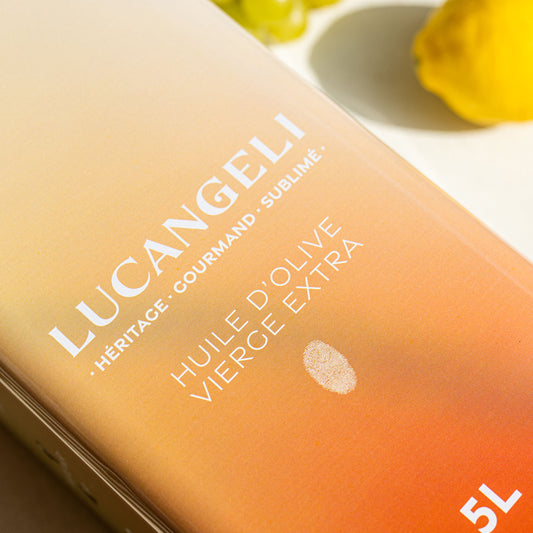
For professional uses in large quantities, the 5-liter jerrycan is the most suitable format for an active kitchen.
Which oil for which cooking?
Everyday cooking
The vast majority of pan-frying takes place between 140 °C and 180 °C. A vegetable sauté, a fish fillet, fried eggs: these preparations never reach the smoke point of a quality extra virgin oil. You can use your 500 ml discovery duo without any hesitation for these uses.
Baking at 180 °C is also compatible with extra virgin oil. For stews, gratins, or roasted vegetables, olive oil brings an aromatic depth that no other fat can reproduce.
Frying and its limits
Frying requires a stable temperature between 170 °C and 180 °C. A low-acidity extra virgin oil perfectly supports this range. In Southern Italy, frying with olive oil is a common and ancient practice: fritture di pesce, zeppole, Calabrian pettole are all made with olive oil.
The real limit is not the smoke point, but the repetition of heating cycles. An oil used several times for frying gradually degrades, regardless of its initial quality. For occasional domestic frying, the trio of oils allows you to set aside a bottle specifically for this use.
The most common mistake
The classic mistake is to buy a low-end extra virgin olive oil and conclude that "olive oil cannot withstand cooking" after noticing that it smokes quickly. It's not the olive oil that's at fault: it's its high acidity, a sign of insufficient quality.
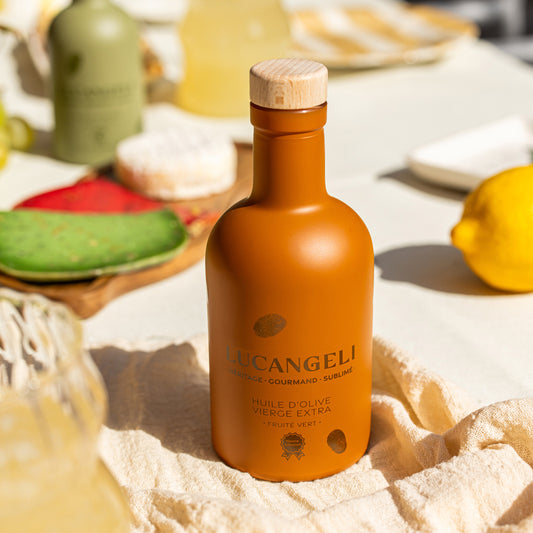
A quality extra virgin oil, with a real acidity below 0.5%, behaves very differently when heated. Chefs working with Lucangeli know this: they use the same oil to finish plates and to cook vegetables. To learn more about professional uses, consult the professionals area.
For large tables or active kitchens, the limited edition jeroboam is also an option to consider.
Frequently asked questions
Does extra virgin olive oil withstand pan-frying?
Yes, provided its acidity is low. An extra virgin oil with an acidity of less than 0.5% easily withstands pan-frying up to 180 °C, which covers almost all daily preparations.
At what temperature does olive oil start to smoke?
It depends on its quality. A high-quality extra virgin oil (acidity less than 0.3%) starts to smoke around 200-210 °C. A standard extra virgin oil (acidity close to 0.8%) can smoke from 175-180 °C. The "extra virgin" mention alone is not enough: look at the acidity indicated on the label.
Can you deep-fry with olive oil?

Yes. Frying is done between 170 °C and 180 °C, a range that any quality extra virgin oil supports. The culinary tradition of Southern Italy largely relies on frying with olive oil. The only precaution: do not reuse the same oil too often, as each heating cycle gradually degrades its stability.




 lucangeli.it