


Why bergamot and scallops work together
A scallop has a delicate flavour profile: a milky sweetness up front, a light salinity on the finish, and almost no bitterness. To avoid smothering it, you need an oil whose aromas blend in without taking over. Bergamot olive oil meets exactly that requirement.
Bergamot is a thick-skinned Calabrian citrus fruit, harvested from November to March in the Reggio Calabria area. Its aromatic profile is floral, slightly bitter and very persistent — halfway between clementine and citron. In a bergamot olive oil made by crushing the fruit together with the olives at extraction, these aromas become part of the oil's structure instead of floating on the surface. That's what sets a co-crushed oil apart from an oil simply flavoured with added aroma: the first coats the palate, the second covers it.
In practice, bergamot brings the scallop what lemon usually brings it — an aromatic acidity — but with less aggressiveness and more roundness.
What chefs say about this pairing
In professional kitchens that work with pressed oils, scallops are often finished with a drizzle of citrus oil rather than butter. The oil stays stable at finishing heat, it doesn't brown and it doesn't mask the briny flavour. Bergamot adds a floral note that neither lemon nor orange gives.
If you work in a restaurant and want to bring this kind of product into your autumn menu, the professionals area gives you access to prices and formats suited to restaurants.
---
The recipe: pan-seared scallops with bergamot olive oil

This recipe serves two as a starter. It's quick — under ten minutes of cooking — and rests on three principles: a very hot pan, a quality finishing oil, and a measured dose.
Ingredients for 2
- 6 to 8 fresh scallops (U8 size, with or without roe, as you prefer)
- 1 tablespoon of plain extra virgin olive oil for cooking (pick a green fruity or ripe fruity oil with a high enough smoke point)
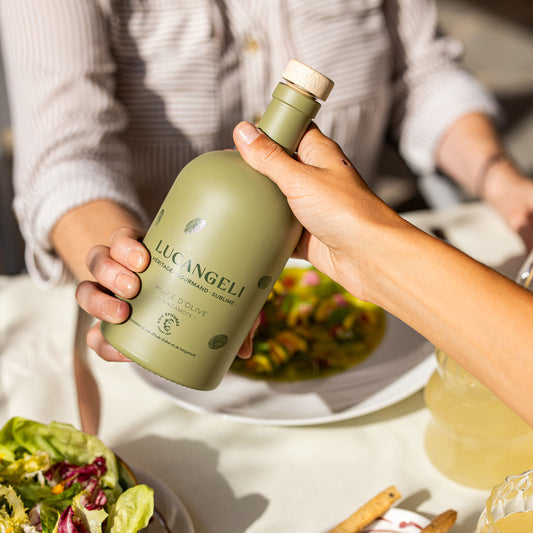
- 1 teaspoon of bergamot olive oil for finishing
- Fleur de sel
- A few lamb's lettuce leaves or a thin slice of raw fennel for plating
- Optional: a dash of pure organic bergamot juice to add a little acidity to the plate
Cooking steps
- Dry the scallops carefully with paper towel. Moisture is the enemy of browning: a wet scallop boils instead of searing.
- Heat the pan over high heat, stainless steel or cast iron, with no fat. Wait until it's very hot — a drop of water should evaporate instantly.
- Pour in the plain oil (not the bergamot oil, which doesn't handle very high temperatures), then lay the scallops in without touching them.
- Cook 90 seconds on the first side, without moving them. The colour should be golden and even.
- Flip only once and cook another 60 seconds. The scallop should stay pearly in the centre — an overcooked scallop turns rubbery.
- Take off the heat, season with fleur de sel, then pour the bergamot oil straight into the hot pan off the heat, in a light drizzle over each scallop. That's enough to release the aromas without destroying them.
- Plate immediately.
Why pour the oil off the heat
Bergamot pressed oil contains volatile aromatic compounds that evaporate quickly at high temperature. Pouring it off the heat, into the pan's residual warmth, releases them without destroying them. It's the same principle as finishing a pasta aglio e olio: the oil is never burnt, it's worked in with gentle heat.
---
Variations and pairings to go further
The basic recipe adapts easily to whatever you have on hand in October.
On a bed of squash
Mash 200 g of steamed red kuri squash with a knob of almond spread — yes, almond and squash make a soft, slightly sweet bed that contrasts with the bergamot. Set the scallops on top and finish with the bergamot oil. It's a complete starter, ready in under fifteen minutes.
With a dash of white vinegar
If you want acidity without the usual lemon, a drizzle of white balsamic condiment on the plate, alongside the bergamot oil, adds a sweet-sour tension that wakes up the palate without interfering with the floral side.
With braised endives
Seasonal endives, braised in plain olive oil until caramelised, bring a bitterness that complements the bergamot. Lay the scallops on top and finish with the bergamot oil: it's a pairing built on continuity of bitterness, elegant and easy to read.
Worth noting: an award that counts
The bergamot olive oil used here won the 2023 Épicure d'Argent — an award based on a blind tasting by a jury of professionals. This kind of recognition gives an objective benchmark in a market full of quality claims.
If you want to personalise a bottle as a gift or to show off on a festive table, the custom bottle configurator lets you create your design from 24 bottles.
---
Frequently asked questions
Can you use bergamot olive oil to cook the scallops?
No, or only over very low heat. Bergamot oil is a finishing oil: its aromas don't hold up well at high temperatures. For searing, use a plain extra virgin oil, and save the bergamot oil for the last thirty seconds, off the heat.
How much bergamot oil per serving?
Half a teaspoon per plate is enough. Bergamot oil is very aromatic — too much masks the briny flavour of the scallop instead of highlighting it. Better to add more at the table to taste.
Can you use this recipe with other seafood?
Yes. Scallops are the most obvious pairing in October, but the same principle works with seared king prawns, queen scallops, or a poached sea bass fillet. In every case, the bergamot oil goes in as a finish, never during cooking.



 lucangeli.it