

Why choose an orange and lemon pressed olive oil in your restaurant
Going for an orange and lemon pressed olive oil in a restaurant means betting on a unique flavour, obtained by milling fresh citrus together with the olives rather than by adding flavourings. That process gives the oil fresh, natural notes, perfect for lifting your autumn dishes: fennel salads, grilled fish, fruit desserts or a carpaccio.
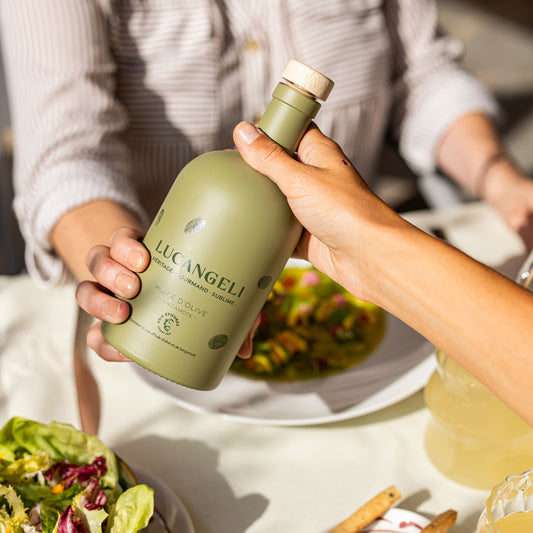
To make the most of that choice, build a menu that gives real space to original oils. Take a look as well at the personalisation service for professionals: it lets you put your logo or your identity on the bottle, creating a table signature of your own.

Criteria for choosing a citrus-pressed olive oil supplier
Quality and traceability
- Check that the oil comes from fresh olives milled together with citrus, with no added flavouring.
- Favour suppliers who state the olive variety and the exact origin.
- Ask for a detailed spec sheet and the chance to taste the oil on site or as a sample.
Formats, costs and logistics
- Choose formats that match how fast your stock turns over: a 200 ml bottle for the table, 500 ml for the kitchen, cans for prep.
- Compare ingredient cost per portion: a good aromatic oil lets you use less while making the dish count for more.
- Ask the supplier about lead times, restocking frequency and minimum order volumes (with some, the minimum is 24 bottles for personalisation, for example).
Standing out and the guest experience
- Offer a signature oil as a finishing touch on the plate or at the table.
- Highlight what makes co-milling different when your team talks to guests.
- Use bottle personalisation as a marketing and loyalty tool.
To go further on managing oils on your menu, have a look at the professional area guide.
Checklist for getting your September supply right
- Taste the orange and lemon pressed olive oil before putting it on the menu.
- Check traceability and the spec sheet.
- Match the format to how you will use it (table, kitchen, finishing).
- Plan your restock before the September rush.
- Train your front-of-house team to present the signature oil.
- Give the oil its place on the menu, mentioning the co-milling.
Sourcing: a concrete example of standing out
In September, several restaurants on the Côte d'Azur launch an autumn-winter menu with an orange and lemon pressed olive oil finishing a roasted fig dessert or a white fish carpaccio. Sourcing is planned from the end of August to make sure personalised bottles are available when they reopen, with roughly 10 working days needed to create the custom design.
Discover the trio of 200 ml olive oils to vary how you use them on the menu, or the 5 L can for the kitchen.

Frequently asked questions
How can you guarantee the quality of an orange and lemon pressed olive oil in a restaurant?
Ask for a spec sheet, check that co-milling is stated, and taste the oil before you buy. Favour suppliers who are transparent about where the olives and citrus come from.
What are the lead times for a personalised olive oil?
Allow around 10 working days for bottle personalisation, on top of delivery time. Order ahead of the September restart.
How do you make the most of a citrus-pressed olive oil on a restaurant menu?
Mention the extraction method (co-milling) and the origin, and offer it as a finishing touch on dishes or at the table, explaining the difference to your guests.




 lucangeli.it