


Why choose a lemon-pressed olive oil in a professional kitchen?
Lemon-pressed olive oil gives professionals a refined way to create original dressings, lift raw fish or salads, and put your signature on a Mediterranean table experience. What makes it distinctive is its extraction method: fresh lemons milled together with the olives, which is very different from adding flavourings. This process guarantees a natural aromatic intensity that restaurateurs actively look for.
Adding this oil to your menu sets you apart, while answering a growing demand for authentic, traceable products. Discover the lemon olive oil to bring out the best in your creations.
For professional management, it is essential to select the format suited to your business, optimise the cost per portion and keep stock rotation under control.

The available formats and their advantages
200 ml bottle: the tasting and finishing format
This compact format is a perfect fit for front-of-house service or for finishing on the plate. It lets you offer a premium oil in small quantities, ideal for table presentation or for tasting menus.
- Easy to handle, little evaporation
- Adds value to the customer experience
- Ideal for venues with low rotation or for testing how a new product is received
500 ml and 1 L bottles: the professional standard
The mid-range formats are the most versatile. They suit both kitchen and dining-room use, offer a good compromise between convenience and food cost, and limit the oxidation risks linked to a bottle staying open for a long time.
- Versatile use (kitchen, dining room)
- Good volume-to-price ratio
- Easier storage
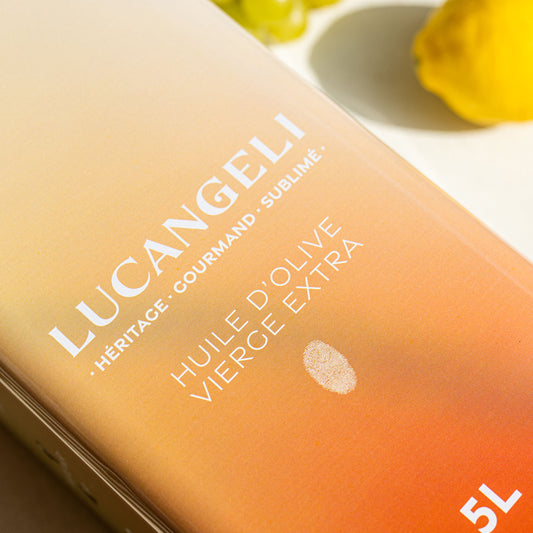
5 L tin: for large volumes
The tin format is reserved for high-rotation venues, such as high-volume restaurants or caterers. It brings the price per litre down, but it requires rigorous storage management (decanting into small bottles, storing away from light and heat).
- Lower food cost
- Less packaging waste
- Watch oxidation management and how quickly it is used up
To see the full range, take a look at the 5 L tin of organic olive oil.

Mastering food cost and stock management
Calculating the cost per portion
To put lemon-pressed olive oil on your menu, you need to think in terms of cost per portion. Here is a concrete example for a restaurant:
| Product | Price (€) | Consumption per portion (ml) | Cost per portion (€) |
|---|
*Indicative figures, to be adjusted according to your suppliers and volumes.*
Optimising rotation and storage
- Order the format suited to your weekly volume.
- Always store away from light and heat.
- Decant large formats into opaque bottles for table service.
- Check freshness and the best-before date regularly.
To go further, explore the bottle personalisation solutions for restaurants and combine visual identity with practical management.
Limiting waste and showcasing the menu
- Train the front-of-house team in olive oil service
- Offer a tasting on the plate or at the table
- Highlight the origin and the co-milling method on the menu
Frequently asked questions
What are the advantages of co-milling for a lemon olive oil in a professional kitchen?
Co-milling guarantees a natural aroma, with no artificial additions, and an intensity that showcases Mediterranean cooking both front and back of house.
How do I choose the right lemon-pressed olive oil format for my restaurant?
Match the format to your consumption volume: a small bottle for finishing, a tin for high-volume kitchens, always putting freshness first.
How should a lemon-pressed olive oil be stored in a professional kitchen?
Store away from light and heat, use opaque bottles for service, and keep an eye on the best-before date.
For more professional advice, visit the area dedicated to restaurant and hotel professionals.




 lucangeli.it