

Filtered olive oil can be stored for several months without losing its qualities. Unfiltered oil should be consumed within four to six weeks of pressing. This isn't a matter of superior or inferior quality: it's a question of usage and timing.
However, on labels and in stores, the mention "unfiltered" is often presented as a guarantee of naturalness, or even superiority. Before choosing your next organic green fruity olive oil or your organic ripe fruity olive oil, here's what filtration truly changes, and what it doesn't.
What happens at the mill before filtration

Centrifugation and residues
When it leaves the mill, olive oil is not yet the clear liquid you pour into your plate. After crushing the olives and kneading the paste, centrifugation separates the oil from the vegetation water and solid matter. But this separation is never complete: micro-particles of pulp, skin fragments, and especially a fraction of residual water in suspension remain in the oil.
It is this residual water that poses a problem over time. In the presence of water, the enzymes naturally present in the olive continue their activity after extraction. They accelerate the hydrolysis of triglycerides, which increases free acidity and gradually degrades the oil's aromatic profile. Unfiltered oil left in the bottle for too long does not improve: it degrades faster than filtered oil under the same storage conditions.
Filtration or decantation: two different paths
What many labels don't specify is that there are two ways to obtain clear oil: mechanical filtration and natural decantation.
Mechanical filtration involves passing the oil through cotton or cellulose filters that retain suspended particles. The result is immediate: the oil is clear as soon as it is bottled.
Natural decantation involves allowing the oil to rest in stainless steel tanks for several weeks. The particles settle at the bottom by gravity. The oil drawn from above is then clear, but the process is slower and requires significant storage space.
An oil labeled "unfiltered" can therefore be either a crude centrifuged oil or a naturally decanted oil. These two products do not behave the same way in the bottle. If you want to compare oils of different profiles, the organic olive oil trio allows you to test the two available fruity oils side by side.
Filtered or unfiltered: key differences

Here are the six criteria that specifically distinguish a filtered oil from an unfiltered oil:
- Appearance: filtered oil is clear and brilliant; unfiltered oil is cloudy and veiled.
- Optimal shelf life: 18 to 24 months after harvest for filtered; 4 to 6 weeks after pressing for unfiltered.
- Oxidation stability: high for filtered; limited for unfiltered due to active residual water.
- Aromatic profile: stable over time for filtered; very expressive upon opening but evolving rapidly for unfiltered.
- Deposit in bottle: absent for filtered; possible and normal for unfiltered.
- Professional context: recommended for filtered; not recommended unless very rapid rotation for unfiltered.
When to choose unfiltered oil
Unfiltered oil has its place, but in a specific context: that of new oil, at the very beginning of the season, consumed quickly after harvest. In Calabria, the Carolea variety harvest generally begins in October and ends in December. Unfiltered oil from this harvest, consumed between November and January, expresses an aromatic profile of an intensity that filtration slightly attenuates.
If you receive unfiltered oil as a gift or if you buy it directly from the producer, consume it within six weeks. Do not store it in the light, do not leave it open between uses. The discovery duo in 500 ml bottles is a good format for regular consumption without risk of aging.
When to choose filtered oil
For the vast majority of uses, filtered oil is the most consistent choice. It can be stored in good condition for eighteen to twenty-four months from harvest, provided it is stored away from light and heat. It does not develop a deposit in the bottle, which facilitates serving and avoids unpleasant visual surprises at the table.
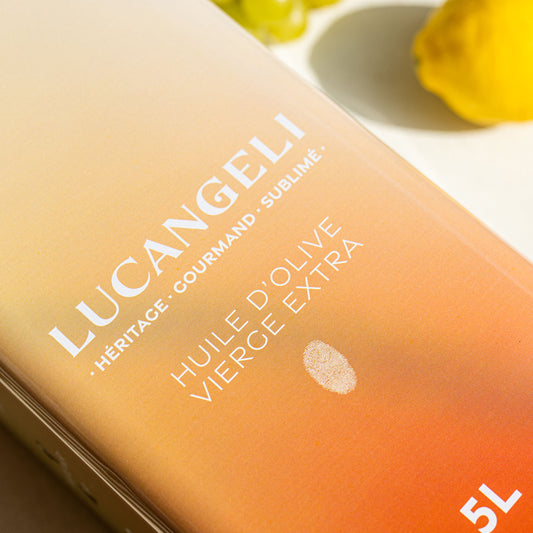
If you buy in large format, such as the 5-liter can for everyday cooking, filtration is essential: an unfiltered oil in a can would degrade before being fully consumed.
What it changes in the kitchen and at the table
The deposit in the bottle: should you worry?
If you find a deposit at the bottom of your olive oil bottle, there are two possible scenarios. Either the oil is unfiltered and the deposit consists of pulp particles, which is normal and harmless. Or the oil is filtered but has been stored in the cold: the waxes naturally present in the oil crystallize below 10 °C and form a whitish or flaky deposit. In the latter case, simply return the bottle to room temperature for a few hours for the deposit to completely disappear.
This phenomenon of cold crystallization is often confused with a sign of poor quality. It is exactly the opposite: it indicates that the oil has not been heat-treated to remove these waxes. To learn more about the formats adapted to each use, the limited edition jeroboam is an example of packaging designed for quick consumption at large tables.
The choice of professionals
In restaurants, hotels, and catering establishments, the choice systematically falls on filtered oils. The reasons are practical: an unfiltered oil served in the dining room has a cloudy appearance that can be misinterpreted by the customer, and its limited shelf life complicates stock management. An establishment that renews its oils every two to three weeks may consider an unfiltered oil in season, but this is an exception.
Professionals who wish to offer quality oil on their menu, for finishing or table service, can find information adapted to their context in the professionals section, where formats and order conditions are detailed.
Frequently asked questions
Is unfiltered olive oil better than filtered?
No, not systematically. The quality of an oil depends on the olive variety, the harvest time, the time before pressing, and the extraction conditions. Filtration neither improves nor degrades intrinsic quality: it affects stability over time. Poor quality unfiltered oil remains poor quality. Superior quality filtered oil remains superior.
Why does my olive oil have a deposit at the bottom of the bottle?
Two possible reasons: either the oil is unfiltered and the deposit consists of olive pulp particles, which is normal. Or the oil has been stored in the cold and the natural waxes have crystallized. In this case, leave the bottle at room temperature for a few hours: the deposit will disappear without altering the oil's quality.
How long does unfiltered olive oil keep?
Unfiltered oil ideally keeps for four to six weeks after pressing, in a cool, dark place. Beyond that, residual water and active enzymes accelerate oxidation and degrade the aromatic profile. If you cannot consume it quickly, prefer filtered oil, which offers a shelf life of eighteen to twenty-four months.




 lucangeli.it