


Poor management of olive oil stock in catering costs more than an upgrade. Between an poorly sealed can oxidizing and running out in the middle of service, losses are avoidable if you follow three simple rules: the right format, the right rotation, the right replenishment time. This practical guide is for purchasing managers, kitchen chefs, and establishment directors who want to secure their olive oil supply without increasing their workload.
Oxidation in professional kitchens: understanding the risks before experiencing them

Extra virgin olive oil is a living product. Its organoleptic quality—aromas, bitterness, pungency—deteriorates when exposed to its three main enemies. Identifying these factors can reduce losses by half.
The three enemies of olive oil quality
- Light: Direct exposure to light, even artificial, accelerates the degradation of aromatic compounds. An opaque tin container fully protects the oil; a transparent plastic container or a clear glass bottle placed near a pass-through exposed to light does not.
- Heat: Storing a can near the stove, fryer, or convection oven can raise the ambient temperature above 25 °C. Beyond this limit, the oxidation rate approximately doubles every 10 °C. The ideal storage area is between 14 and 18 °C.
- Oxygen: Each opening of a container introduces air. An opened and poorly sealed 5-liter can gradually oxidizes, even in the dark and at the correct temperature.
Specific risks of an opened large format in a low-volume kitchen
This is the most frequent and least well-managed case: an establishment with 30 to 50 covers orders a 5-liter professional can to reduce its cost per liter, but its weekly consumption does not exceed 300 to 400 ml. The can remains open for three to four weeks. Under these conditions, even a quality oil like a Carolea from Calabria, harvested in October-November and whose optimal shelf life is 18 months from the harvest date, can show significant signs of oxidation from the third week if the container is not properly sealed and stored away from heat.
The practical rule: if your weekly consumption is less than 500 ml for a given station, the 5-liter can is not the right format for that station. Reserve it for high-volume stations (cooking and large-volume dressings) and opt for smaller formats for finishing stations.
How to detect oxidized oil before service
Three indicators are sufficient for a quick check before service.
- Smell: Oxidized oil gives off a smell of old fat, damp cardboard, or wax. The pungency and fresh vegetable notes have disappeared.
- Taste: Rancid oil is flat, without bitterness or pungency. It can leave a persistent greasy sensation without any aromatic complexity.
- Color: Oil that has turned very pale straw yellow or brown may have undergone advanced oxidation, although color alone is not a sufficient criterion.
If any of these signs are present, the oil should not be served as a finishing oil or raw seasoning. It may still be suitable for high-heat cooking where the aromas are neutralized anyway, but the safest rule is to replace it.
Stock rotation and ordering strategy: best practices

Rigorous management of olive oil stock relies on two pillars: knowing your actual consumption per station, and applying a rotation method without exception.
Calculating the right quantity to order based on weekly consumption
Before placing an order, it is useful to measure actual consumption over two to three weeks, station by station. For a 40-cover restaurant serving lunch and dinner, here are the usual orders of magnitude.
- Plate finishing: approximately 8 ml per cover, or 2.2 liters per week for 280 covers.
- Dressings and seasonings: approximately 12 ml per cover, or 2.4 liters per week for 200 covers.
- Pan and griddle cooking: approximately 18 ml per cover, or 5 liters per week for 280 covers.
- Bread and table oil: approximately 10 ml per cover, or 2.8 liters per week for 280 covers.
In this example, the total weekly consumption exceeds 12 liters. A 5-liter can is consumed in less than three days at the cooking station, which fully justifies this format. However, the finishing station consumes 2.2 liters per week: a duo of 500 ml bottles is more suitable for maintaining the freshness of the oil at this station.
The first-in, first-out method applied to olive oil
The FIFO (first-in, first-out) method applies to olive oil exactly as it does to any perishable food. In practice, this means four simple actions.
- Date each container upon receipt with a marker or label.
- Place new arrivals behind existing stock, never in front.
- Check the best-before date (DDM) upon each receipt and immediately report any batch with a DDM of less than six months.
- Never transfer new oil into a container partially filled with old oil: oxidized residues contaminate the fresh content.
This last rule is often overlooked in kitchens that use cruets or service bottles refilled manually. A cruet not washed between two refills is a source of accelerated oxidation.
Choosing the right format depending on the kitchen station
The choice of format is not just a question of cost per liter. It is primarily a question of rotation speed. Here are the recommended correspondences.
- 200 ml bottle: ideal for finishing, table service, and hotel rooms. Ideal consumption time: 3 to 5 days.
- 500 ml bottle: suitable for finishing and low-volume seasonings. Ideal consumption time: 5 to 10 days.
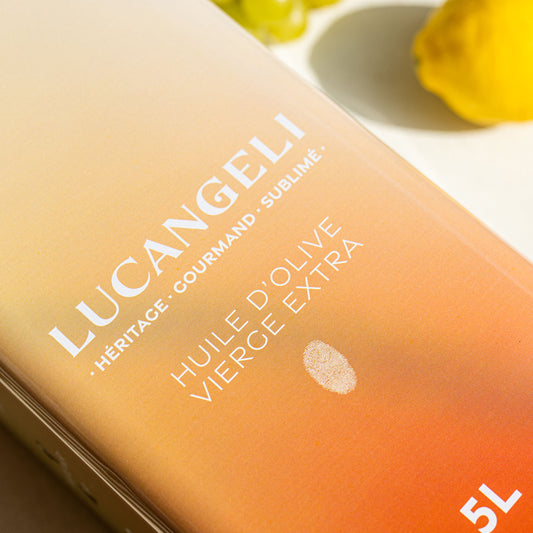
- 5 L can: reserved for cooking, high-volume dressings, and high-volume seasonings. Maximum consumption time once opened: 7 to 14 days.
- 3 L Jeroboam: presentation format for high-end finishing and gastronomic table service. Ideal consumption time: 10 to 15 days.
For gastronomic table service where the oil is presented to the client, the Jeroboam of extra virgin olive oil is a presentation format with high visual impact, provided that the rotation is sufficient to guarantee freshness.
Replenishment logistics for hotels, restaurants, and caterers: anticipating without overstocking
Running out of olive oil in the middle of service is one of the most avoidable incidents. It almost always results from late replenishment or poor estimation of available stock.
When to replenish and how to avoid stockouts
The safety stock rule applies simply here: order when your stock reaches the level corresponding to your consumption over the delivery time plus two days' margin. If your supplier delivers in 48 hours and you consume 2 liters per day, your replenishment threshold is 6 liters, or four days' consumption.
For establishments wishing to simplify their supply, the dedicated professional area allows for setting up a regular delivery schedule in advance, which eliminates manual replenishment management and reduces the risk of stockouts.
Storage conditions that extend shelf life
Four rules are sufficient to maximize the shelf life of your stock.
- Store in a cool place (14 to 18 °C), away from direct light and heat sources.
- Keep cans upright, cap up, to limit the contact surface between the oil and residual air.
- Seal each container tightly after each use.
- Never store near strong-smelling products, such as vinegar, bulk spices, or cleaning products: olive oil absorbs ambient odors.
The particular case of finishing oils versus cooking oils
Finishing oils and cooking oils do not have the same storage constraints. A high-volume cooking oil is renewed quickly, and the risk of oxidation is low. A characterful finishing oil, with a pronounced green fruitiness, bitterness, and pungency, is used in small quantities and must be protected with more care.
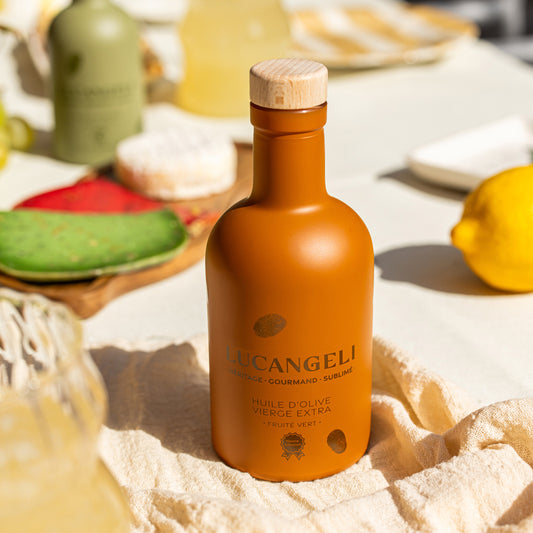
For establishments wishing to offer a distinctive finishing oil without risking waste, the 200 ml green fruity oil allows for rapid rotation while offering a quality aromatic profile with each service. For establishments wishing to go further and offer a bottle with their name on the tables, the bottle personalization service allows ordering from 24 units with a design created by the establishment.
Frequently asked questions
How long can an opened 5-liter can of olive oil be stored in a kitchen?
An opened 5-liter can should ideally be consumed within 7 to 14 days maximum. Beyond that, and especially if the can is stored near a heat source or poorly sealed, the oil may show perceptible signs of oxidation in smell and taste. In a low-volume kitchen, it is better to opt for 500 ml to 1 liter formats for finishing stations.
What is the difference between the best-before date and the harvest date on a professional olive oil?
The best-before date (DDM) indicates the date until which the manufacturer guarantees the organoleptic qualities of the product under normal storage conditions. The harvest date, mentioned on some quality labels, indicates the year of production. An oil harvested in November 2025 with a DDM of November 2027 has a shelf life of 24 months, but its optimal quality window is within the first 12 to 18 months after harvest.
How to calculate the cost per portion for olive oil in catering?
The formula is simple: portion cost = (volume served in ml divided by 1,000) multiplied by the price per liter. For an oil purchased at 9 euros per liter, an 8 ml finishing drizzle costs 0.07 euros per plate. A 12 ml dressing costs 0.11 euros. Even a premium oil at 14 euros per liter keeps the finishing cost under 0.12 euros per cover, which represents less than 0.5% of the selling price of a 25 euro dish.




 lucangeli.it