

On a bottle of olive oil, "cold extraction" and "first cold press" seem to say the same thing. This is not the case. These two terms have distinct regulatory definitions, set by European Regulation EC 1019/2002, and understanding the difference allows you to choose with much greater precision.
The regulatory difference between "cold extraction" and "first cold press"

What European Regulation EC 1019/2002 states
Regulation EC 1019/2002 is the reference text for optional labeling terms on olive oil. It defines two distinct terms, which are not interchangeable.
Cold extraction: the oil was obtained by centrifugation or percolation of an olive paste whose temperature did not exceed 27°C during the process. This is the dominant method in modern oil mills.
First cold press: the oil was obtained during a first mechanical pressing of the olive paste, at a temperature below 27°C, using a traditional hydraulic press. This term can only legally appear if a hydraulic press was actually used.
The confusion stems from the fact that both terms guarantee the same temperature limit. But the mechanical process is different, and the hydraulic press is now very rare in industrial or semi-industrial production.
Why the hydraulic press has almost disappeared
The hydraulic press, also known as a disk press or scourtin press, was the norm until the 1980s. It worked by stacking fiber disks soaked in olive paste, then compressing them to extract the oil. The process was slow, difficult to clean between batches, and exposed the paste to air for several hours, which promoted oxidation.
Two- or three-phase centrifugation gradually replaced this system. It is faster, more hygienic, easier to control in terms of temperature, and allows processing large volumes without breaking the cold chain. Today, almost all extra virgin olive oils on the market are obtained by centrifugation, including quality artisanal oils.
Result: the term "first cold press" has become rare and is often mistakenly used as a marketing argument, without a hydraulic press actually having been used. The regulation prohibits it, but controls are limited.
What this actually changes for you
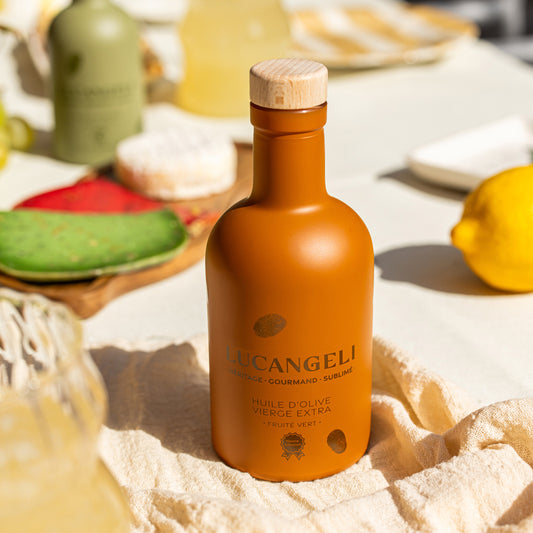
If you see "cold extraction" on an organic green fruity olive oil, it means that the centrifugation was carried out below 27°C, which preserves the aromas and freshness of the fruit. This is a real and verifiable guarantee.
If you see "first cold press", ask yourself if the producer actually uses a hydraulic press. In the vast majority of cases, this is not the case, and the term is used as a signal of tradition without a technical basis.
The most reliable mention remains "extra virgin" accompanied by "cold extraction", with a precise harvest date and geographical origin.
What the extraction temperature reveals about quality

The 27°C threshold and what it protects
The 27°C limit is not arbitrary. Above this temperature, some volatile aromatic compounds begin to degrade or evaporate during malaxation and centrifugation. The result is a less expressive oil, with less olfactory complexity.
Below 27°C, the characteristic aromas of the olive variety are better preserved: the herbaceous and vegetal notes of a green fruity oil, or the notes of ripe fruit and almond of an organic ripe fruity oil remain intact until bottling.
Carolea, a Calabrian variety harvested by hand between October and November, is processed within 24 hours of picking. This very short delay between harvesting and pressing guarantees a very low peroxide value, well below the regulatory threshold of 20 meq O2/kg set for the extra virgin category. This is what distinguishes a quality oil from one that is merely compliant.
What the terms guarantee: comparison
Here's what each term on a label actually means:
- Cold extraction: centrifugation or percolation at less than 27°C. Term regulated by EC 1019/2002. Common and reliable process.
- First cold press: pressing with a hydraulic press at less than 27°C. Regulated term, but the process has become very rare. To be verified with the producer.
- Extra virgin: category defined by the International Olive Council. Any mechanical process, without a specific temperature threshold. Guarantees the absence of organoleptic defects and a free acidity of less than 0.8 g per 100 g.
- Cold pressed (without "first"): unregulated term. No legal definition. Commercial value only.
- Artisanal or traditional: purely commercial terms, without legal definition or control.
Only the first two terms have a precise regulatory value. The others are marketing arguments without legal definition.
How to read an olive oil label correctly
Mandatory and optional terms
An olive oil label must obligatorily indicate:
- The category of oil (extra virgin, virgin, olive oil)
- The net volume
- The minimum durability date (MDD)
- The name and address of the person responsible for placing it on the market
- The country of origin or production area
Optional but useful terms include:
- The extraction method (cold extraction, first cold press)
- The olive variety
- The harvest date or vintage
- The designation of origin (PDO, PGI)
- The farming method (organic farming)
To easily compare several oils, the trio of olive oils allows you to read three labels side by side and understand what each term changes in terms of taste.
What the label doesn't say
The label does not mention the peroxide value, nor the free acidity measured in the laboratory, nor the result of the organoleptic panel test. This data exists for each batch produced, but it is not displayed on the bottle.
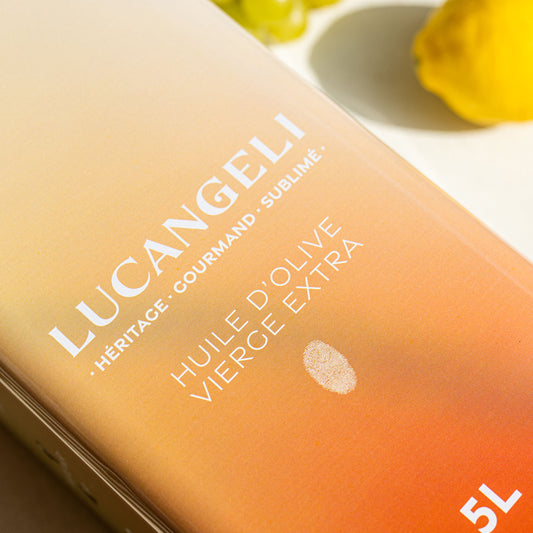
To obtain them, you can contact the producer directly or consult the technical sheet for the batch. Serious producers communicate them without difficulty. This is also one of the criteria to check if you are supplying an establishment: the 500 ml discovery duo is designed to test two aromatic profiles before moving to a larger format, such as the 5 L can intended for regular professional use.
The label also does not say how quickly the stock turns over at the distributor. A "cold extraction" oil stored for two years in a poorly lit warehouse is worth less than an oil without a particular mention bottled three months ago. The harvest date, when indicated, is the most useful information on the entire label.
Restaurateurs and hoteliers who wish to go further in choosing their table oil can consult the professionals section or explore options for personalized bottles for in-room service.
Frequently asked questions
Are "cold extraction" and "first cold press" the same thing?
No. Both terms guarantee an extraction temperature below 27°C, but the process is different. "Cold extraction" refers to modern centrifugation. "First cold press" refers to pressing with a traditional hydraulic press, which is very rare today. The confusion is frequent because the two terms are often used interchangeably in commercial communication, which is not compliant with Regulation EC 1019/2002.
Which term on an olive oil label truly guarantees quality?
No single term is sufficient. The most reliable combination is: "extra virgin" + "cold extraction" + a recent harvest date + a precise geographical origin (region, PDO or PGI designation). The olive variety mentioned is an additional indicator of traceability.
Can an oil without the "cold extraction" mention still be of quality?
Yes. The "cold extraction" mention is optional. An extra virgin oil produced by centrifugation below 27°C may not display this mention if the producer has not included it on the label. The absence of the mention does not mean that the temperature was exceeded. This is why the harvest date and batch traceability remain the most reliable indicators.




 lucangeli.it