

In October, the olive groves of Calabria come alive. While the grape harvest is wrapping up in the rest of Italy, Calabrian producers are only just starting their season: a harvest that stretches from October to December depending on altitude, variety and how the groves are exposed. This late calendar isn't a delay, it's a feature of the terroir — and you can read it straight from the glass.
Why Calabria harvests its olives in October and not in September

A climate that pushes ripeness back
In central Italy, in Tuscany or Umbria, varieties such as Frantoio or Moraiolo are harvested from late September, sometimes earlier. In Calabria, the summer heat paradoxically slows down veraison — the change of colour in the olive that signals the start of ripening. The olives take longer to turn from green to black because high summer temperatures hold back the internal biochemical changes.
The result: October marks the real start of the harvest in the lowland and hillside areas of southern Calabria, and November-December for the higher-altitude areas around the Aspromonte or the Serre Vibonesi. That progression by altitude is one of the distinctive traits of Calabrian olive growing: the same producer can harvest their low-lying plots in October and their mountain plots six weeks later.
The right moment for a quality oil
The ideal harvest window sits between partial veraison — when about half the olives turn purple — and full black ripeness. It is in this window, in Calabria generally between mid-October and mid-November, that you get oils with a high concentration of natural polyphenols, with clear bitterness and pungency and an expressive green fruitiness. Harvesting earlier gives a lower yield; harvesting too late, once the olives are fully black, gives more volume but an oil with a softer profile and a shorter shelf life.
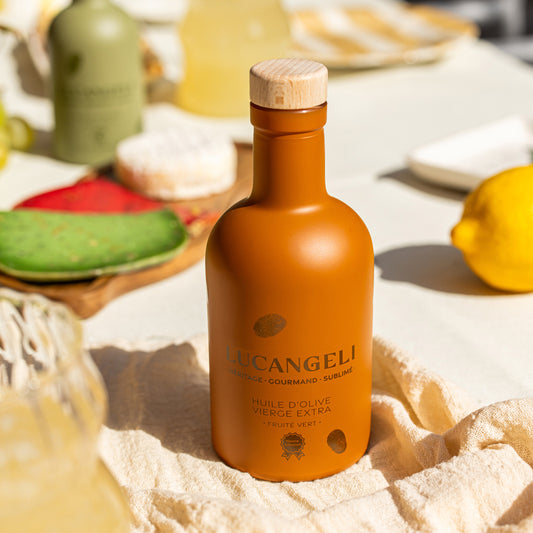
The Lucangeli online shop offers an organic green fruity olive oil that reflects exactly this early-harvest profile: a lively attack, a straightforward bitterness, a pungency that lingers at the back of the throat.
The Calabrian varieties that make October
Carolea, the backbone of the region
Carolea is the most widely grown olive variety in Calabria. Found in the provinces of Cosenza, Catanzaro and Vibo Valentia, it gives both a table olive and a milling oil. Its harvest runs mainly from late October to mid-December depending on altitude.
The profile of the oil obtained from Carolea:
- Medium to intense green fruitiness, with notes of fresh grass and artichoke
- Clear bitterness, assertive from the first few seconds
- Sharp, lingering pungency, the sign of a harvest at the start of ripeness
- Yellow-green colour at bottling, moving towards gold after a few months
It is a robust variety, well suited to the dry summers and cold winters of the inland areas. Its extraction yield is lower than that of some Mediterranean varieties, which partly explains the price of quality Calabrian oil.
Roggianella and Tondina, the quiet companions
Roggianella, a less widespread variety but one you find in the Cosentino area, gives an oil with a softer profile than Carolea: light green fruitiness, moderate bitterness, short pungency. It is often blended with Carolea in local assemblages to balance out the intensity.
Tondina, another minor Calabrian variety, occupies certain areas in the province of Reggio Calabria. Its harvest is slightly later, often in November-December. It gives oils with an intermediate fruitiness and a roundness in the mouth that contrasts with Carolea's clear-cut character.
These three varieties often live side by side in traditional Calabrian olive groves, which are rarely single-variety in the strict sense. It is this old genetic diversity that gives Calabrian olive oils their complexity.
Dolce di Rossano and the varieties of the Ionian coast
On the Ionian coast, between Sibari and Crotone, Dolce di Rossano and Grossa di Cassano give late-harvest olives, often in November-December. The name says it: the oils obtained are softer, with a pronounced ripe fruitiness and less bitterness. These are different profiles from those of the inland areas, suited to other uses in the kitchen.
If you prefer a rounder oil profile, the shop offers a limited-edition ripe fruity olive oil in that register.
New oil from Calabria: how to recognise it and how to taste it
What changes in the first few weeks
A new oil from Calabria, extracted in October or November, is clearly different from an oil from the same harvest put on sale six months later. Just after extraction:
- The colour is very green, sometimes cloudy if the oil has not been filtered yet
- The aromas are intense and volatile: green tomato, fresh grass, olive leaf, artichoke
- Bitterness and pungency are at their peak, because the phenolic compounds are at their highest concentration
- The taste can surprise you with its intensity: that is not a flaw, it is the signature of a fresh oil
Over the weeks, the oil settles. The aromas blend together, the bitterness rounds off slightly, the colour moves towards a more golden yellow. This natural evolution is why an oil you buy in October will not have quite the same profile in April — even though it stays excellent.
How to taste it at home
Tasting a new oil means taking the time to smell it before you taste it. A few simple pointers:
- Pour a small amount into a glass warmed slightly between your palms
- Cover it and swirl to release the aromas
- Smell slowly: look for notes of grass, green fruit, fresh almond
- Taste while drawing in a little air at the same time, to spread the oil across your palate
- Note the bitterness in the middle of your tongue, then the pungency in your throat a few seconds later
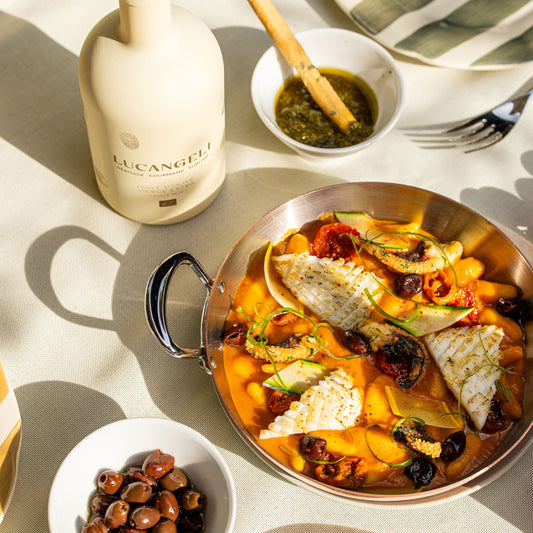
At the table, new oil is served over simple foods that do not cover it: toasted bread with nothing else added, steamed vegetables, fresh goat's cheese, or as a finishing touch on a pasta dish. The idea is to let the oil speak.
New oil and the trade
In restaurants and hotels, October is the moment to renew the bottle on the table. An oil from the 2026 harvest, brought into the autumn menu right now, is a concrete talking point the front-of-house team can share with guests: freshness of the harvest, a precise terroir, a named variety. That kind of detail turns a condiment into a conversation.
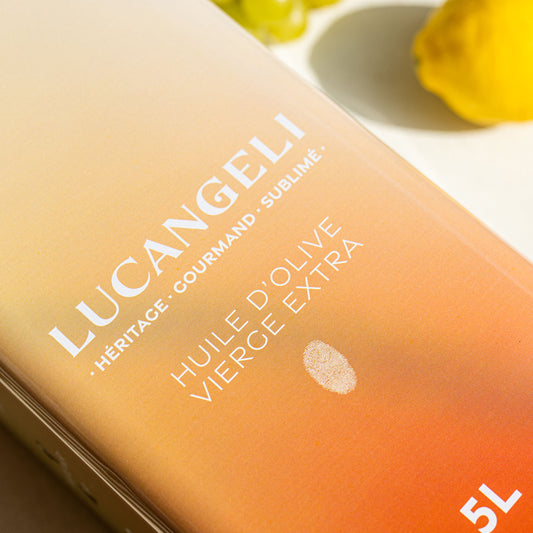
Venues that want to bring a selection of Calabrian oils onto their menu, or to work with formats suited to foodservice — from the 5-litre tin to the service bottle — can get in touch with the team dedicated to professionals.
Frequently asked questions about the olive harvest in Calabria
When exactly is the olive harvest in Calabria?
The Calabrian harvest generally begins between mid-October and the end of October in low-altitude areas, and carries on until December in mountain areas above 600 metres. The Carolea variety, the most widespread, is harvested mainly from late October to mid-December.
Why are Calabrian olives harvested later than in Tuscany?
The intense summer heat of the south slows down veraison in the olives. The high temperatures of July and August hold back the internal changes in the fruit, which reaches its optimal ripeness later in the season. The phenomenon is accentuated by the higher altitudes of the inland Calabrian olive groves.
How can you tell whether an olive oil really is from the new harvest?
Look at the harvest date or the vintage shown on the label — it is a voluntary mention, but one you find on quality oils. A new oil generally has a greener colour, a more intense aroma and a more marked pungency. The discovery duo is a good starting point for comparing two profiles, green fruity and ripe fruity, from the same harvest.
New oil from Calabria: how to recognise it and how to taste it (image 2)





 lucangeli.it