


Why host an olive oil tasting at home
An olive oil tasting workshop at home is a convivial evening you can organize with four to eight people, three to five oils, and a few slices of bread. Here’s how to do it, from setup to tasting.
Group olive oil tasting is nothing like solitary tasting. When several people share their impressions of the same oil, perceptions become clearer, words come more easily, and the experience becomes memorable. This is exactly what happens during a wine tasting: the collective dimension amplifies the pleasure.
The other advantage is that you don't need to be an expert. A well-organized tasting is structured around a few simple steps and a logical serving order. The perfect trio of 200ml organic olive oils is designed for this type of occasion: three distinct profiles, three manageable sizes, a natural progression from mild to intense.
What a group tasting offers that a solo tasting doesn't
When you taste alone, you perceive sensations but often lack benchmarks to name them. In a group, others' descriptions act as revelations: someone says "artichoke," and you realize that's exactly what you were feeling without being able to articulate it. This phenomenon is documented in professional panel test trainings: collective verbalization improves the sensory precision of each participant.
How many people and how many oils
The ideal format for a home workshop: four to eight people, three to five oils. Below three oils, the comparison is too limited. Beyond five, sensory fatigue sets in and the last oils are poorly evaluated. For the oils, plan about 15 ml per person per reference, for a total of 60 to 120 ml per bottle for a group of eight.
Preparing the table and equipment

Essential equipment
You don't need professional equipment to organize a successful tasting. Here's what you'll need:
- Opaque tasting glasses or small dark liqueur glasses — they prevent color from influencing judgment
- Country bread or ciabatta, cut into thin, lightly toasted slices — neutral bread serves to cleanse the palate between oils
- Still water at room temperature — never sparkling, which disrupts aroma perception
- Simple scoring sheets: one column per oil, three lines (nose, mouth, general impression)
- A pencil or pen per person
Avoid scented candles, strongly perfumed flowers, and strong cheeses on the table: they interfere with olfactory perception.
Table setup
Arrange the glasses in a line in front of each participant, numbered 1 to 5 (or from 1 to the number of oils chosen). Pour the oils in advance into the glasses, cover them with a small plate or cardboard, and let them rest for ten minutes at room temperature, between 18 and 22 °C. Oil that is too cold releases fewer aromas. Oil that is too hot distorts them.
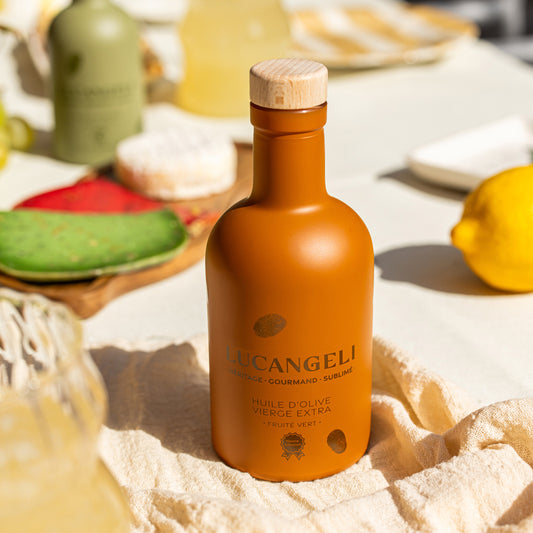
Place the bread and water in the center of the table, accessible to everyone. For a neat presentation, a 200ml organic ripe fruity olive oil placed on the table with its label provides a visual reference and invites curiosity even before the tasting begins.
Choosing and ordering the oils

From mildest to most intense
The tasting order follows a simple rule: from the mildest profile to the most intense. If you start with a very bitter or very pungent oil, it will saturate your taste buds and distort the perception of subsequent oils.
Here is the recommended serving order for a home workshop:
- Mild ripe fruity (e.g., Carolea from Calabria) — aromas of ripe tomato, sweet grass, round mouthfeel, slight pungency
- Balanced ripe fruity — notes of ripe fruit, slight bitterness at the end of the mouth, moderate pungency
- Light green fruity — fresh grass, artichoke, more pronounced pungency
- Intense green fruity — clear bitterness, vegetal notes, long pungency
- Flavored oil (bergamot, basil, lemon) — distinct aromatic profile, to be tasted last
Carolea from Calabria, a mild ripe fruity profile variety, is ideal for opening a tasting with beginners: its slight pungency doesn't put people off, and its aromas of ripe tomato and sweet grass are immediately accessible. It's an excellent gateway to the world of quality olive oil.
Flavored oils: at the end of the journey
Flavored oils obtained by co-milling the fruit with the olives should always be tasted last. Their aromatic profile is too strong not to influence the perception of subsequent oils. The bergamot olive oil awarded at the Épicures d'Argent 2023 is an excellent choice to conclude the tasting on an original and memorable note. The organic basil olive oil or the orange and lemon olive oil also work very well in this role.
Tasting gestures
For each oil, guide your guests through three steps:
- The nose: cover the glass with your palm, swirl gently, then uncover and sniff. Allow two to three seconds. What aromas do you perceive? Grass, artichoke, tomato, almond, green apple?
- The mouth: take a small sip, roll it over your entire tongue, draw in a little air. Do you perceive bitterness? Pungency in the throat?
- The general impression: is the oil balanced? Long in the mouth? Short? What is your first culinary association?
Between each oil, eat a slice of bread and drink a little water. Wait thirty seconds before moving to the next. For a green fruity organic olive oil, the pungency in the throat can persist for one to two minutes: this is normal, a sign of quality, not a defect.
Bread and oil pairings for each profile
Neutral toasted bread is suitable for all oils. But if you want to go further, here are some pairings that highlight each profile:
- Mild ripe fruity: lightly toasted country bread, unsalted
- Light green fruity: warm, slightly salted focaccia
- Intense green fruity: grain bread, tomato bruschetta
- Bergamot flavored oil: toasted white bread, or directly by the spoonful
To offer this experience as a gift, the customizable gift box allows you to assemble several oils according to the recipient's profile. For establishments wishing to offer this type of workshop to their customers, the professionals section provides access to appropriate formats and volumes.
Frequently Asked Questions
How many oils do you need to organize an olive oil tasting workshop at home?
Three to five oils are sufficient for a home workshop. Below three, the comparison is too limited to be instructive. Beyond five, sensory fatigue sets in and the last oils are poorly perceived. A 500ml discovery duo or a 200ml trio make a solid foundation to start.
Do you need special glasses to taste olive oil?
Professionals use cobalt blue glass to mask the color of the oil, which can unconsciously influence judgment. At home, small dark liqueur glasses or opaque tasting glasses work perfectly well. The essential thing is that the glass is clean, free of detergent odors, and at room temperature.
In what order should olive oils be tasted during a home workshop?
Always start with the mildest profile: a ripe fruity oil, whose pungency is light and aromas are accessible. Then progress to green fruity profiles, which are more bitter and pungent. Finish with flavored oils, whose strong profile should not interfere with the perception of previous oils. For a personalized bottle to give as a gift at the end of the evening, the online configurator allows you to create a custom design starting from 24 bottles.




 lucangeli.it