

What free acidity truly is — and what it is not
Free acidity measures the proportion of fatty acids that have detached from triglycerides in oil. It is expressed as a percentage of free oleic acid relative to the total weight of the oil. The lower this percentage, the more intact the oil is at the time of its production.
This parameter has no connection to mouthfeel. An oil can sting in the throat, leave a distinct bitterness or a persistent pungency — and still show a free acidity of 0.2%. Conversely, a smooth, mellow oil can have higher acidity. The pungency you feel comes from phenolic compounds, not free fatty acids. This is the most common misinterpretation among consumers, and it leads to rejecting high-quality oils.
Why does acidity increase?
Triglycerides are stable as long as the olive is intact. As soon as the skin breaks — due to impact, an olive fly attack, falling to the ground, or prolonged storage in a hopper — oxygen enters and triggers a hydrolysis reaction: fatty acids are released, and acidity increases.
Three moments are particularly critical:
- Harvesting: an olive that falls to the ground before being picked accumulates mechanical damage. Manual harvesting or harvesting with a comb limits these impacts.
- Time before milling: every additional hour between picking and pressing increases acidity. The best oils are milled within four to six hours of harvest. This is a real logistical constraint, which partly explains why quality oils cost more.
- Storage in the cellar: a tank that is not airtight continues to oxidize the oil after production. Serious mills inject nitrogen to remove residual oxygen.
Regulatory thresholds by category

European regulation 2568/91 and its revisions set precise thresholds for each category of olive oil.
Extra virgin olive oil: maximum free acidity of 0.8%. Premium quality oil, mechanical extraction only.
Virgin olive oil: maximum free acidity of 2.0%. Lower quality, but still mechanical extraction.
Olive oil (blend): maximum free acidity of 1.0%. Blend of refined and virgin oil, standardized taste.
Olive pomace oil: maximum free acidity of 1.0%. Solvent extraction, mainly for industrial use.
An extra virgin oil showing 0.2% or 0.3% acidity is generally a sign of careful harvesting, a short delay before milling, and controlled storage. Some Calabrian producers regularly achieve under 0.15% for their green fruity oils, harvested at the beginning of the season from varieties like Carolea or Roggianella.
What the label says — and doesn’t say
Why acidity is often not displayed
Since the revision of the European regulation, a producer wishing to mention acidity on their label must simultaneously include four parameters: free acidity, peroxide value, waxes, and UV absorption coefficients (K232, K270, and ΔK). This constraint has led the majority of industrial producers to remove acidity from their labels rather than display all the data.
Result: the absence of acidity on a label does not mean the oil is bad. It means the producer has chosen not to undertake the full disclosure process. However, when a producer displays all these parameters, it is a sign of transparency.
What you can read instead
On bottles that do not display acidity, other clues guide the choice:
- Harvest date (not just the best-before date): an oil harvested in October and consumed within two years is within its optimal window.
- Olive variety: a Coratina or a Carolea from Calabria gives indications about the expected profile.
- Appellation: an oil with an Olio di Calabria IGP or Bruzio DOP label has been controlled by a tasting panel and meets precise analytical criteria, including acidity.
- Packaging: a dark glass bottle or an opaque can protects the oil from photo-oxidation, which degrades triglycerides and increases acidity after bottling.
The 500 ml organic discovery duo (https://www.lucangeli.co/products/duo-decouverte-bouteilles-d-huile-d-olive-500ml-bio) allows for a side-by-side comparison of a green fruity and a ripe fruity oil, two profiles that concretely illustrate how harvest date and ripeness stage influence both acidity and aromatic profile.
How to use this parameter to choose better
Acidity alone is not enough
An honest comparison clearly states it: low acidity is necessary but not sufficient. An oil can be extra virgin with 0.5% acidity and still have organoleptic defects — moldy, muddy, or vinegary taste — that disqualify it in tasting. This is why the European regulation also requires a sensory panel test to classify an oil as extra virgin.
Acidity is a production indicator. The panel test is a result indicator. Together, they provide a reliable picture.
What acidity level to aim for depending on use
For daily use as a seasoning, an extra virgin oil under 0.5% offers good value for money. For tasting or finishing a hot dish, going below 0.3% provides a fresher, livelier oil with better aromatic retention when heated.
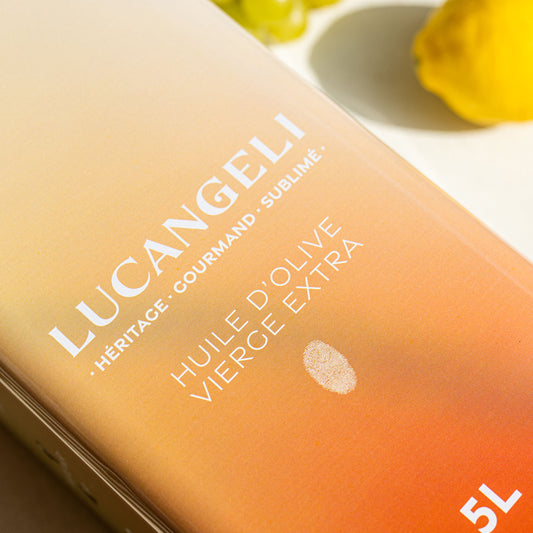
For professionals looking for a stable finishing oil on a menu, the 5-liter organic olive oil canister (https://www.lucangeli.co/products/huile-dolive-bio-5-lbidon-5l-huile-dolive-italienne-bio) offers a format suitable for kitchen rotation, with controlled acidity and batch traceability. The professional area (https://www.lucangeli.co/pages/professionnels) allows direct ordering from sales.
For a first quality bottle, the 200 ml olive oil trio (https://www.lucangeli.co/products/le-trio-parfait-huile-dolive-bio-200-ml) is a good starting point: three different profiles, three intensity levels, to concretely understand what the acidity figure means in tasting.
Frequently asked questions
Is an olive oil with 0.1% acidity better than an oil with 0.5%?
Not necessarily. Very low acidity indicates careful production, but the final quality also depends on the sensory panel test. An oil with 0.1% and organoleptic defects cannot be classified as extra virgin. Acidity is one criterion among others.
Why does my olive oil sting my throat if its acidity is low?
The stinging sensation in the throat, called pungency, is due to phenolic compounds — notably oleocanthal — and not free fatty acids. An oil that stings is often an early harvest oil. This is not a defect; it is a sign of freshness and early ripeness of the olives.
How can I tell if an oil's acidity is good if it's not displayed on the label?
Look for the harvest date, olive variety, appellation (DOP or IGP), and packaging type. An oil under controlled appellation has been laboratory-analyzed and has passed a panel test. If the producer displays acidity, they must also display the peroxide value and UV coefficients — this is an additional guarantee of transparency.





 lucangeli.it