

A drip-free spout for olive oil truly makes a difference at the table. No more spills on the tablecloth, drowned plates, or greasy bottles. However, not all spouts are created equal, and the choice depends as much on the use as on the quality of the oil you want to highlight.
Why a drip-free spout is worth considering
Olive oil is a living product. It oxidizes on contact with air, absorbs odors, and reacts to light and heat. The spout you choose is not just an accessory: it is the last step between the bottle and the plate, and it matters.

The problem with bottles without a spout
An olive oil bottle without a pouring spout pours too quickly, too forcefully, and almost always leaves a drop on the neck. This drop oxidizes, becomes rancid, and eventually gives an unpleasant smell to the outside of the bottle. This is the first sign of poorly maintained oil, even if the oil inside is perfect.
For a organic green fruity olive oil with delicate aromas of fresh grass and artichoke, this detail is not trivial: a rancid drop on the neck can distort the perception of the oil from the moment it is opened.
What a good pouring spout really does
A drip-free pouring spout fulfills three essential functions:
- It slows and guides the flow for precise dosing.
- It cuts off cleanly at the end of pouring, without leaving a drop.
- It limits air entry into the bottle between uses.
The third point is often overlooked. A spout that lets air in with each use accelerates the oxidation of the remaining oil. For an organic ripe fruity olive oil that you use over several weeks, this makes a real difference in its aromatic shelf life.
The question of dosage
At the table, dosing olive oil is a skill in itself. A too-generous stream drowns the dish and masks other flavors. A too-timid stream is useless. In professional kitchens, finishing chefs work with between 3 and 8 grams of oil per plate depending on the dish, a quantity that corresponds to roughly a two-second pour with a well-calibrated spout. A good spout allows you to replicate this action at home without a scale.
Which spout to choose depending on your use
There are several solutions for pouring olive oil at the table, each with its advantages and limitations. Here are the five most common options, ranked by dosing precision:
- Adjustable stainless steel pouring spout: precise dosing, clean cut, durable. Ideal for daily kitchen use. Requires regular rinsing to prevent clogging.
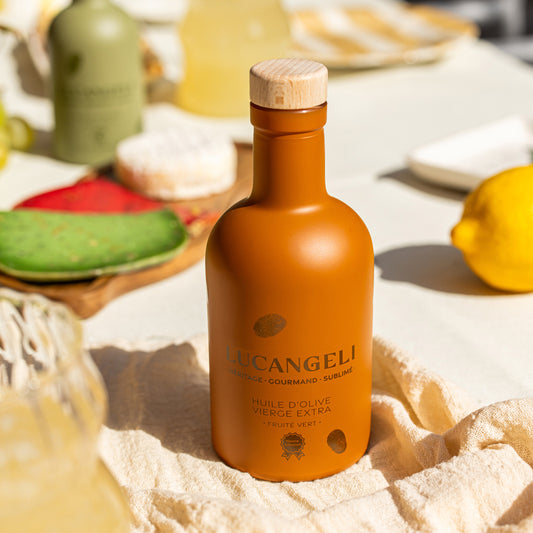
- Narrow neck of the original bottle: no accessories, hygienic, perfectly suited for 200 ml and 500 ml formats. This is the preferred solution in professional gourmet kitchens.
- Cork pouring spout with tube: economical and easy to install, but less precise and allows more air in. Suitable for occasional use.
- Glass carafe or oil cruet: elegant on the table, easy to clean. Be careful not to expose the oil to light if the glass is transparent.
- Opaque ceramic oil cruet: protects the oil from light, beautiful on the table. Difficult to see the remaining level.
Bottle size changes everything
In professional catering, the drip-free spout is often replaced by a 200 ml or 500 ml narrow-neck bottle, which allows for precise portion dosing without additional accessories. This is a common practice in gourmet kitchens that work with quality finishing oils: the bottle itself is the dosing tool.
For home use, the 500 ml discovery duo offers exactly this profile: a narrow neck that guides pouring naturally, without accessories. For large families or regular cooks, the 5-liter canister can be decanted into a smaller bottle with a pouring spout for daily service.
Flavored oils require more precision
With a flavored oil, dosing is even more important. A bergamot olive oil, obtained by co-crushing the fruit with the olives rather than by adding flavor, has an intense aromatic profile. A few grams are enough to flavor a dish. An adjustable pouring spout is particularly useful here for fine dosing.
Similarly, an organic garlic and chili olive oil should be sparingly applied to a bruschetta or pizza: a precise dispenser avoids unpleasant surprises.
Maintaining your dispenser and properly storing oil
Clean the pouring spout regularly
A pouring spout that is not cleaned quickly becomes a point of oxidation. The oil that stagnates in the tube or around the mechanism turns rancid in a few days. The simple rule: rinse the spout with hot water without soap once a week, and let it dry completely before putting it back in place. Soap leaves residues that alter the taste of the next oil.
Store the bottle correctly
The pourer does not replace proper storage conditions. A bottle of olive oil should be stored away from light, away from heat sources, ideally between 14 and 18 °C. If you use a transparent glass oil cruet for table service, do not leave it permanently on the countertop exposed to light: transfer only the necessary amount for the meal.
The custom bottle on the restaurant table
For establishments wishing to offer a custom-branded bottle on the table, with their logo, graphic charter or a personalized message, the custom bottle is a distinct advantage over a generic oil cruet. It sends a strong signal about the establishment's identity. Restaurants and hotels can consult the dedicated professional space or create their own design via the custom bottle configurator, starting from 24 bottles.
Frequently Asked Questions
How to avoid oil drips on the tablecloth when pouring at the table?
The gesture matters as much as the equipment. Slightly turn the bottle towards you at the end of pouring, a quarter turn, to cut the flow cleanly. With a well-calibrated drip-free pouring spout, this gesture is enough to avoid any spills. If you don't have a spout, a piece of absorbent paper tucked under the neck between uses absorbs residual drops.
Can the same pouring spout be used for several different oils?
Technically yes, but it is not recommended if the oils have very different profiles. A dispenser used for a green fruity oil and then for a flavored oil can transfer residual aromas. If you use several oils at the table, which the trio of olive oils in 200 ml format allows very well, plan for one dispenser per bottle.
Should olive oil be transferred to an oil cruet or left in its original bottle?
The original bottle is often the best option: it is designed to protect the oil with tinted glass and a suitable neck, and it carries traceability information such as lot number, harvest date, and appellation. Transferring to a transparent glass oil cruet exposes the oil to light. If you insist on an oil cruet for table aesthetics, choose an opaque ceramic or tinted glass model, and only transfer the amount needed for the meal.



 lucangeli.it