

Origin and Geography of Roggianella in Calabria
A Variety Rooted in Northern Calabria
Roggianella is an indigenous olive cultivar from Calabria, primarily grown in the province of Cosenza, in the northern part of the region. Its name comes from the village of Rogiano Gravina, in the Crati valley, where this variety has been cultivated for centuries. It grows at altitudes between 200 and 600 meters, on well-drained clay-limestone soils, in an environment with hot summers and mild winters.
Unlike the Carolea, the dominant variety in the region and harvested between mid-October and mid-November, Roggianella ripens later, between mid-October and late November. This two-to-three-week delay in the harvest calendar directly impacts the oil's aromatic profile, which develops sweeter and less bitter notes than those of a Carolea harvested green.
Roggianella is a dual-purpose variety: its olives are used for both oil production and table consumption. As a table olive, it is consumed black, candied, or marinated. As an oil olive, it yields an average quantity but consistent quality, with a high oleic acid content and naturally low free acidity.
Roggianella in IGP Olio di Calabria

Roggianella is one of the authorized varieties in the specifications of IGP Olio di Calabria, the protected geographical indication that has regulated olive oil production in Calabria since 2016. To obtain this label, the oil must be 100% produced from olives grown and processed in Calabria, with free acidity below 0.8% and a peroxide index below 20 meq O₂/kg.
IGP Olio di Calabria is one of the least known Italian appellations in France, yet it covers one of Italy's most important producing regions. Calabria accounts for approximately 25% of national olive oil production. If you want to explore this range, the discovery duo in 500 ml bottles is a good starting point to compare two aromatic profiles from this region.
Tasting Profile and Characteristics of Roggianella Oil
On the Nose and Palate
A monovarietal Roggianella oil exhibits a medium-intensity green fruitiness. On the nose, initial sensations evoke fresh grass, raw artichoke, and green almond. A slight citrus note, characteristic of Calabrian oils from late-harvested varieties, is sometimes perceived.
On the palate, bitterness is present but moderate, and pungency—the tingling sensation in the throat typical of quality oils—remains mild. This is precisely what distinguishes Roggianella from an early-harvested Carolea: where Carolea can exhibit pronounced pungency and frank bitterness, Roggianella offers a rounder, more accessible balance for palates unaccustomed to intense oils.
The fluidity is medium, and the color ranges from golden green to straw yellow depending on the degree of filtration. An unfiltered oil will have a slight haze and more complex aromas, but a slightly reduced shelf life.
Roggianella and Carolea: Key Differences
To understand what distinguishes these two Calabrian varieties, here are the six most useful comparison points:
- Production area: Roggianella is concentrated in the province of Cosenza, northern Calabria; Carolea is present throughout the region.
- Harvest period: Roggianella is harvested from mid-October to late November, Carolea from mid-October to mid-November.
- Fruity intensity: Medium for Roggianella, medium to intense for Carolea.
- Bitterness and pungency: Moderate for Roggianella, moderate to pronounced for Carolea.
- Aromatic notes: Fresh grass, artichoke, almond, and citrus for Roggianella; grass, green tomato, artichoke, and pepper for Carolea.
- Preferred uses: Fish, delicate vegetables, and fresh cheeses for Roggianella; grilled meats, legumes, and bruschetta for Carolea.
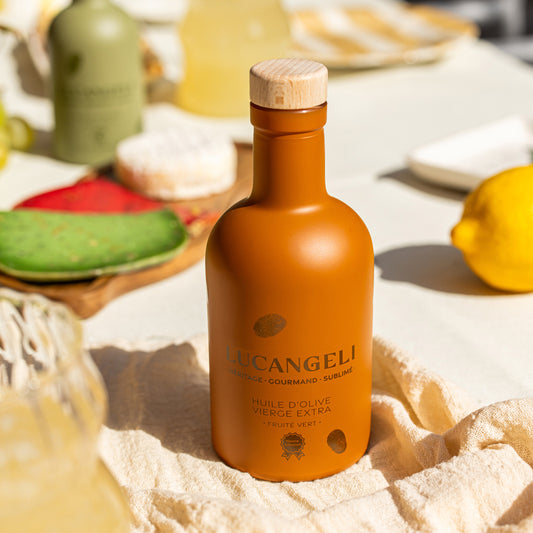
To discover a profile close to ripe fruitiness, even milder, the 200 ml organic ripe fruity oil bottle is a useful reference for understanding how the harvest time transforms the taste of an oil.
Culinary Pairings and Uses in Cooking

Dishes That Showcase Roggianella
Roggianella's relative sweetness makes it an ideal finishing oil for preparations where an overly intense oil would overpower other flavors. Here are the pairings that work best:
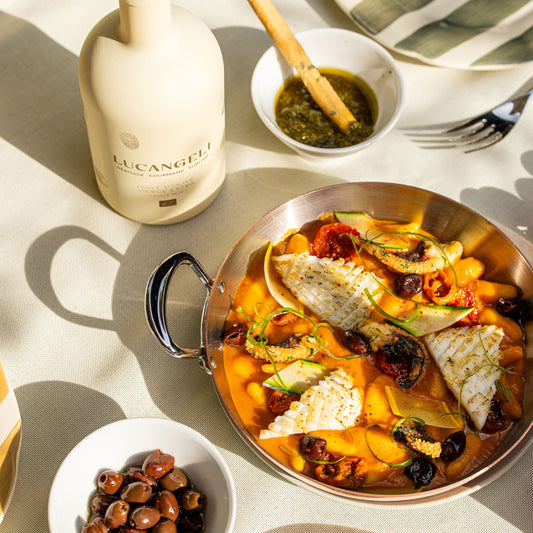
- Poached or steamed white fish: a drizzle of Roggianella poured raw over a freshly cooked sea bass or sea bream reveals the artichoke notes without masking the fish.
- Fresh and goat cheeses: a few drops on burrata or fresh goat cheese, with a pinch of sea salt, are enough to transform a simple appetizer into a memorable dish.
- Roasted seasonal vegetables: zucchini, peppers, eggplants—summer vegetables naturally pair well with this sweet green fruity profile.
- Carpaccio of vegetables or raw fish: Roggianella perfectly plays the role of a finishing oil on raw preparations, where its moderate bitterness adds depth without aggressiveness.
- Quality bread: poured directly onto a lightly toasted slice of country bread, it is sufficient on its own.
For professionals wishing to integrate a Calabrian monovarietal oil into their menu, the dedicated space for cafes, hotels, and restaurants allows for discussion of formats and volumes adapted to each establishment.
When to Use a Monovarietal Roggianella Oil
A monovarietal oil is used differently from a blended oil. It is not designed for high-temperature cooking, where its aromas would be lost. Its domain is finishing: poured raw, at the end of cooking, or as a direct seasoning.
If you want to build a small olive oil cellar at home, the trio of 200 ml organic olive oil is a practical way to compare several aromatic profiles and understand how each oil reacts differently depending on the dishes. For events or gifts, personalized bottles allow you to offer a selection of Calabrian oils with a custom-designed label, starting from 24 bottles.
Frequently Asked Questions
What is Roggianella and where is it cultivated?
Roggianella is an indigenous olive cultivar from Calabria, primarily cultivated in the province of Cosenza, in the northern part of the region. It is used for both oil production and as a table olive. Its name comes from the village of Rogiano Gravina, in the Crati valley.
What is the difference between Roggianella oil and Carolea oil?
Both varieties are Calabrian, but Roggianella is harvested later (until late November) and yields an oil with a milder profile, with moderate bitterness and pungency. Carolea, harvested earlier, generally exhibits a more intense fruitiness and more pronounced pungency. Roggianella is better suited for delicate dishes, Carolea for more robust preparations.
How to recognize a good monovarietal Roggianella olive oil?
A quality Roggianella oil exhibits a medium-intensity green fruitiness, notes of fresh grass, artichoke, and almond, moderate bitterness, and mild pungency. It must have free acidity below 0.8% and a peroxide index below 20 meq O₂/kg to be classified as extra virgin. The IGP Olio di Calabria mention on the label guarantees the Calabrian origin of the oil.



 lucangeli.it