


Easter holidays are approaching, and with them, the desire for gourmet family breakfasts. But between the ubiquitous industrial spreads on supermarket shelves and artisanal alternatives, how do you choose? Composition, ingredients, nuts: here are the essential criteria for choosing an artisanal spread that truly makes a difference.
Industrial vs. artisanal: why the difference matters

Spreadable paste is one of the most consumed breakfast products in France. However, behind this daily pleasure lie very different realities depending on whether you choose an industrial or artisanal product. Industrial spreads are produced in large quantities, with standardized and often low-quality ingredients. Artisanal recipes, on the other hand, focus on the rigorous selection of raw materials and more product-friendly manufacturing processes.
The ingredient list, the first indicator of quality
The first thing to look at before buying a spread is its ingredient list. A short list with easily identifiable names — hazelnuts, almonds, cocoa, cane sugar — is generally a sign of a quality product. Conversely, a long list with additives, artificial flavors, or unspecified vegetable oils should be a red flag. A good artisanal spread does not need to hide its ingredients behind complex names.
Palm oil, an ingredient to avoid
Palm oil is widely used in industrial spreads for its texture and low cost. But its production is often associated with problematic agricultural practices for the environment, particularly deforestation. Moreover, it brings no particular taste value. Prefer a palm oil-free spread, whose creamy texture comes naturally from the oils contained in the nuts themselves.
Sugar: what's its place in the recipe?
In the ingredient list, the order of appearance reflects the quantity used. If sugar appears first, it means it constitutes the majority of the product — which is often the case for industrial spreads. A well-balanced artisanal recipe places nuts at the top of the list, with sugar only as a supplement to refine the taste. The Piedmont hazelnut cocoa spread is a good example: hazelnuts dominate, cocoa adds depth, and sugar remains measured.
Nuts at the heart of the best recipes

What truly distinguishes an artisanal spread from an industrial product is the quality and proportion of nuts used. Hazelnuts, pistachios, almonds: each nut brings a unique taste personality. And their geographical origin plays a decisive role in the final result. The major producing regions of Italy — Piedmont for hazelnuts, Sicily for pistachios — are renowned for the exceptional quality of their harvests.
Piedmont hazelnuts, the queen of spreads
Piedmont hazelnuts are considered among the best in the world. Their intense, slightly roasted flavor and melting texture make them the benchmark ingredient for high-end spreads. When carefully processed — slowly ground to preserve their natural aromas — they produce a hazelnut spread of incomparable richness, far from industrial versions diluted in palm oil.
Pistachio, the flavor that stands out
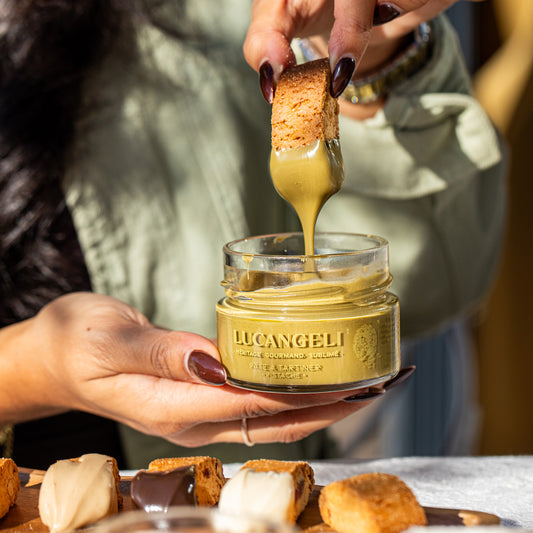
Pistachio is gaining increasing popularity in gastronomy, and for good reason: its sweet, slightly sugary and vegetal flavor appeals to both children and adults. A quality pistachio spread must contain a generous proportion of pistachios, without palm oil or artificial flavors. The naturally green color of the pistachio is also an indicator: too bright a shade can betray the addition of colorants.
Almond, sweet and delicate
Almond is the most versatile nut. Its subtle flavor and creamy texture make it an ideal base for a sweet spread, suitable for all palates. The almond spread pairs perfectly with a slice of toasted country bread, crepes, or pancakes. It can also be used in cooking to fill pastries or accompany fresh fruit.
How to choose your artisanal spread for Easter?
Easter is the ideal occasion to rediscover the pleasure of family breakfast, with carefully chosen products. It is also a good time to offer authentic delicacies to loved ones. Artisanal spreads are particularly well suited for this: they combine pleasure, quality, and originality.
For family breakfast
For a memorable Easter breakfast, why not offer several flavors at the table? The set of 5 spreads — hazelnut, pistachio, almond, hazelnut cocoa, and bergamot — allows the taste buds of the whole family to travel. Everyone finds their favorite flavor, and tasting becomes a true moment of sharing. The bergamot spread, in particular, surprises with its citrus and floral notes, typical of Calabria.
As a gourmet gift idea
An artisanal spread also makes an original and refined gourmet gift for Easter. Rather than a simple chocolate egg, offering a customizable gift box with several artisanal spreads means offering a lasting culinary experience, to savor long after the holiday weekend. A thoughtful gesture that speaks volumes about the care taken in choosing the gift.
Choosing an artisanal spread is above all choosing transparency: ingredients that are recognizable, nuts selected for their quality, and expertise that respects the raw material. As Easter approaches, it is also an opportunity to reconnect with the simple pleasure of a delicious piece of toast, shared with family around a well-laden table.




 lucangeli.it