

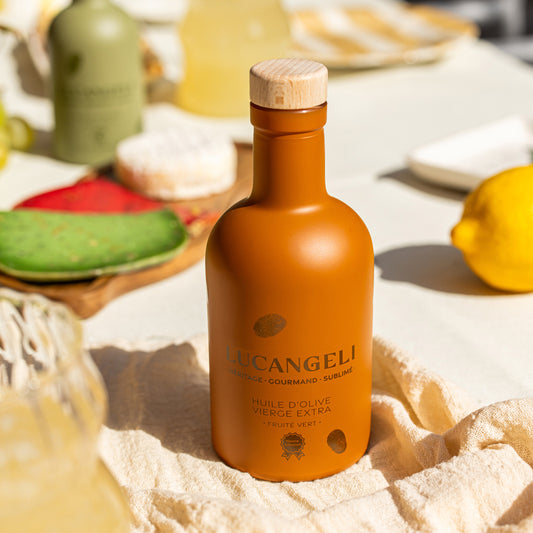
In bistronomy, olive oil is neither a back-of-kitchen commodity nor a simple condiment: it is one of the few elements that runs through every stage of service, from cooking to the finishing drizzle on the plate. Choosing the right oil, in the right format, and knowing how to talk about it in the dining room is a way to stand out that is within reach of every establishment, whatever its number of covers.
Late September also marks the opening of the harvest season in Italy. This is the exact moment to refresh your references, before the new oil reaches the market and your competitors catch up.
Which olive oil profile to choose for your style of cooking

The green fruity / ripe fruity distinction, a criterion that determines everything
Bistronomy rests on assertive products and precise execution. Olive oil follows the same logic: the aroma profile has to be chosen to match the food you serve, not by default.
A green fruity oil has a clear-cut attack, perceptible bitterness and a peppery finish. It goes naturally with dishes where freshness and tension are what you are looking for: raw vegetables, fish carpaccio, seasonal salads, green vegetable soups, burrata. This autumn, it suits dishes built around chicories, raw celeriac or fresh walnuts. The organic green fruity olive oil offers this profile at an accessible entry price for testing your menu.
A ripe fruity oil is rounder, softer on the attack, with notes of ripe fruit and almond. It suits dishes based on roasted vegetables, slow-cooked meats, risottos, mushrooms and fish in sauce. It is often the most versatile profile for a high-volume bistronomy service. The organic ripe fruity olive oil or the limited edition ripe fruity 1L fit without difficulty into a fast-turnover lunch service.
Should you use the same oil for cooking and for finishing?
In bistronomy the most frequent answer is no — and it is the right one. Using a standard-quality extra virgin oil for pan and oven cooking, and keeping a more characterful oil for finishing on the plate, is a rational way to manage food cost without sacrificing impact on the palate.
Finishing on the plate is the moment when the oil is perceived directly, with no heat transformation. That is where the aroma profile expresses itself fully, where a few millilitres are enough to mark a dish, and where the gesture can be visible and commented on in the dining room.
For cooking and base preparations in volume, the 5-litre tin of organic olive oil is the economical format for a kitchen with a medium number of covers. It lasts two to three weeks depending on your pace, with a controlled cost per portion.
Olive variety: a menu argument rarely used in bistronomy
Few bistronomy restaurants mention the olive variety on their menu. Yet it is information your curious guests are waiting for, and one the specialist press has valued for several years.
Carolea, the emblematic variety of Calabria, gives oils with a balanced, slightly ripe fruity profile, with a softness on the palate that does not mask the flavours of the dish. It is one of the varieties most used in Calabrian extra virgin oils. Mentioning it on your board or in a dish description brings a level of precision that few establishments offer at this price positioning.
---
Formats, food cost and stock management
Choosing the right format for your service volume
Bistronomy is not fine dining: margins are tighter, teams are smaller, and stock has to turn over faster. The wrong supply format creates two opposite risks: an oil oxidising because it has been open too long, or running out in the middle of service.
Here are the formats to consider according to your pace:
- The 5-litre tin for daily cooking and base preparations. Recommended period of use once open: six to eight weeks maximum, somewhere cool and away from light.
- The 500 ml or 1 litre bottle for finishing oils. Plating uses little per portion, but an open bottle oxidises quickly in the kitchen if it is exposed to heat. Go for small formats, replaced regularly.
- The 2.5-litre jeroboam is the in-between format. It suits establishments with a medium number of covers and a single finishing reference. The 2.5L organic extra virgin olive oil jeroboam can also be shown off in the dining room as a talking point, provided your team can comment on it.
Working out the food cost per portion
A finishing drizzle represents between 3 and 8 millilitres of oil depending on the dish and the gesture. Based on an organic extra virgin oil at around 15 to 20 euros a litre, the food cost per plate sits between 0.05 and 0.16 euro.
That is a very low cost given the sensory impact and the selling point the gesture creates. Poor use in the kitchen, on the other hand — oil poured in excess, heated too high, left in the light — can double or triple actual consumption with no matching gain in taste.
Turnover and oxidation: the two most frequent mistakes in bistronomy
Extra virgin olive oil oxidises as soon as it is exposed to air, heat and light. In a restaurant kitchen, those three factors are permanent.
The two most frequent mistakes are:
- Keeping an open finishing bottle in the kitchen for several weeks, close to the stove.
- Ordering large volumes to get a lower unit price, without planning enough turnover.
The practical rule: an open finishing bottle should not stay in service for more than three weeks. An open cooking tin should not go beyond six weeks. After that, the organoleptic qualities degrade and the risk of serving a rancid oil goes up.
To structure your supply and match volumes to your real pace, the professionals area lets you set delivery frequencies that suit you, with no restrictive minimum order.
---
Showcasing olive oil in the dining room: service, words and guest experience
Training your team in ten minutes
In bistronomy, the section waiter has no time for a lecture. What they need to be able to say about olive oil fits into three sentences:
- Where it comes from (Calabria, southern Italy, organic extra virgin).
- Why it is on this dish (finishing, balance, freshness).
- What it brings to the taste (roundness, slight bitterness, fruity note).
That is enough to turn a kitchen gesture into a dining-room argument. And it is what no competitor at the same price positioning does systematically.
The bottle on the table: communication tool or risk of overuse?
Putting a bottle of oil on the table is a house choice that can work as long as it is kept under control. The main risk is uncontrolled overuse by the guest, which creates unbudgeted food cost. The solution: use a drip-free pourer that controls the flow, and choose a small capacity (200 ml) for table bottles.
That bottle can also become a communication object in its own right. A bottle personalised with your establishment's name or logo puts a strong visual identity on every table and stays in your guests' memory. The bottle personalisation service lets you create this format from 24 units, with a design entirely defined by the establishment.
Building the presentation on the menu
Mentioning olive oil on the menu of a bistronomy establishment answers a growing expectation of traceability and precision from guests. A few formats that work:
- In a dish description: “sea bream fillet, confit fennel, extra virgin olive oil from Calabria”.
- In a dedicated section at the bottom of the menu: “our reference products”, with two or three emblematic ingredients and their origin.
- Spoken by the service team, on the seasonal dishes that change every week.
This approach adds value to the plate without weighing down the menu. It positions the establishment as rigorous in its choice of products, which justifies an average spend slightly above that of the local market.
---
Frequently asked questions
Which olive oil should you use in bistronomy for cooking and for finishing?
For pan or oven cooking, an organic extra virgin oil in a large format (5L tin) is enough and keeps food cost under control. For finishing on the plate, go for an oil with a more characterful profile, green fruity or ripe fruity depending on your cooking, in a small format to guarantee its freshness.
How do you work out the right olive oil supply volume for a bistronomy restaurant?
Estimate your real weekly consumption, separating cooking from finishing. An open finishing bottle should not stay in service for more than three weeks. A 5-litre cooking tin suits a service of 40 to 80 covers a day, over a four to six week turnover depending on use.
Is it worth mentioning the origin and variety of the olive oil on a bistronomy restaurant's menu?
Yes, and it is an underused lever at this level of positioning. Mentioning Calabria, the Carolea variety or the organic extra virgin designation brings a level of precision that few establishments offer in bistronomy. It is a credible way to stand out, and it fits what guests currently expect in terms of traceability.




 lucangeli.it