


Why the harvesting method matters as much as the terroir
People often talk about olive variety, soil or altitude to explain the quality of an oil. They talk far less about the way the fruit is harvested, and yet this is one of the most decisive variables. An olive picked by hand, intact, processed within the hours that follow, gives a radically different oil from an olive shaken off mechanically, mixed in with leaves and twigs, and sometimes waiting several days before it reaches the mill.
In October, the harvest is in full swing across southern Italy. It is the right moment to understand what the picking technique really tells you about a bottle you are about to buy.
The intact olive, the starting point of quality
The quality of extra virgin olive oil rests on a simple rule: the less the olive is damaged before being pressed, the better the oil. Every bruise, every scratch triggers localised oxidation that raises free acidity and the peroxide value — two regulated indicators you can find on some producers' technical sheets.
Hand picking respects this principle: the olives are harvested one by one, by hand or with light combs that let the fruit slide into nets stretched out on the ground. Sorting out damaged, diseased or long-fallen olives is easy to do on the spot. The result: healthy, consistent fruit that reaches the mill in the best possible condition.
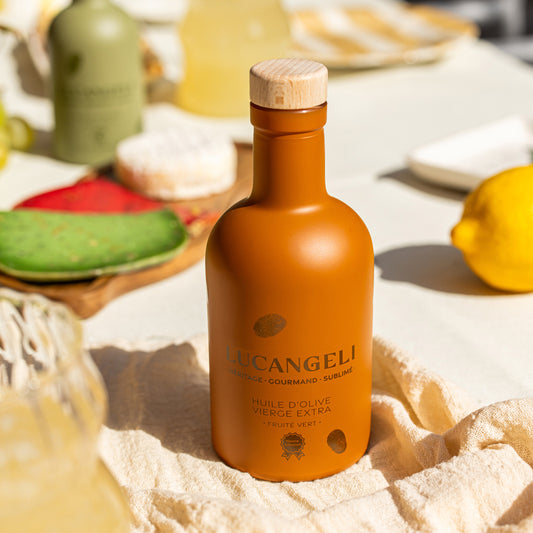
You will find this kind of production in the organic green fruity olive oils or organic ripe fruity oils from plots worked on a human scale, where heavy mechanisation is often impossible because of the slope or the density of the trees.
---
The two main picking methods and their concrete effects

Hand picking: deliberate slowness, quality preserved
Hand picking is slow and costly. Over a day, an experienced picker harvests between 50 and 100 kg of olives depending on the density of the grove and the variety. To produce one tonne of olives, that means ten to twenty days of work, against a fraction of that time with a mechanical shaker.
So why do some producers keep this practice going despite the cost?
- Selection is possible at source. The picker naturally sets aside fallen, worm-eaten or overripe olives. This sorting, impossible on a large mechanised scale, reduces the enzyme load that degrades the oil during transport to the mill.
- The olive stays whole. No violent impact, no laceration. The integrity of the fruit is preserved right up to milling.
- The harvest can be split by stage of ripeness. An attentive producer comes back to the same tree ten days later to pick the olives at their optimal stage, something heavy mechanisation does not allow.
It is precisely this last constraint that justifies hand picking for Carolea, the dominant variety in Calabria. Harvested at véraison — the moment the olive turns from green to purple, between mid-October and mid-November depending on altitude — it develops the fine bitterness and pungency that only a targeted harvest, plot by plot, makes it possible to capture with precision.
Mechanical harvesting: productivity, quality trade-offs
Trunk shakers, scuotitori (branch shakers) and canopy harvesters make it possible to pick several tonnes of olives a day on flat, accessible land. The productivity is incomparable. But the effects on quality are worth understanding.
- Micro-bruising is unavoidable. The intense vibration drops the olives onto nets or into containers, with repeated impacts. On olives at their optimal stage of ripeness, that is enough to start a slight oxidation.
- Sorting is less precise. Leaves, twigs, olives that fell several days ago: everything arrives at the mill together. Cleaning is possible, but never as selective as a human hand.
- The delay between harvest and milling is often longer. The logistics of large mechanised harvests sometimes involve intermediate storage of several hours to several days. And every extra hour between picking and the mill raises acidity.
This does not mean that every mechanically harvested oil is of lesser quality. Some modern estates combine fast mechanical harvesting with milling within the following four to six hours, producing thoroughly remarkable extra virgins. Well-managed mechanisation is not the enemy of quality.
---
How to read a label in the light of all this

The picking method is not a mandatory mention on the label. You will not systematically find “hand-picked” or “machine-harvested” on a supermarket bottle. Here are the clues to look for in order to piece that information together.
The mentions that point to a careful harvest:
- The harvest date — present on the best oils, it lets you check that the oil is from the current year or the previous one. An oil harvested in October and used within the following eighteen months is ideally fresh.
- Free acidity and the peroxide value — when the producer displays them, it is a sign of transparency. An acidity below 0.3% and a peroxide value below 10 meq O₂/kg generally correspond to an early, carefully handled harvest.
- The variety name — a single-variety oil from a local variety (Carolea in Calabria, Taggiasca in Liguria, Nocellara in Sicily) often implies production on a human scale, compatible with hand or semi-hand picking.
- The designation of origin — PDO and PGI specifications sometimes regulate harvesting methods. Olio di Calabria PGI, for example, imposes production rules that rule out practices incompatible with a quality extra virgin oil.
- The size and the price per litre — an oil at 8 euros a litre cannot fund an entirely manual harvest. The production cost of a carefully made oil shows up in its price.
The discovery duo lets you compare a green fruity and a ripe fruity oil from the same Calabrian territory, so you can taste for yourself how the stage of ripeness at harvest shapes the aromatic profile in the glass. The discovery trio gift box — one of the latest arrivals on the site — adds a third expression to extend the comparison.
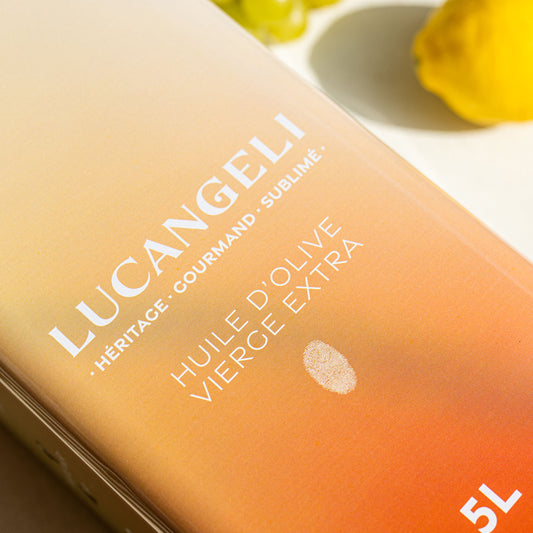
For everyday use in a large format, the 5-litre tin of organic olive oil offers the best quality-to-volume ratio, and the 2.5-litre cuvée is an ideal middle option for households that use it regularly.
Restaurants and professionals who want to work with oils whose origin and production methods they know precisely can access the technical details through the professionals area.
---
Frequently asked questions about olive harvesting
Does “hand-picked” guarantee a better quality oil?
Not automatically. The picking method is one factor among others: the variety, the stage of ripeness, the delay before milling and the storage conditions all play just as important a role. Hand picking followed by poor storage can give a worse oil than a mechanical harvest processed within two hours.
How can you tell whether an oil was hand-picked when the label does not say so?
Several clues point to a careful harvest: a stated acidity below 0.3%, a low peroxide value, a precise harvest date, a named local variety and a price per litre consistent with the cost of artisanal production. Very large industrial oils sold at low prices cannot fund an entirely manual harvest.
In October, is it too early to buy the new oil?
October marks the start of the harvest in southern Italy, especially for high-altitude production or for early stages of ripeness. The first new oils arrive in November. In the meantime, a well-kept oil from the previous harvest is still excellent: just check that the harvest date really is 2025 or 2026, and that the bottle has not been exposed to light or heat.




 lucangeli.it