

Finding a reliable Italian food supplier in Lille is still a challenge for restaurateurs and fine food shops: general directories tell you nothing about selection criteria, about the formats that suit food service, or about real lead times. This guide answers those practical questions, from choosing which references to list to supply terms, so every establishment in Lille can build a coherent and profitable Italian offering.
Why Italian products have become a fixture in Lille's restaurant scene

Customers who know the products and ask for them
Lille is one of the French cities where food culture runs deepest. The concentration of restaurateurs, caterers and fine food shops is high, and customers — whether they are there for business or for pleasure — can tell the difference between an industrial pesto and a DOP basil sauce, between a supermarket balsamic vinegar and an IGP condiment from Modena. That rising standard pulls the whole offering upwards, in the dining room as well as on the shop shelf.
Italian products meet two expectations at once: they are recognisable, they carry a story your team can tell at the table, and they are versatile enough to appear on an autumn menu as well as on an aperitif platter. This is not a passing trend, it is a deep-rooted shift in the way people eat.
Autumn, the right moment to rethink your sourcing
October marks the start of the olive harvest in southern Italy. This is when the new oils reach the market, when serious suppliers can offer you products from the current crop, traceable back to the grove. It is also when chefs in Lille rework their menus, moving from summer vegetables to mushrooms, squash and braised meats — dishes that call for precise finishing oils, well-measured balsamic vinegars and nut pastes for desserts.
Renegotiating your supply terms at the start of the season, before stocks run down, is a smart logistical decision. Establishments that wait for the December peak to place an order often end up with longer lead times and substitute formats.
Which Italian products to select to set your establishment apart

Olive oils: from cooking to finishing
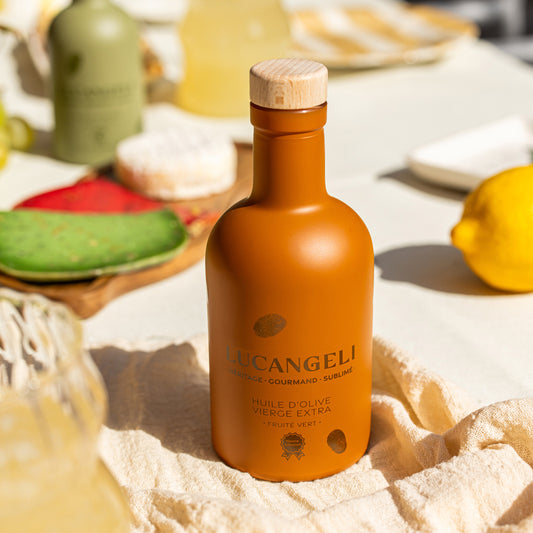
Olive oil is the product that deserves the most care when you select it. In the kitchen, the 5-litre tin of organic olive oil is the reference format for keeping food costs down and avoiding running out mid-service. For plating and table service, 200 or 500 ml bottles allow fast rotation and limit oxidation once opened.
For establishments that want to move beyond the generic, pressed oils bring real added value:
- The lemon-pressed olive oil, made by crushing the fresh fruit together with the olives at the moment of extraction rather than by adding flavouring, works perfectly with raw fish, carpaccio and steamed vegetables. It is an easy product to talk about at the table.
- The organic garlic and chilli pressed olive oil, made by that same co-crushing process, is ideal for pizzas, roasted vegetables, grilled dishes and sautéed pasta. It draws attention on autumn and winter menus.
A selection of two or three oils, one plain and one or two pressed, is enough to build a coherent offering without overloading your storeroom.
Balsamic vinegars, nut pastes and spreads
The Gold collection IGP balsamic vinegar of Modena is the finishing product par excellence for establishments that want to work on how their plates look. A few drops on a burrata, a slice of duck breast or a veal stock reduction are enough to transform the plating. The Silver collection IGP balsamic vinegar is the entry-level reference for everyday cooking, sauces and marinades.
For pastry chefs and kitchens with a house dessert offering, nut pastes in the professional 1 kg format are a major asset:
- 100% pistachio paste – 1 kg: flawless texture and aroma for creams, mousses and fillings.
- 100% Piedmont hazelnut paste – 1 kg: the IGP Piedmont hazelnut brings a distinctive aromatic profile that a knowledgeable clientele recognises.
- 100% almond paste – 1 kg: versatile, it works just as well in fine pastry as in Mediterranean-leaning savoury preparations.
On the spreads side, the DOP basil pesto with olive oil is a constant reference for antipasti boards, bruschetta and pasta toppings. The sun-dried tomato spread and the black olive spread round out an aperitif or sharing-board offering without any extra prep in the kitchen.
Personalisation and bottles carrying your establishment's identity
A growing number of establishments in Lille — fine dining restaurants, hotels and caterers — want to put their name or logo on the bottle of oil set on the table. It is a strong identity lever, particularly effective for banquets, private events and business meals.
Bottle personalisation starts at 24 units, with a production lead time of 10 to 15 working days to allow for, depending on how complex the design is. For large volumes or bespoke projects, it is best to get in touch with the sales team through the professionals area for dedicated support.
Logistics and supply: what to know before you order
Formats, sizes and stock management
One of the most common problems in food service is the mismatch between the format ordered and how fast the product actually turns over in the kitchen. A serious supplier should offer you several sizes of the same product, so you can match your order to the volume you get through each week.
Here are the formats available, by use:
- Daily cooking and base preparations: 5-litre tin for olive oil, 1 kg pastes for nuts. These formats cut down on reordering and keep your cost per portion stable.
- Table service and plate finishing: 200 to 500 ml bottles for tasting oils and balsamic vinegars. Fast rotation keeps an opened product fresh.
- Aperitif boards and spreads: retail formats of 80 to 120 g for serving directly at the table or for display in a fine food shop.
Watch out for oxidation: once opened, a 500 ml bottle of oil should ideally be used within four to six weeks. If your turnover is slow, go for several small formats rather than one large container left open too long.
Ordering, lead times and a dedicated contact
For professionals based in Lille, delivery from a national supplier involves no particular logistical constraint: carriers cover the Lille area with lead times of 48 to 72 hours depending on the delivery method you choose. For a first order or an ongoing partnership, get in touch directly through the area dedicated to professionals to get terms suited to your volume and your order frequency.
For establishments that want to offer gift sets in their shop or at the end of a meal — a practice that is growing in the city's fine dining restaurants —, the olive oil trio discovery set in a terracotta box is a reference available immediately, with no personalisation required and a positioning suited to resale.
---
Frequently asked questions
Can you order Italian products in small quantities to test them before listing them?
Yes. Most serious suppliers offer retail formats or tasting kits that let you try the products before committing to a volume. The terracotta olive oil discovery set, for example, can be bought as a single unit to assess the aromatic profiles before you list anything.
Which Italian products are the easiest to justify in terms of food cost in a restaurant?
Finishing oils used on the plate have a very low cost per portion — a few centilitres is enough — but their effect on how the customer perceives quality is immediate. IGP balsamic vinegars like the Gold collection follow the same logic: used in precise doses, they transform a plate without weighing on your food cost.
How do I set up a personalised bottle with my own name for my restaurant's tables?
Bottle personalisation is open from 24 units. You create your design through the online configurator, or you contact the sales team for bespoke support if your project goes beyond that volume or involves a specific brief. Allow 10 to 15 working days of production once the proof is approved.



 lucangeli.it