


What the Peroxide Value Really Measures
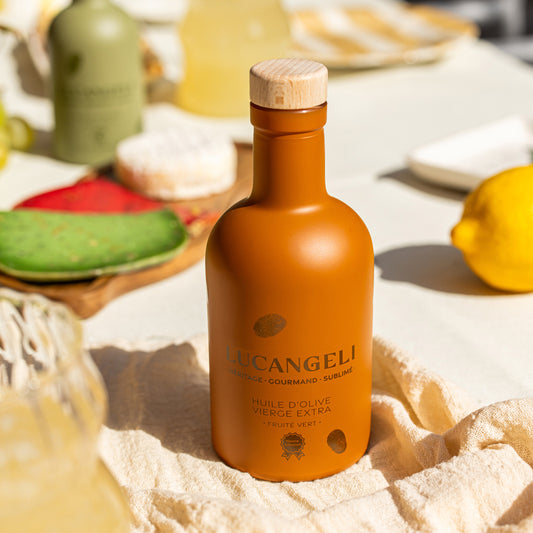
The peroxide value of olive oil measures the oil's level of oxidation at the time of bottling. The lower this number, the fresher the oil. If you see this number on a label, it tells you the condition of the oil as it left the mill, not when you buy it. This is an important nuance that most labels do not explain. To explore oils where freshness is a production priority, you can start with a fruity and vibrant oil from the Calabrian harvest.
The Two-Step Oxidation Reaction
When olive oil is exposed to air, heat, or light, it oxidizes. This process occurs in two stages. First, unsaturated fatty acids react with oxygen to form peroxides, unstable compounds that give the oil a rancid smell. Second, these peroxides break down into aldehydes and ketones, which are the compounds responsible for the characteristic rancid taste. The peroxide value precisely measures the first stage: it captures primary oxidation, before the oil is perceptibly altered in taste. This is why an oil can show an acceptable peroxide value while already being on a downward slope. For an oil with soft and round notes, made from ripe olives, this ripe fruity profile clearly illustrates what rapid pressing of an advanced maturity variety produces.
The Regulatory Threshold and What It Hides
The European regulation sets the maximum peroxide value threshold at 20 meq O₂/kg for an oil to be classified as extra virgin. This threshold is a minimum quality limit, not a goal. A high-quality oil generally has a value below 10, or even below 7 for the best productions. What the regulatory threshold doesn't tell you is that the peroxide value evolves over time: an oil bottled with a value of 8 can reach 18 after twelve months of storage under poor conditions. The bottling date and storage conditions are therefore as important as the number itself. If you want to compare several profiles from the same origin, this trio of three 200 ml oils allows you to do so without committing to a large volume.
Why This Number Alone Is Not Enough
The peroxide value is a partial indicator. It measures primary oxidation, but not secondary oxidation, which is often more indicative of the oil's actual degradation. This is why industry professionals do not stop at this single number. For a practical first approach, the discovery duo of two 500 ml bottles allows you to test two profiles for a sufficient duration to observe how an oil evolves over time.
TotOx, The Indicator Professionals Look At
TotOx is a combined index that adds primary and secondary oxidation. It is calculated as follows: TotOx = 2 × peroxide value + K270 value (ultraviolet absorbance). A TotOx below 10 indicates a low oxidized oil. A TotOx above 26 indicates an oil that is too degraded to be consumed under good conditions. This indicator is used by professional buyers, competition juries, and analytical laboratories. It is not mandatory on consumer labels, but some producers provide it upon request or in their technical sheets. For establishments that wish to work with oils whose analytical parameters are available, the dedicated professional section provides access to this information.
What the Label Doesn't Always Tell You
The peroxide value is not mandatory on the label of extra virgin olive oil sold at retail. Some producers mention it voluntarily, others do not. When it is absent, it does not mean that the oil is of poor quality, but it removes a tool for comparison. However, the presence of the harvest date, lot number, and mill name are positive signals that indicate a producer concerned about traceability. An oil without a harvest date may have been bottled from a stock several months old, or even from a previous campaign. For large quantities, the 5-liter container is a practical option provided it is consumed within three to four months of opening.
How to Use the Peroxide Value When Purchasing
Knowing this number is useful, but knowing how to interpret it is even more so. Here are concrete benchmarks to guide you when choosing an extra virgin olive oil.
Thresholds to Know
- Extra Virgin, Standard Quality (value less than or equal to 20 meq O2/kg): minimum freshness compliant with regulations. Acceptable, but check the harvest date before buying.
- Extra Virgin, Good Quality (value less than or equal to 12 meq O2/kg): fresh, well-produced oil. Good choice for everyday cooking.
- Extra Virgin, Superior Quality (value less than or equal to 7 meq O2/kg): rapid pressing, careful harvesting. Ideal for finishing and raw tasting.
- Virgin, Not Extra (value less than or equal to 20 meq O2/kg): lower quality than extra virgin. To be reserved for cooking.
- Lampante (value greater than 20 meq O2/kg): not edible raw, intended for industrial refining. Do not consume as is.
Time Before Pressing, A Key Factor
The main factor determining an oil's peroxide value is not the olive variety, nor the altitude of the olive grove: it is the time between harvesting and pressing. The shorter this time, the lower the value. Olives begin to oxidize as soon as they are separated from the tree. In Calabria, the Carolea variety, which represents a significant portion of the region's olive groves, yields naturally fruity and stable oils. But even with this variety, a pressing time exceeding 48 hours significantly increases the peroxide value. The best Calabrian productions press their olives within 12 to 24 hours of harvesting. This short delay explains the low values found on the analytical sheets of high-quality oils. For enthusiasts who wish to have a large reference bottle on their table, the Jeroboam cuvée is a limited edition from a traced harvest.
Frequently Asked Questions
What is the peroxide value of a good extra virgin olive oil?
A high-quality extra virgin olive oil has a peroxide value below 10 meq O2/kg, often below 7 for the best productions. The regulatory threshold is set at 20, but this figure is a minimum limit, not a quality objective.
Does the peroxide value change after opening the bottle?
Yes. Once the bottle is opened, the oil is exposed to air, and oxidation accelerates. The peroxide value gradually increases. This is why it is recommended to consume an opened bottle within four to six weeks, storing it away from light and heat.
How to know if an olive oil is oxidized without laboratory analysis?
Advanced oxidation can be detected by smell and taste: a rancid oil gives off an odor of old fat, wax, or wet cardboard. On the palate, it leaves a greasy, flat sensation, without bitterness or pungency. These two characteristics, bitterness and pungency, are markers of freshness in a quality extra virgin oil.




 lucangeli.it