


For a caterer, catering olive oil is not just a condiment: it's a cost item to manage, a product to store without loss, and a visible mark of quality on the plate. Here's how to choose the right format, calculate your cost per portion, and organize your stock rotation.
Choosing the right olive oil format for caterers

The question of format is the first operational decision. It directly impacts your purchase cost, storage logistics, and the product's shelf life once opened.
The 5 L container: the standard format in event catering
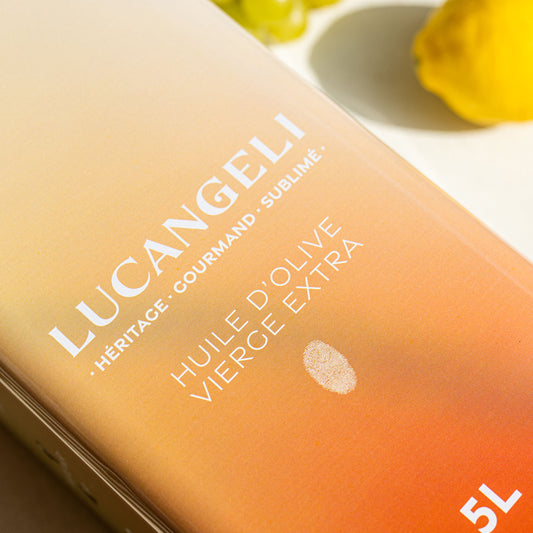
The 5 L container of organic Italian olive oil is the most commonly used format in professional kitchens for medium volumes. It offers a practical logistical advantage: with each opening, the oil's surface exposed to air is smaller compared to a wide-necked glass bottle. With intensive use – daily cooking, marinades, bulk seasonings – a 5 L container is consumed within four to six weeks, which corresponds to the optimal storage window after opening.
For caterers who work on spaced-out events, this rotation is a point of vigilance. Oil that has been opened and rarely used for two months loses its aromatic qualities long before its best-before date. The 5 L format is therefore suitable for operations that cook regularly, not for those who only open a container for a monthly event.
The Jeroboam and large formats for high-volume events
For banquets of more than 200 covers or residential seminars, the Jeroboam of organic extra virgin olive oil offers an interesting alternative: it combines sufficient volume for a busy kitchen staff and a refined presentation that can be showcased in the dining room or at a buffet. It's also a format that lends itself to personalization for corporate events.
200 ml bottles for finishing on the plate

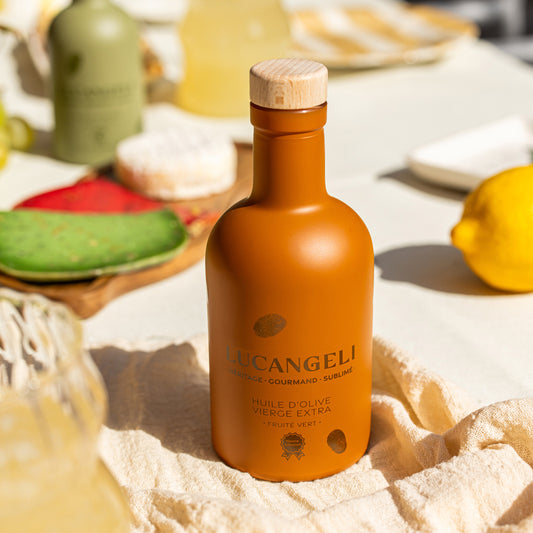
The logic of finishing is different from that of cooking. For à la carte service in event gastronomy, a 200 ml organic green fruity olive oil allows for precise dosing, varying profiles according to dishes, and limiting exposure to air between services. A 200 ml bottle opened during evening service should ideally be consumed within the week.
Here are the four formats to know and their recommended use:
- 5 L container: cooking, marinades, bulk seasonings. Recommended rotation: 4 to 6 weeks after opening.
- 3 L Jeroboam: buffet, banquet, corporate event. Recommended rotation: 3 to 4 weeks after opening.
- 200 ml bottle: plate finishing, gourmet service. Recommended rotation: 1 to 2 weeks after opening.
- 500 ml bottle: mixed use, small kitchen staff. Recommended rotation: 2 to 3 weeks after opening.
Calculating the raw material cost of olive oil in event catering
The raw material cost of olive oil is often underestimated because it's diluted within a global grocery budget. Calculating it per portion allows for better purchasing decisions.
Method for calculating cost per portion
The basic calculation is simple: divide the ex-tax purchase price of the container by the number of portions it contains. A 5 L container holds approximately 4,600 ml of usable oil, taking into account bottom losses and handling. If you use an average of 8 ml of oil per plate for finishing, this container covers 575 portions.
For cooking, volumes are higher: a vegetable sauté for 10 covers consumes between 30 and 50 ml depending on the technique. Integrate these two items separately into your technical sheet.
Cooking oil and finishing oil: two distinct budgets
A common mistake in event catering is to use the same oil for everything. This decision is costly in terms of quality or budget, depending on how it's applied.
The professional logic is as follows: a bulk cooking oil can be a good quality extra virgin oil, purchased in a container, with a neutral profile that doesn't interfere with other flavors. The Carolea variety, grown in Calabria and harvested between October and November, provides precisely this profile: mild ripe fruity, slight bitterness, moderate pungency. It doesn't mask other ingredients and withstands pan-frying temperatures well.
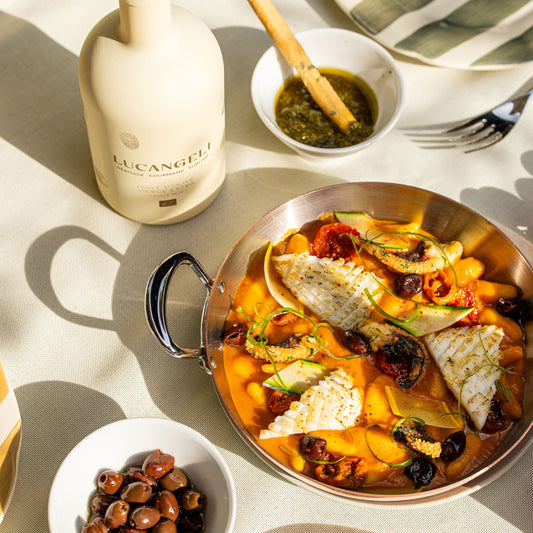
Finishing oil deserves a different investment. It's what the guest directly perceives. An organic ripe fruity olive oil or a flavored oil like organic garlic and chili olive oil can transform a simple dish into a culinary signature, for an additional cost of a few cents per portion.
What the calculation per liter reveals
Here are the three consumption items to include in your technical sheet:
- Cooking (sauté, stir-fry): 30 to 50 ml for 10 covers, an indicative cost of €0.03 to €0.08 per portion.
- Seasoning (salad, marinade): 5 to 10 ml per cover, an indicative cost of €0.02 to €0.05 per portion.
- Plate finishing: 5 to 8 ml per cover, an indicative cost of €0.03 to €0.07 per portion.
These ranges are indicative. The price per liter varies depending on origin, variety, production method, and purchase format. Buying in a 5 L container is systematically cheaper per liter than buying in 500 ml bottles, for equivalent quality.
Managing olive oil stock without loss or oxidation
Stock management is the most overlooked aspect in event kitchens. Olive oil is a living product: it evolves after opening, and poor management leads to actual losses.
The three enemies of olive oil in stock
Olive oil oxidation is accelerated by three factors: light, heat, and air. In professional kitchens, these three factors are often present: containers placed near stoves, bottles left open between services, poorly ventilated storage areas.
The storage rule is simple: stable temperature between 14 and 18 °C, away from direct light, airtight cap after each use. An opened container should not remain open for more than 24 hours without being resealed.
Organizing rotation: FIFO method and batch traceability
The FIFO method (first-in, first-out) applies to olive oil as to all food products. Note the opening date on each container or bottle. For establishments subject to health controls, batch number traceability is mandatory: keep the container label until the stock is depleted.
For caterers who work on occasional events, the temptation is to order in large quantities to benefit from a better price. This is a valid approach provided the stock is consumed within the deadlines. Oil purchased in January for a June event will have lost some of its aromatic qualities if stored in poor conditions.
Adapting orders to the event calendar
The seasonality of your activity should guide your orders. If your peak activity is between May and September, order your containers in April to have oil from the recent harvest. Olive oil from the October-November harvest arrives on the market between December and February: this is the ideal time to build a quality stock for the following season.
For professional orders, purchase conditions, available formats, and delivery times, the professional area allows direct contact with the sales department. Lucangeli also offers tailored support for establishments wishing to structure their Italian olive oil supply.
If you wish to offer a personalized bottle to your clients during a corporate event or banquet, the personalization page details the available options starting from 24 bottles, with a production time to be included in your planning.
Frequently Asked Questions
How much olive oil should be planned for a banquet of 100 covers?
For 100 covers, allow between 1.5 and 2.5 liters of oil depending on the menu. A menu with seasoned starter, pan-fried main course, and plate finishing consumes approximately 20 to 25 ml per cover, all items combined. Allow a 20% margin for unforeseen service issues.
Can the same olive oil be used for cooking and finishing in event catering?
Technically yes, but it's neither the most economical nor the highest quality practice. A bulk cooking oil and a plate finishing oil serve different purposes: the former must be heat-stable and neutral in taste, the latter must be aromatically expressive. Separating the two allows for optimizing the budget without sacrificing the quality perceived by the guest.
How to tell if olive oil in stock is still usable?
Pour a few milliliters into a glass and smell it. Oxidized oil gives off an odor of old fat, cardboard, or wax. In the mouth, it is flat, without bitterness or pungency. If these signs are present, the oil should not be used for finishing. It may still be suitable for high-temperature cooking where aromas are volatilized anyway, but the cautious rule is not to serve oil you doubt.




 lucangeli.it