


Plate finishing olive oil is not the same as cooking oil. In professional catering, this final gesture, a few milliliters poured at the moment of plating, changes the perception of the dish, its brilliance and its aromatic profile. Here's how to master it.
Plate finishing: why olive oil is not a detail

In professional cooking, the distinction between cooking oil and finishing oil is fundamental. Oil heated to over 180°C loses a large part of its volatile aromas. Using the same oil for finishing as for cooking means wasting a quality product, or missing out on the benefits of a finishing oil.
Plate finishing fulfills three distinct functions. It provides visual brilliance, which immediately enhances the diner's perception of the dish. It deposits an aromatic surface layer, perceived from the first bite. It can also modify the perceived texture of an element, by lightly coating a protein or vegetable.
What your guests see before tasting
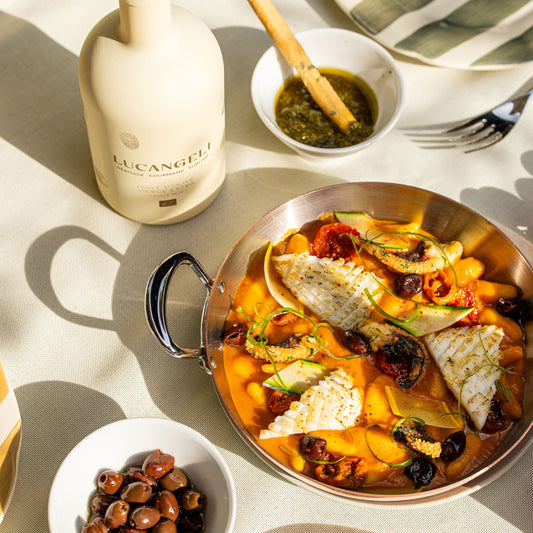
A well-dosed drizzle of oil on a slice of white fish, burrata, or vegetable carpaccio creates an immediate visual effect: the surface shines, colors intensify, the dish appears vibrant. This is a technique systematically applied by gourmet chefs and increasingly integrated into plating protocols by bistronomy brigades.
The difference between cooking oil and finishing oil
A green fruity oil has a marked pungency and intense herbaceous notes: it is ideal for finishing dishes where liveliness is desired, such as a cold soup, tuna carpaccio, or raw vegetable salad. A ripe fruity oil, softer, with notes of ripe tomato and almond, is better suited for delicate dishes: poached white fish, risottos, creamy soups.
The basic rule: the more delicate the dish's flavors, the softer the finishing oil should be. The more powerful the dish, the more you can use an oil with a pronounced character.
What dosage for plate finishing?

Dosage is the variable most often miscalibrated in professional kitchens. Too little, and the finish is invisible. Too much, and the oil drowns the dish, heavying the texture and masking other aromas.
Practical benchmarks by dish type
Here are the recommended dosages and oils depending on the type of dish:
- White fish (sole, sea bass, cod): 3 to 5 ml when plating after cooking, ripe fruity Carolea variety oil.
- Grilled vegetables: 3 to 5 ml when plating off the heat, ripe fruity oil or basil oil.
- Grilled red meat: 5 to 8 ml just before serving, green fruity oil or garlic and chili pepper olive oil.
- Pasta and risottos: 5 to 8 ml for mantecatura or when plating, green fruity or ripe fruity oil.
- Carpaccio, tartare: 3 to 5 ml when plating, green fruity oil or lemon pressed oil.
- Cold soup, gazpacho: 5 to 8 ml drizzled on the surface, green fruity oil.
- Burrata, mozzarella: 3 to 5 ml when plating, ripe fruity oil or basil oil.
- Pizza straight from the oven: 5 to 10 ml immediately after cooking, green fruity oil or garlic and chili pepper oil.
The Carolea variety, cultivated in Calabria, produces a ripe fruity oil with characteristic notes of ripe tomato and sweet almond. It is particularly suitable for finishing white fish and grilled vegetables, with a dosage of 3 to 5 ml per plate. It is a variety little known in France, but widely used by chefs in Southern Italy precisely for its mildness in finishing.
Flavored oils for finishing: a lever for differentiation
Oils pressed with a fruit or herb open up an additional range. They are obtained by co-crushing the fresh fruit with the olives at the time of extraction, and not by adding flavoring: the aromatic integration is therefore total, without any artificial notes.
A lemon pressed oil on a scallop carpaccio or a sea bream fillet brings a citrus freshness without altering the balance of the dish. A basil oil on burrata or fresh pasta advantageously replaces a diluted pesto. A garlic and chili olive oil as a finish on a Neapolitan pizza or roasted vegetables creates an immediately identifiable aromatic signature.
These oils allow you to create a signature dish without complicating the recipe. They are used in the same dosages as natural oils, but their aromatic impact is more direct.
Integrating olive oil finishing into the service protocol
Plate finishing is only effective if it is reproducible. In a brigade, this implies a clear protocol: which oil for which dish, what dosage, what serving tool.
Choosing the right container for kitchen service
In professional kitchens, three formats coexist depending on usage:
- The 200 ml bottle with a drip-free spout: ideal for flavored oils and precise finishing. It allows for milliliter-accurate dosing and is easily stored on the pass.
- The jeroboam format (3 liters): suitable for high-volume establishments that use a single finishing oil across the entire menu.
- The 5-liter jerrycan: reserved for cooking and preparation, never for direct plate finishing.
The rotation rule is simple: an open bottle of finishing oil should not remain in the kitchen for more than four weeks. Exposure to heat and light rapidly degrades the aromas of a quality oil.
Training the brigade in this technique
Finishing with olive oil is a technical gesture that must be learned. It cannot be improvised during service. Two points deserve particular attention during brigade training:
- The pouring gesture: hold the bottle 20-25 cm from the plate, tilt slowly, describe a circular or linear movement depending on the composition. Avoid sudden movements that create irregular puddles.
- Consistency between plates: in service, all plates at the same table must receive the same finish. A shiny plate and a dull plate at the same table indicate an unsynchronized brigade.
The bottle on the table: an extension of table service
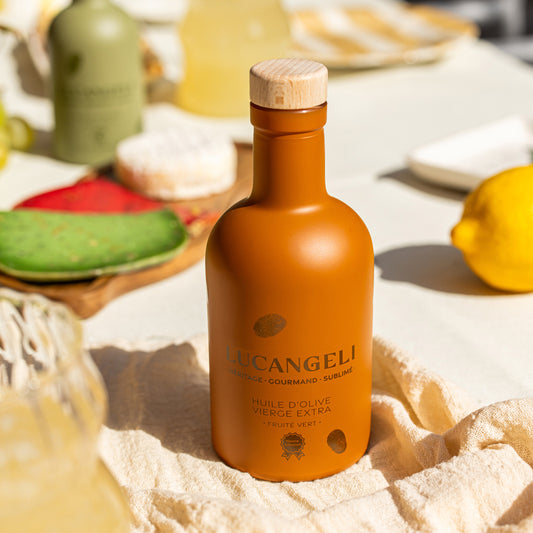
Some establishments choose to extend the experience by offering a bottle of olive oil on the table, allowing guests to season their own dishes. This is a common practice in Italian and Mediterranean restaurants, which values the product and creates a moment of interaction with the customer.
For establishments wishing to go further, it is possible to have the establishment's label affixed to the bottle. A personalized bottle with your name reinforces the brand identity and transforms a condiment into a communication tool. For all professional inquiries, the professionals section allows you to define the volumes, formats, and delivery conditions adapted to your establishment.
Frequently Asked Questions
Which olive oil should be used for plate finishing in a restaurant?
For plate finishing, choose a quality extra virgin oil, distinct from your cooking oil. A ripe fruity oil is suitable for delicate dishes (fish, vegetables), while a green fruity oil is for more powerful dishes (meats, pasta). Cold-pressed flavored oils (lemon, basil, garlic, and chili) allow you to create an aromatic signature on a dish without changing the recipe.
What is the dosage of olive oil for finishing a plate in a professional kitchen?
The standard dosage for plate finishing is 3 to 5 ml for delicate dishes (fish, fresh cheeses, carpaccios) and 5 to 8 ml for more substantial dishes (grilled meats, pasta, pizzas). Beyond 10 ml, the oil becomes perceptible as a dominant element and can unbalance the dish.
Can the same olive oil be used for cooking and plate finishing?
Technically yes, but it is not recommended. Heated oil loses its volatile aromas. Using a quality oil only for cold finishing preserves its entire aromatic profile. In practice, most professional kitchens use a standard oil for cooking and reserve one or two quality oils for finishing and front-of-house service.



 lucangeli.it