


Why choose lemon-pressed olive oil for your restaurant in Nice?
In Nice, lemon-pressed olive oil is a differentiating asset on the menu. Obtained by co-crushing fresh olives and whole lemons at the time of extraction, it offers an aromatic intensity impossible to achieve with a simple flavored oil. This profile appeals to both chefs and customers seeking freshness and Mediterranean identity.
To incorporate this product into your offering, it is essential to select a reliable supplier, capable of ensuring consistent quality, availability, and formats adapted to the restaurant industry. The page dedicated to professionals details the support solutions for cafés, hotels, and restaurants.

Criteria for selecting a lemon-pressed olive oil supplier in Nice
Quality and traceability
- Prioritize extra virgin olive oil, made from ripe olives and pressed with fresh lemons.
- Demand complete traceability: origin of olives and lemons, co-crushing method, production date, batch number.
- Request a detailed technical data sheet and, if possible, a sample to validate the aromatic profile.
Our lemon olive oil meets these criteria with traceability from Calabria to the bottle.
Formats, packaging, and logistics
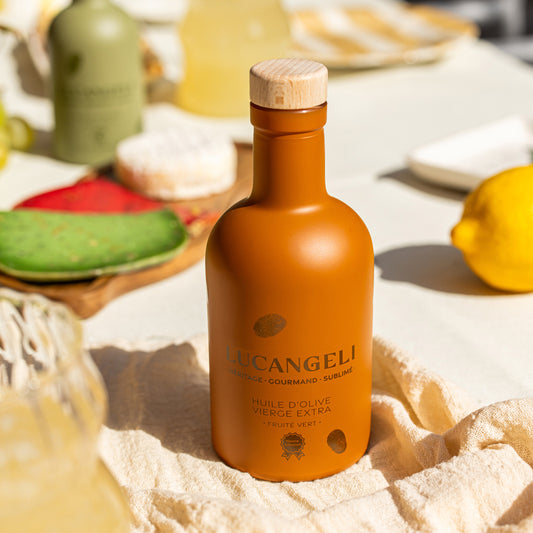
- Opt for formats adapted to table and kitchen turnover: 200 ml bottle for table service, 5 L canister for cooking or large-volume preparations.
- Check for a drip-free pourer for table service.
- Anticipate delivery times, especially at the beginning of the season or during back-to-school periods, when demand soars on the French Riviera.
For optimal management, the 5 L organic canister allows for easy storage in professional kitchens.
Service, support, and customization
A good supplier offers:
- A dedicated contact person for order tracking and quick resolution of unforeseen events.
- The possibility to customize the bottling or labeling to enhance your restaurant's table.
- Advice on food pairings and uses, or even training for the front-of-house team on oil presentation.
The customization page presents options for creating a bottle that reflects your establishment's image.
Integrating lemon-pressed olive oil into your menu
Uses in the kitchen and dining room
- Finishing touch on raw fish or scallop carpaccio
- Dressing for fennel or heirloom tomato salads
- Enhancing a lemon dessert or panna cotta
- Table service to accompany bread
Each use requires a precise amount. For example, for a carpaccio, use 4 to 5 ml per plate to reveal the aromas without masking the product.
Storage and stock rotation
- Store away from light and heat, ideally in a cellar or air-conditioned storage.
- Ensure quick rotation: a lemon-pressed oil maintains its optimal aromatic intensity for six to eight months after extraction.
To anticipate back-to-school demand, plan your orders from the end of August on the professional website.

Checklist before choosing your supplier
- Clearly documented origin and manufacturing method
- Technical data sheet and sample available
- Suitable formats (200 ml, 500 ml, 5 L)
- Delivery time compatible with your needs
- Customization options
- Professional support (training, advice)
- Price consistent with quality and service
Frequently asked questions
How to recognize a genuine lemon-pressed olive oil?
Check that fresh lemon is co-crushed with the olives during extraction, and not added as a flavor afterwards. The mention "lemon-pressed olive oil" must appear on the technical data sheet.
What are the most suitable formats for a restaurant?
The 5 L canister is ideal for the kitchen, the 200 ml bottle for table service. Some suppliers also offer personalized bottles reflecting your establishment's image.
Can the label or bottle be customized for the restaurant?
Yes, from 24 bottles, it is possible to create a custom design via the configurator. For large volumes, contact our sales department for dedicated support.




 lucangeli.it