

Training your front-of-house team to present olive oil transforms a condiment into a sales argument and a tool for differentiation. A server who knows how to name a variety, describe an aromatic profile, and recommend the right pairing for a dish adds immediate value to the diner's experience and to your revenue.
What your team needs to know before serving olive oil

Most front-of-house teams know how to pour olive oil. Very few know how to talk about it. Yet, it is precisely this narrative that makes the difference between an establishment that places a bottle on the table and an establishment that creates an experience. Before organizing any training session, it is necessary to identify the three levels of knowledge that each team member must master.
The three fundamental concepts to master
The first concept is the distinction between aromatic profiles. An extra virgin olive oil is not a uniform product: it can have a green fruity, mature fruity, or black fruity profile, depending on the ripeness stage of the olives at the time of harvest. A green fruity evokes fresh grass, raw artichoke, sometimes green tomato; it is accompanied by a frank bitterness and a perceptible pungency at the finish. A mature fruity is softer, with notes of apple, almond, and fresh butter; the pungency is light, the bitterness discreet. This distinction is the first thing a server should be able to explain in one sentence.
The second concept is origin and variety. Just as a sommelier cites the grape variety and appellation of a wine, a trained server cites the olive variety and region of production. The 200ml organic green fruity cuvée comes from the Coratina variety, cultivated in Calabria, southern Italy: its profile is intense, vegetal, with a marked pungency that enhances red meats and legumes. The 200ml organic mature fruity cuvée expresses the Carolea variety, also Calabrian: round, soft, with notes of ripe apple and fresh almond, it is suitable for fish, white vegetables, and risottos. These two varieties are the two pillars of a well-constructed olive oil menu.
The third concept is preservation and freshness. A server must know that olive oil oxidizes in light and heat, that an opened bottle should be consumed within four to six weeks, and that rancid oil can be recognized by an odor of old fat or wax. This knowledge allows them to answer the questions of the most attentive guests and to rigorously manage the rotation of bottles in the dining room.
Tasting vocabulary adapted for front-of-house staff
Olive oil vocabulary borrows from wine, but it distinguishes itself on one essential point: pungency. This term refers to the sensation of warmth or tingling in the throat, characteristic of quality green fruity oils. It is a quality, not a defect, and it is often the first thing an uninitiated guest interprets as an anomaly. Training your team to anticipate this reaction and explain it positively is one of the most profitable gestures of the training.
Here are the five terms to integrate into the front-of-house discourse, with their translation into everyday language:
- Green fruity: oil harvested early, intense vegetal aromas, present bitterness and pungency. In the dining room: a characterful oil, with notes of fresh grass and a slight warmth on the finish.
- Mature fruity: oil harvested later, soft and round aromas, light pungency. In the dining room: a soft and enveloping oil, with notes of apple and almond.
- Pungency: tingling in the throat, a sign of freshness and quality. In the dining room: a slight warmth on the finish, indicating that the oil is fresh and of premium quality.
- Bitterness: sensation in the middle of the palate, related to the natural compounds of the olive. In the dining room: a slight bitterness that balances rich dishes.
- Extra virgin: the highest category, obtained by cold mechanical extraction, without chemical treatment. In the dining room: an oil obtained solely by mechanical pressing, without any treatment.
The most common presentation errors
The first error is to place the bottle without saying anything. An anonymous bottle placed in silence tells no story and sells nothing. The gesture must be accompanied by a phrase, even a short one: Here is our Calabrian green fruity olive oil, which we recommend with the house bread.
The second error is to confuse profiles when making a recommendation. Suggesting an intense green fruity oil with delicate fish risks masking the dish's subtlety. Training must include a clear correspondence between profiles and menu dishes.
The third error is to leave a bottle opened for too long in the dining room. Oxidized oil harms the establishment's image as much as corked wine. The rotation of service bottles must be as rigorous as that of the wine cellar.
Building a three-step service protocol
A service protocol is not a rigid script: it is a framework that ensures consistency of experience, regardless of who is serving. It is built in three distinct moments.
The bread and oil ritual at the start of the meal
The most natural moment to present olive oil is when the bread arrives. It's a ritual rooted in Mediterranean and Italian culture, and it's the guest's first taste contact with your establishment. The recommended protocol is as follows:
- Bring the bread and oil bottle simultaneously, or the bottle a few seconds after the bread.
- Present the bottle, holding it by the body, label visible, and name the variety and origin in one sentence.
- Offer to pour or let the guest serve themselves, depending on the establishment's positioning.
- Mention the aromatic profile in a word or two: green fruity, with a nice pungency, or soft and round, almond notes.
This ritual takes less than thirty seconds. It immediately positions the establishment as a place that carefully selects its products.
Recommendation based on the dish
Recommendations during the meal are more demanding: they assume that the server knows the menu dishes and knows which oil profile best accompanies them. For establishments offering two finishing oils, the 500ml bottle discovery duo is a suitable format for testing both profiles in service before setting permanent references.
The basic rule is simple: characterful dishes (red meats, legumes, aged cheeses, carpaccios) call for an intense green fruity oil; delicate dishes (fish, white vegetables, risottos, citrus desserts) call for a mild mature fruity oil. For establishments wishing to go further, a bergamot olive oil, obtained by co-crushing the fruit with the olives rather than by adding flavor, opens a third register, particularly suitable for raw fish, tartares, and desserts.
Presenting the bottle at the table
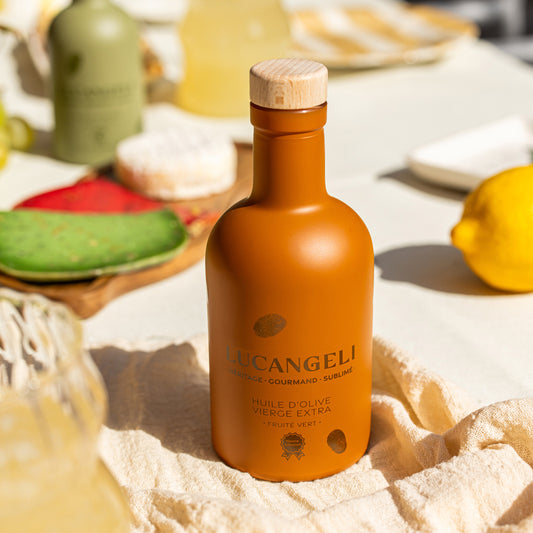
The bottle placed on the table is a communication tool. An identified bottle, with a named variety and precise origin, becomes part of the meal's narrative. For establishments wishing to go further, a personalized bottle with the establishment's colors is available from 24 bottles, with a design created by the establishment itself. This is a communication investment that pays off over a season.
For high-volume kitchens, the 5-liter organic olive oil drum remains the reference format for cooking and seasoning stations, while 200ml bottles are reserved for table service and plating finishing.
Organizing practical training
Training is not done in a single meeting. It is built over several weeks, with simple tools and regular sessions.
Internal tasting as a training tool
Internal tasting is the most effective and least expensive tool. It consists of gathering the front-of-house team around two or three oils, having them taste them blind, and asking them to describe what they perceive. The goal is not to train experts: it is to give each server a personal taste memory that they can spontaneously mobilize in the dining room.
The 200ml olive oil trio is designed for this type of session: three distinct profiles, three small bottles, rapid rotation. A twenty-minute session is enough to establish the differences between an intense green fruity, a mild mature fruity, and a flavored oil. Lucangeli also offers tailor-made support for establishments wishing to structure their training program via the dedicated space for catering professionals.
Correspondence between variety, dish, and front-of-house discourse
Here are the three profiles to remember for organizing your team's discourse:
- Coratina, green fruity: notes of raw artichoke, fresh grass, marked pungency. Recommended dishes: red meats, legumes, carpaccio, aged cheeses. Front-of-house discourse: a characterful oil, with vegetal notes and a pleasant warmth on the finish.
- Carolea, mature fruity: notes of apple, fresh almond, light pungency. Recommended dishes: fish, white vegetables, risotto, citrus desserts. Front-of-house discourse: a soft and round oil, with notes of apple and fresh almond.
- Bergamot, co-crushed: notes of fresh citrus, floral, lightness. Recommended dishes: raw fish, tartares, desserts, fresh cheeses. Front-of-house discourse: an oil infused by co-crushing with Calabrian bergamot, floral and light.
Frequency and follow-up
An initial training of two sessions, a tasting and a role-playing exercise in the dining room, is sufficient to lay the groundwork. Follow-up then occurs with each menu change, each new reference, and each new team member. A laminated, one-page memo, posted in the back office, detailing the variety-dish correspondence, is more effective than a lengthy document that no one re-reads.
For establishments wishing to structure their procurement and benefit from support in selecting references, the jeroboam of organic extra virgin olive oil is an intermediate format suitable for table service in high-volume establishments, with sufficient rotation to guarantee freshness at each service.
Frequently Asked Questions
How to quickly train a server to present olive oil in the dining room?
A twenty-minute internal tasting session, with two or three oils of distinct profiles, is sufficient to anchor the essential differences. Supplement this with a one-page memo in the back office, outlining the variety-dish-discourse correspondence. Training is then reinforced through daily practice during service.
Which olive oil to choose for table service in a gourmet restaurant?
Opt for two references: an intense green fruity oil, Coratina variety, with artichoke notes and marked pungency, for characterful dishes; and a mild mature fruity oil, Carolea variety, with apple and almond notes, for delicate dishes. 200ml bottles are the ideal format for table service: rapid rotation, quality preserved after opening.
How to justify the cost of a high-end olive oil to a guest?
Justification comes through discourse, not price. Naming the variety, citing the origin, describing the aromatic profile in a sentence: these three elements transform a bottle into an identified product. A guest who understands what they are tasting does not question the price; they perceive it as consistent with the experience offered.



 lucangeli.it