

Why the price of a premium extra virgin olive oil is always justified in food service
A quality extra virgin olive oil costs less than €0.30 per plate as a finishing touch — and yet it is often the first line item teams struggle to defend when guests ask about it. Here is how to turn that cost into a selling point, and your oil into a signature of the house.
The French restaurant market has been under pressure on food costs for two years now. The temptation to shift your olive oil selection towards the entry level is real. But that decision, which looks sensible on a spreadsheet, produces the opposite effect in the dining room: it erases a differentiator that is visible, tangible and memorable for your guests.
What the price per bottle actually covers
A bottle of quality Italian organic extra virgin olive oil generally sits between €12 and €22 per litre depending on the size, the variety and the estate. That price is not marketing positioning: it reflects concrete production constraints.
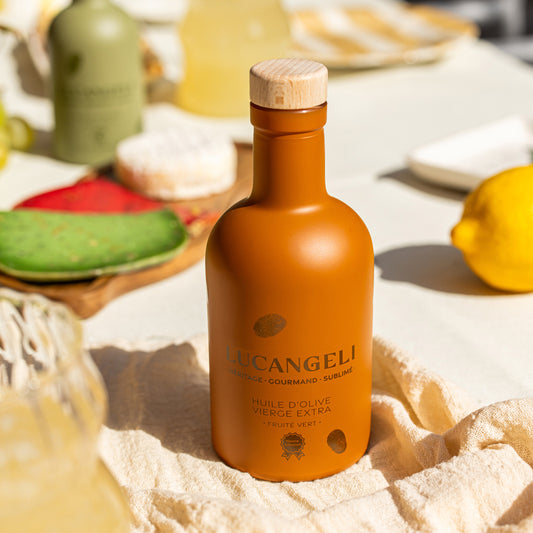
An organic olive oil in a 5-litre tin intended for the professional kitchen brings the cost down to far more manageable levels, without sacrificing quality. Conversely, a 200 ml bottle of fruité vert or fruité mûr set on the table plays a role in your identity that a tin simply cannot fill.
Here are the factors that explain the price of a premium extra virgin olive oil:
- Early harvesting: olives picked before full ripeness, by hand or with vibrating combs, produce oils with intense green fruitiness and high polyphenol levels — but the yield is two to three times lower than a late mechanical harvest.
- Time to milling: a quality oil is extracted within six to twelve hours of picking. That short window demands local logistics and a tightly constrained mill schedule.
- Cold extraction: keeping the temperature below 27 °C during malaxation preserves the volatile aromas, but reduces the oil yield by 15 to 20% compared with standard extraction.
- Packaging in dark glass: protection from light slows oxidation and extends the product's shelf life — an investment that also protects your stock in the storeroom.
These constraints are not advertising claims: they mechanically explain why an oil produced under these conditions cannot be sold at supermarket prices.
The real food cost per portion: what the numbers say
Before turning to how you present it in the dining room, put the numbers on the table. The calculation is simple and often surprising for teams who have never done the exercise.
Finishing a plate with organic fruité mûr olive oil never exceeds €0.35 per cover under sensible sourcing terms. So the question is not whether your establishment can afford a quality olive oil — it is whether your positioning can afford not to have one.
Dining room techniques for presenting and showcasing your olive oil

Having a good oil is not enough. The value of a premium product in food service is conveyed through the gesture, the words and the setting it belongs to.
The service gesture: how the bottle is presented
The bottle should not land silently on the table like an ordinary condiment. It is brought with the explanation that gives it meaning. Two sentences are enough:
> "Our oil is an organic extra virgin from southern Italy, cold pressed from Carolea olives at the start of the harvest. It goes particularly well with our fish and our seasonal vegetables."
That introduction takes ten seconds. It turns a product into an editorial statement from your house. It also opens a conversation, which is one of the most effective ways to strengthen the guest relationship during a meal.
To go further on training your teams in this presentation, the professionals section lets you look directly at sourcing terms and the tools available to you.
The right words to talk about it at the table
Your team does not need to master the vocabulary of oenology. Four words are enough to describe an extra virgin olive oil and pass it on to your guests:
- Fruity: the overall aromatic intensity, green (fresh grass, artichoke, almond) or ripe (slow-cooked tomato, butter, hazelnut).
- Bitter: the slightly bitter sensation on the palate, a sign of freshness and of polyphenols being well present.
- Pungent or peppery: the slight tickle at the back of the throat, characteristic of early-harvested oils. It is not a fault: it is a marker of quality.
- Origin: name the region and, if possible, the variety. Calabria, Sicily, Tuscany — one word is enough to root the product in a place.
These reference points let your servers answer the most common question — "Why does this oil cost more?" — without hesitating, without groping for words.
An olive oil list as an upselling tool
In establishments that have taken the plunge, an olive oil list — even limited to two or three references — generates guest engagement you can measure right away. It also justifies charging for a tasting or selling bottles to take home.
Two well-chosen references cover almost every use:
- An organic fruité vert olive oil for raw fish, steamed vegetables, tartares and light starters.
- A limited edition 1-litre fruité mûr olive oil for white meats, roasted vegetables, pasta and risottos.
Add a pressed oil such as the lemon — obtained by milling the fresh fruit together with the olives at the moment of extraction, rather than by adding flavouring — for fish and seafood, and you have a list that is coherent, defensible and profitable.
---
Choosing the right format for your establishment and your service flow
The question of format is often looked at purely through the lens of purchase price. That is a mistake: format also affects oxidation, stock rotation, the guest experience and the consistency of your image.
The 5 L tin in the kitchen, the bottle in the dining room
The golden rule is simple: whatever is cooked or marinated can come from a large economical format; whatever finishes the plate or arrives on the table should come from a recognisable bottle.
The 5-litre tin of organic olive oil is the kitchen format par excellence. It brings down the cost per portion, cuts packaging waste and makes restocking easier. Provided you store it properly — away from light and heat, ideally between 14 and 18 °C — and never leave an open tin for more than six weeks.
In the dining room, the individual 200 or 500 ml bottle remains the benchmark. It is visible, easy to handle, easy to read. It is changed regularly, which guarantees the freshness of what you serve.
The jeroboam: visual impact and a signal of difference

The jeroboam of organic extra virgin olive oil is a format of its own. Its 3-litre capacity and imposing silhouette make it a spectacular object on the table, particularly suited to large parties, festive meals and communal tables.
The impact on guests is immediate and documented by the restaurateurs who have adopted it: the bottle prompts questions, conversations, photos. It signs the experience without you having to say a word. It is the kind of detail that separates a memorable meal from a merely good one.
For bottle projects carrying your own house identity, the personalisation service lets you work on your own label from 24 bottles upwards — an option increasingly used by establishments that want to take consistency all the way.
---
Frequently asked questions
Can you really justify the price of a premium olive oil to guests without specialist training?
Yes. Two sentences are enough: the origin and the extraction method. "Organic extra virgin, cold pressed in Calabria from Carolea olives" — that is a complete pitch. It requires no oenological knowledge, only a clear instruction passed on at the service briefing.
At what kind of establishment does setting up an olive oil list become profitable?
As soon as an establishment regularly serves starters or dishes that lend themselves to it — fish, vegetables, bruschetta, lunch menus — a list of two or three oils is profitable. The investment is minimal (printing an insert in the menu or a table card) and the value perceived by the guest is consistently higher than the food cost involved.
How do you stop open bottles in the dining room from oxidising between services?
Rotation is the first answer: in the dining room, never serve a bottle that has been open for more than three weeks. Always reseal with an airtight drip-free pourer after each service, and store bottles away from light and heat between covers. For establishments with lower footfall, 200 ml sizes limit this risk by shortening the time it takes to finish a bottle.



 lucangeli.it