


Why olive oil is the most underestimated finishing tool in the kitchen
A drizzle of olive oil poured at the right moment over a hot dish can make the difference between a decent plate and one that truly tempts. This finishing touch, systematically used by chefs, can be learned in just a few minutes and immediately elevates the result on the plate.
Most home cooks use olive oil only for cooking: in the pan, in marinades, in vinaigrettes. This is a methodological error. When cooked, heat transforms many of the oil's aromas, erasing a large part of them. When used as a finish, poured raw over a warm or hot dish just before serving, the oil expresses all its aromas, color, and texture. This is where it becomes irreplaceable. To explore the different profiles available, the trio of small bottles is a practical way to test several oils on the same dishes.
What olive oil does for a dish
Finishing olive oil fulfills three simultaneous functions. It adds shine: a dull surface becomes luminous, roasted vegetables look like they just came out of the oven, and a soup instantly gains visual depth. It adds texture: the drizzle creates a contrast between the richness of the oil and the dry or crunchy elements of the dish. It adds flavor: the oil's aromas, intact because they are not heated, complement the dish's taste profile without overpowering it.
These three effects are cumulative. A dish finished with olive oil is visually more appetizing, texturally more interesting, and gastronomically more complex than a dish without a finishing touch. This is why professional kitchens never serve a dish without this final gesture. For establishments looking to structure this service, the professionals' section offers formats adapted for the restaurant industry.
The timing rule: never during cooking, always at the end
The timing of pouring is the most important rule. Finishing oil is poured after cooking, on the plated dish, just before serving it to the guest. It is not poured into the pan, not into the cooking water, not onto the dish while it rests to stay warm.
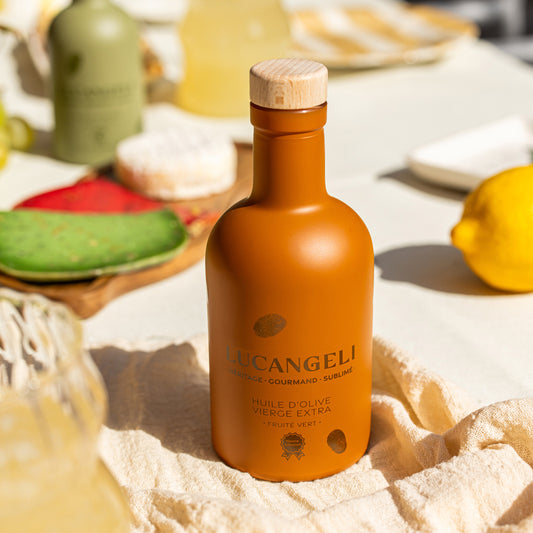
If you pour the oil too early, it will be absorbed by the food and visually disappear. If you pour it on a cold dish, it will congeal slightly and lose its fluidity. The ideal window is when the dish is warm or hot, plated, and ready to be served. Ten seconds are enough. For regular home use, a green fruity oil in a 200 ml format is the most practical: it's easy to hold and allows for precise pouring.
Which oil to choose based on the dish

Not all olive oils produce the same effect as a finish. The choice depends on the dish, its temperature, and the desired taste profile.
Green fruity oils: for dishes that need character
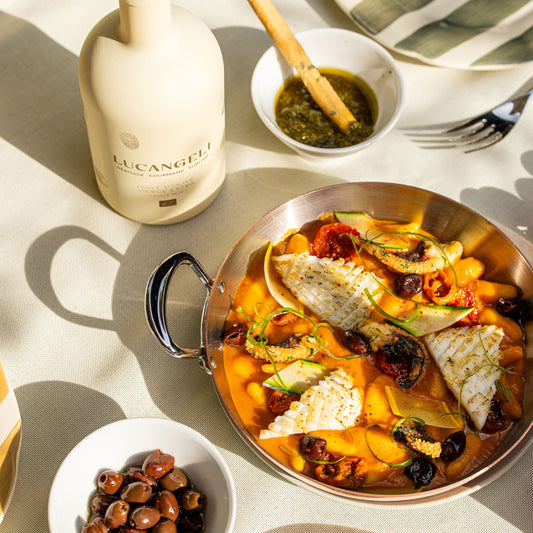
A green fruity oil is the natural finish for dishes that can handle bitterness and pungency: grilled vegetables, white fish, vegetable soups, carpaccios, garlic pasta. Its intense profile holds its own against strong flavors.
The Carolea variety, cultivated in the province of Cosenza in Calabria, is particularly suited for this role. It produces an intense green fruity oil with a pronounced pungency at the finish. This pungency arrives after tasting and extends the culinary experience: the dish continues to linger for a few seconds after the last bite. It is precisely for this effect that Calabrian cooks systematically use it as a finish on hot dishes, never for cooking.
Mature fruity oils: for sweet dishes and desserts
A mature fruity oil is suitable for dishes with mild or sweet flavors: risotto, mashed potatoes, scrambled eggs, fresh cheeses, roasted figs, panna cotta. Its round and less bitter profile does not create a harsh contrast with delicate flavors.
It's also the finishing oil for olive oil desserts, a common practice in Italian pastry: a drizzle over vanilla ice cream, yogurt cake, or sugared strawberries. The result always surprises those who haven't tried it. For sweet and savory pairings, bergamot olive oil, awarded at the Épicures d'Argent 2023, opens up unexpected possibilities with citrus desserts and fish.
Flavored oils: to create a precise pairing
Flavored oils allow for creating a pairing between the finish and the aromas of the dish. Orange and lemon oil pairs well with poultry, roasted carrots, and cakes. Garlic and chili oil is the finish for pizzas, pasta, grilled vegetables, and red meats.
Here are the basic pairings to remember:
- Grilled vegetables: intense green fruity, poured just out of the oven.
- Steamed white fish: green fruity or bergamot, on the plated dish.
- Risotto: mature fruity, at the very end of mantecatura.
- Vegetable soup: green fruity, in the bowl before serving.
- Garlic pasta: garlic and chili, on hot pasta on the plate.
- Fruit-based dessert: mature fruity or orange-lemon, on the cold or warm dessert.
- Pizza: garlic and chili or green fruity, out of the oven.
Technical gestures: dosing, pouring, presenting
Dosing: less than you think
The amount of oil for finishing is always less than one imagines. For an individual plate, five to ten milliliters are sufficient, which is one to two teaspoons. The goal is not to drown the dish but to sign it. Too much oil creates a puddle on the plate, masks other elements, and visually weighs down the presentation.
The practical rule: pour in motion, never staying in one spot. A circular or zigzag motion distributes the oil evenly and creates a more interesting visual effect than a central blob. For dishes where precision matters, a pouring spout helps control the flow and prevent drips on the edge of the plate.
Pouring height
The height at which you pour the oil changes the result. Poured from high (20 to 30 centimeters above the plate), the oil disperses into fine droplets and creates a light rain effect, ideal for salads and carpaccios. Poured from close (5 to 10 centimeters), it forms a continuous, shiny stream, ideal for soups, risottos, and purées.
Here are the four basic gestures to master:
- Continuous stream: bottle held at 5 cm, slow and steady motion, for soups and purees.
- Light rain: bottle held at 25 cm, quick motion, for salads and carpaccios.
- Circle: circular motion around the dish, for risottos and pasta.
- Central dot: a single thick drop in the center, for desserts and cheeses.
Personalizing presentation for an event
For a family meal, a dinner with friends, or an event, a personalized olive oil bottle placed on the table becomes both a conversation piece and a serving tool. The design is created directly online by the customer, for orders of 24 bottles or more. For a professional project or a larger volume, the customization page allows for building a tailor-made order. For individuals wishing to offer a tasting set, the trio of 200 ml oils brings together the three essential profiles in one box.
Frequently Asked Questions
Which olive oil should be used to finish a hot dish?
For a hot dish, choose a green fruity oil with pungency: it stands up better to powerful aromas and extends the tasting experience after consumption. For mild dishes or desserts, a mature fruity oil is more suitable. Flavored oils (bergamot, orange-lemon, garlic-chili) allow for creating a precise pairing between the finish and the flavors of the dish.
Can olive oil be used as a finish on a dessert?
Yes, and it is a common practice in Italian pastry. A drizzle of mature fruity oil over vanilla ice cream, sugared strawberries, or a yogurt cake adds shine, texture, and a vegetal note that contrasts pleasantly with the sweetness. Orange and lemon oil works particularly well on citrus desserts.
How much olive oil is needed to finish a plate?
Between five and ten milliliters per individual plate, or one to two teaspoons. The goal is to sign the dish, not to drown it. Too much oil creates a puddle on the plate and masks other elements. Pour in motion, in a circular or zigzag gesture, to distribute evenly without concentrating the oil in one spot. For establishments wishing to train their teams in this technique, the professionals' section offers dedicated support.




 lucangeli.it