

You come across a bottle of olive oil labeled "DOP" or "IGP" and wonder if it really makes a difference in your glass. The answer is yes—but not for the reasons most often cited. These two acronyms designate official designations regulated by European law, which impose precise constraints on the origin of the olives, authorized varieties, production methods, and pre-bottling inspections. This guide explains what they actually guarantee, what they don't cover, and how to read them on a label without getting lost.
DOP and IGP: two levels of protection, the same logic of origin

The acronyms DOP (Denominazione di Origine Protetta) and IGP (Indicazione Geografica Protetta) are the Italian equivalents of the European labels PDO and PGI that you may know from French wines or cheeses. They are based on a common principle: linking a product to a specific territory and identifiable expertise, then submitting this link to independent verification.
The DOP: when everything happens in the same area
A DOP-designated olive oil owes its character to a precisely defined geographical area. The olives are grown in that area, harvested in that area, pressed in that area, and packaged in that area. Each step is governed by an approved set of specifications: authorized olive varieties, minimum or maximum altitude of the orchards, start and end dates of the harvest, maximum time between harvesting and pressing, maximum authorized free acidity levels, and the expected organoleptic profile.
Certification involves two types of checks: a chemical analysis in a laboratory and an organoleptic panel test conducted by certified tasters. Without both, the oil cannot bear the label. It is a guarantee of consistency between what is announced on the label and what is in the bottle.
Italy has around forty DOP designations for olive oil, including Bruzio DOP and Lametia DOP in Calabria, or the Riviera Ligure DOP, each with a distinct taste profile derived directly from local varieties and the terroir.
The IGP: when origin counts but processing can travel
The IGP requires that at least one significant step of production take place within the indicated geographical area. For olive oil, this is generally the cultivation of the olives or their processing. The specifications are also restrictive, but the area can be larger and the requirements slightly less stringent than for a DOP.

The Olio di Calabria IGP, for example, regulates oil production across the entire Calabria region and requires that the olives be pressed within 24 to 48 hours of harvest—a constraint that directly protects the freshness and quality of the new oil. The authorized varieties (Carolea, Roggianella, Tondina, among others) are listed in the specifications, and the oil must pass the same double chemical and organoleptic check as a DOP.
What these labels do not guarantee
A DOP or IGP designation certifies the origin, varieties, and methods. It does not automatically certify that the oil is organic, nor that it was produced using sustainable farming. These are two independent processes. An oil can be DOP and not organic, or organic without a geographical designation. Both mentions can coexist on the same label, which is often a sign of combined high standards.
A designation also does not guarantee that the oil is recent. The harvest date or vintage remains the most useful information for assessing freshness, regardless of the geographical label.
How to read an olive oil label with a designation: a user's guide
A bottle bearing a DOP or IGP designation generally displays several pieces of regulatory information. Knowing how to read them allows you to compare bottles on an equal footing.
Information the designation requires on the label
When an oil is DOP or IGP certified, you will always find:
- The name of the designation in full (Olio di Calabria IGP, Bruzio DOP, etc.).
- The corresponding European logo: a small round red and yellow sticker for DOP, green and yellow for IGP.
- The certificate number issued by the approved inspection body, sometimes printed in small print on the back label.
- The name of the certifying body, which is independent of the producer.
These four elements work together. If one is missing, the mention of the designation on the bottle has no regulatory value.
Mentions that often accompany a designation
On a quality bottle, you frequently encounter other useful mentions alongside the designation:
- The harvest date or vintage, which indicates the year of production.
- The variety or varieties of olives used, sometimes named explicitly.
- The extraction method, estratto a freddo (cold extraction) or prima spremitura a freddo (first cold pressing), meaning that the temperature did not exceed 27°C during pressing—a necessary condition for preserving aromas.
- The free acidity level, which must be less than 0.8% for an oil to be classified as extra virgin, and which is often much lower for designated oils.
These mentions do not replace the designation, but they complement it. An oil that combines a DOP or IGP, a recent vintage, and an displayed acidity level offers a level of transparency rarely reached by an oil without certification.
How to compare two bottles with and without a designation
An oil without a designation can be excellent. Geographical designations cover only a portion of Italian production, and some producers choose not to certify their oils for economic or logistical reasons—the certification process is expensive and time-consuming.
To compare two bottles fairly, look in this order:
- The harvest date—an oil without a designation but harvested in October 2026 will often be better than a 2024 DOP stored in poor conditions.
- The precise place of origin—a generic "product of Italy" mention without further detail is less informative than a region or producer name.
- The extraction method—cold extraction is a minimum for a quality oil.
- The designation, which additionally guarantees the consistency between the displayed terroir and the actual contents.
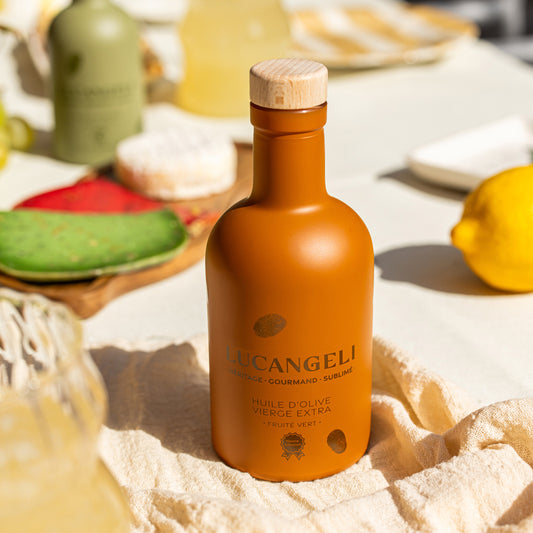
To explore certified organic oils with a precise aromatic profile, the 500ml discovery duo makes it easy to compare a green fruity and a ripe fruity oil from the same Calabrian origin. The new trio olive oil discovery set in a terracotta box offers a third option to complete your tasting.
Designations and harvest: a link few guides explain
Specifications also regulate picking and pressing
This is one of the least known aspects of olive oil designations. The specifications of a DOP or IGP do not just delineate an area on a map: they also regulate the timing and method of the harvest. For some Calabrian designations, the authorized harvest window is precisely defined, and the time between picking and pressing is capped—often at 24 or 48 hours for IGPs—which prohibits practices that degrade quality, such as storing olives in piles for several days before pressing.
This constraint has a direct consequence on the taste profile: an oil pressed within hours of harvest retains its fresh vegetal aromas, bitterness, and pungency characteristic of green fruitiness. It is partly for this reason that designated oils tend to be more intense and complex than generic oils produced without time constraints.
In October, at the height of the harvest, this constraint is particularly visible: certified mills work continuously and deadlines are met precisely. Both the organic green fruity olive oil and the organic ripe fruity olive oil are the result of this care taken from the moment of harvest.
The vintage and the designation: two complementary guarantees
The vintage indicates the year of harvest. The designation guarantees that this harvest complied with precise rules throughout the entire chain, from the olive grove to the mill. Both pieces of information are complementary and independent.
For restaurateurs and fine grocers wishing to work with certified oils, formats adapted to professional volumes are available via the professionals page, where supply terms can be discussed directly.
Frequently asked questions
What is the difference between DOP and IGP for olive oil?
The DOP (Protected Designation of Origin) requires that all production steps—cultivation, harvesting, pressing, packaging—take place within the defined geographical area. The IGP (Protected Geographical Indication) requires that at least one significant step take place in the area, which may allow for a slightly larger area. In both cases, the product undergoes a double chemical and organoleptic check before marketing.
Is a DOP olive oil necessarily better than an unlabeled oil?
Not automatically. The designation guarantees the authenticity of the origin and compliance with specifications, but an oil without a designation produced by a rigorous artisan, harvested at the right maturity, and pressed quickly can be just as good, if not better. The designation is a guarantee of consistency, not an absolute judgment of quality. The harvest date and extraction method remain the most reliable indicators.
How can I verify that a DOP or IGP designation on a bottle is authentic?
The presence of the official European logo (round red and yellow sticker for DOP, green and yellow for IGP) and the certificate number of the approved inspection body are the two elements to check. This information is generally printed on the back label. In the absence of these mentions, the reference to a designation on the main label has no regulatory value.



 lucangeli.it