

A corporate gala dinner is as much about what's on the plate as what's on the table. The table setting sends an immediate signal to your guests: it speaks to the establishment's standards, the consistency of its offering, and its attention to detail. Here's how to plan it methodically.
The fundamentals of a successful gala table setting

Tablecloth, linens, and colors
Table linens are the first element guests notice when sitting down. For a gala dinner, opt for a damask cotton or heavy linen tablecloth in neutral tones: off-white, ecru, pearl gray, or terracotta, depending on the event's visual identity. Avoid synthetic tablecloths, which reflect light unflatteringly and can cause cutlery to slide.
A table runner can add a touch of color or texture without overwhelming the overall look. In a Mediterranean context, ochre, olive green, and midnight blue tones work well with white or ivory tableware. Use a table pad to muffle service noises and protect the table.
Cutlery and tableware arrangement
The basic rule: cutlery is arranged in reverse order of service, from the outermost to the closest to the plate. For a four-course meal, place two forks on the left, two knives on the right, and a soup spoon at the top right. The dessert fork and dessert spoon are placed horizontally above the show plate.
The show plate is placed in the center, two centimeters from the edge of the table. It will not be used for serving; its role is aesthetic and structural. Choose a plate 30 to 32 cm in diameter, preferably plain, so as not to visually compete with the dishes.
For glasses, the classic triangular arrangement places the water glass at the top left, the red wine glass in the center, and the white wine glass to the right. For a gala with food and wine pairing, add a champagne flute in a higher position.
Lighting and centerpieces
Lighting is often overlooked in gala planning, yet it dictates the entire evening's ambiance. Favor warm light (2,700 to 3,000 kelvins) and avoid harsh overhead spotlights that create strong shadows on faces. Low table candles bring a warmth that artificial lighting cannot replicate.
Centerpieces should remain below seated eye level, i.e., less than 30 cm in height, to avoid obstructing conversation. Fresh seasonal flowers, olive branches, small fruits, or simple floral arrangements: the key is not to overload the table.
Integrating condiments into the table setting
Olive oil on the table: format and presentation
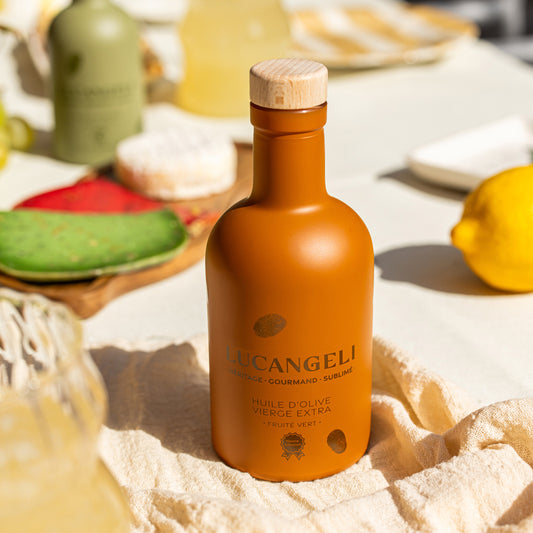
Placing a mild fruity organic olive oil on a gala dinner table transforms a condiment into a service highlight. The 200 ml format is suitable for a table of 4 to 6 place settings. For tables of 8 to 10 people, the 3-liter jeroboam3-liter jeroboam is a generous and visually striking option: a single bottle is enough to serve about 20 finishing portions with a spoon, or 5 to 6 tables of 20 people.
The Carolea variety, cultivated in Calabria, produces a mild fruity oil with notes of fresh almond and artichoke. Its aromatic profile does not overpower dishes, making it particularly suitable for banquet table service, where the oil accompanies without dominating.
Balsamic vinegar and spreads
An IGP Modena Gold Collection balsamic vinegar placed next to the olive oil completes the table setting without cluttering it. These two condiments form a coherent duo, visually and gastronomically, signaling an attention to product quality.
For a welcome service or an amuse-bouche on the table, a black olive tapenade or an assortment of spreads placed in small bowls on the table helps occupy the waiting time between guests' arrival and the first course. It's a simple welcoming gesture that avoids visual emptiness and immediately creates an atmosphere of generosity.
The personalized bottle as a centerpiece
For a corporate gala dinner, a personalized olive oil bottle featuring the company's colors is one of the most distinctive elements of the table setting. It effectively replaces printed place cards and can be offered to guests at the end of the evening, extending the experience beyond the meal.
Personalization is available starting from 24 bottles, with a production lead time of 10 to 15 business days. For a gala project, it is advisable to contact the commercial service dedicated to professionals at least three weeks before the event. Companies wishing to create their own design can use the online configurator.
Organizing banquet service
Team briefing
A successful gala dinner relies on a precise briefing of the service team, conducted at least two hours before doors open. This briefing should cover five essential points.
- The seating plan and any dietary restrictions per guest.
- The order and timing of services.
- The service protocol for condiments: olive oil, vinegar, salt.
- Table products: their origin, profile, and words to present them.
- Management of personalized bottles: when to place them, how to present them, if they are offered at the end of the evening.
Training the team to present olive oil in two sentences, including its origin and aromatic profile, transforms a service gesture into a conversational moment. It's a simple skill to acquire that immediately elevates the establishment's standard. The professional space offers support on this point.
Condiment formats by type of service
For a seated banquet of 100 covers, plan for one 200 ml bottle of olive oil per table of 4 to 6 people, one bottle of balsamic vinegar per table, and small bowls of spreads upon arrival. Personalized bottles are optional but recommended for prestigious events.
For a cocktail reception, individual olive oil bowls and small verrines of spreads are more suitable than a bottle placed on the table. For a gastronomic gala dinner, the jeroboam or personalized bottle are essential centerpieces, accompanied by a bottle of balsamic vinegar and an amuse-bouche on a plate.
For the kitchen, the 5-liter canister is suitable for large volumes. It allows working with quality oil without opening multiple bottles, and reserving presentation formats for the dining room.
Stock and rotation management
For a gala service, an open 200 ml bottle of olive oil should not remain in service for more than two weeks. For a one-off event, this is not an issue. However, if your establishment regularly organizes galas, plan for stock rotation and store bottles away from light and heat, ideally between 14 and 18 °C.
For all professional orders, the dedicated space for establishments centralizes information on formats, minimum order quantities, and lead times. A customizable gift box can also be offered to guests at the end of the evening, in addition to personalized bottles.
Frequently asked questions
How to choose the olive oil format for a gala dinner of 100 people?
For 100 covers distributed across tables of 8 to 10 people, plan for one 200 ml bottle per table, which is approximately 10 to 12 bottles. If you opt for a 3-liter jeroboam, one bottle is sufficient for 5 to 6 tables. The format also depends on the desired visual effect: the individual bottle per table is more practical, the jeroboam is more spectacular.
Can personalized olive oil bottles be ordered for a corporate event?
Yes. Personalization is available starting from 24 bottles, with a production lead time of 10 to 15 business days. It is advisable to place your order at least three weeks before the event to allow for delivery times. For a large volume or a custom project, contact the sales department via the dedicated page for professionals.
Which olive oil to choose for banquet table service?
Opt for a mild fruity oil, whose aromatic profile is gentle and does not overpower the dishes. An oil from the Carolea variety from Calabria, with its notes of fresh almond and artichoke, is particularly suitable for this context. Avoid intense green fruity oils, whose bitterness and pungency might surprise uninitiated guests.




 lucangeli.it