

Why is nonna's cooking so difficult to replicate?
You only have to have tasted a dish prepared by an Italian grandmother once to understand that something essential is hidden within it. It's not a matter of a recipe written in a notebook, nor even of rare ingredients. It's an alchemy between time, technique, and the quality of the chosen products. Nonna's cooking is based on a fundamental principle: nothing is left to chance, and everything is done with care.
In Italy, culinary transmission happens from generation to generation, often without precise measurements or timers. Nonna knows when the sauce is ready by its smell, when the dough is kneaded correctly by touch. This intuitive savoir-faire is the fruit of decades of practice. But it also rests on an indispensable foundation: quality ingredients, starting with a good organic green fruity olive oil, whose herbaceous and fresh taste is the signature of southern Italian cuisine.
The central role of olive oil in traditional Italian cooking
In any authentic Italian cuisine, olive oil is not just a fatty substance: it's a condiment in its own right. It perfumes, it binds, it reveals. Nonnas from southern Italy, particularly in Calabria, use it at every stage of preparation: to sauté vegetables, to finish a pasta dish, to drizzle over warm bruschetta. The quality of the oil makes all the difference between an ordinary dish and a memorable one.
Depending on the season and the dish, one might choose an organic ripe fruity olive oil with sweet and round notes for slow-cooked dishes, or a more lively and herbaceous oil for raw vegetables and salads. Nonna makes this choice instinctively—and that's precisely what we can learn to replicate at home.

Condiments and spreads: the soul of antipasto
Even before the main course, grandma's Italian cooking begins with antipasto. On the table, a few small jars, toasted bread slices, olives, marinated vegetables. It's simple, generous, and deeply rooted in the culture of sharing. Sun-dried tomato tapenade is one of these essentials: concentrated in flavor, it immediately evokes the sun of the Mezzogiorno.
Alongside it, black olive tapenade brings a characteristic umami depth to Calabrian tables. And for basil lovers, DOP basil pesto—made from basil with a protected designation of origin—reminds us that Italian cooking is also a matter of labels and territories.

Key ingredients to recreate Italian grandma's cooking at home
Reproducing nonna's cooking doesn't require complex techniques. What's needed is an understanding of which ingredients are truly essential, and not to overlook them. Traditional Italian cooking is product-driven: the fewer ingredients there are, the more impeccable each one must be.
Olives and balsamic vinegar: two pillars of the Italian table
Pitted black olives in olive oil are present on all Italian tables, from aperitifs to meals. They slip into salads, pasta, pizzas, or are simply enjoyed by hand. Their taste depends directly on the quality of the oil in which they are preserved.
Modena's PGI balsamic vinegar is another treasure of Italian gastronomy. A few drops are enough to transform a salad, a risotto, or even a strawberry into dessert. Nonna uses it sparingly, but always wisely. It's an ingredient that demands respect—and returns it a hundredfold.
Spreads: Italian sweetness for breakfast
Italian grandma's cooking isn't limited to savory dishes. In the morning, nonna prepares generous toast with whatever she has on hand: a creamy almond spread, or a hazelnut cocoa spread with Piedmont hazelnuts, a region renowned for the quality of its nuts.
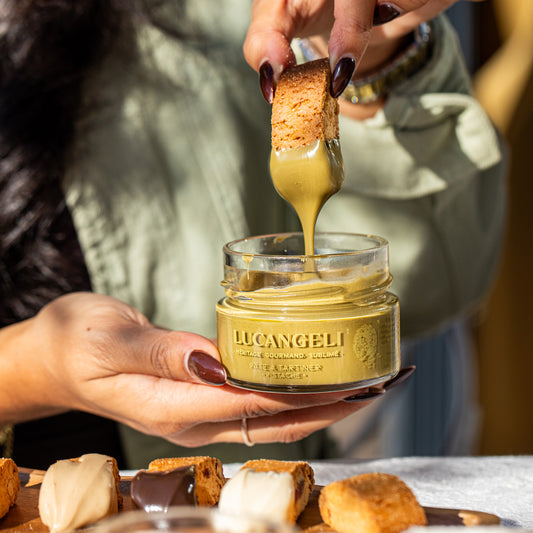
For the more curious, pistachio spread—palm oil-free—offers a gourmet and refined alternative, typical of Sicilian and Calabrian traditions. These morning delights are also a way to transmit a taste, a texture, a memory.
Honoring nonna: ideas to celebrate Grandmothers' Day the Italian way
Grandmothers' Day is the ideal occasion to pay tribute to these women who have shaped our tastes and memories. In Italy, nonna isn't just celebrated with flowers—she's treated to food, cooked with, and shared a table with.
A gourmet gift box as a culinary declaration of love
Giving a customizable gift box filled with authentic Italian products is like offering a journey. It's telling your grandmother: I know your tastes, I respect what you've passed down to me. A box with olive oil, balsamic vinegar, a few spreads—that's a gift that speaks of terroir, family, and sharing.
Bergamot: the surprising Calabrian touch
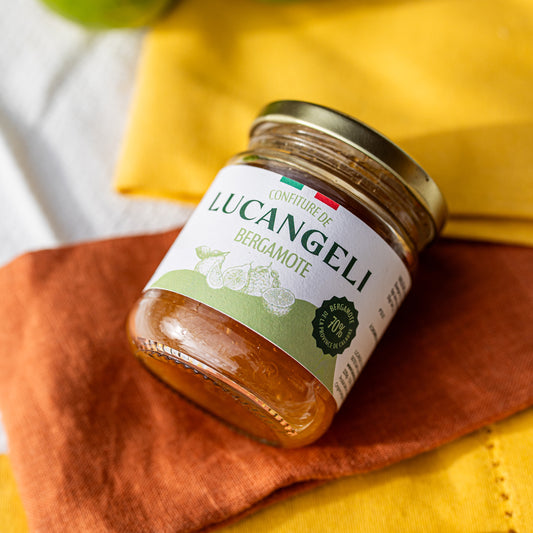
Among Calabria's most unique specialties, bergamot holds a special place. This rare citrus fruit, grown almost exclusively on the Ionian coast, flavors both desserts and savory dishes. Bergamot jam is a delicate way to introduce it to the breakfast or snack table.
For the more adventurous, bergamot spread—awarded at the Épicures d'Or 2024—is an invitation to discover a flavor that few people still know. The Calabrian nonna, however, has always known: bergamot is the soul of Calabria.
Nonna's cooking is not an inaccessible myth. It's a daily philosophy: choosing good products, taking the time to cook, sharing with loved ones. By using authentic ingredients from Italian soil, everyone can rediscover—or transmit—that unique taste that makes Italian cuisine one of the most beloved in the world.





 lucangeli.it