

Building an olive oil menu in a restaurant first involves choosing two or three coherent references, assigning them to specific roles, and training the team to present them. This practical guide details each step, from choosing profiles to supply logistics.
The two or three references that structure an olive oil menu
An effective olive oil menu is not built around a single versatile bottle. It distinguishes uses: finishing raw, everyday cooking, and possibly a flavored oil for establishments wishing to offer an original pairing. Three references are enough to cover all the needs of a professional kitchen.
The three roles to cover:
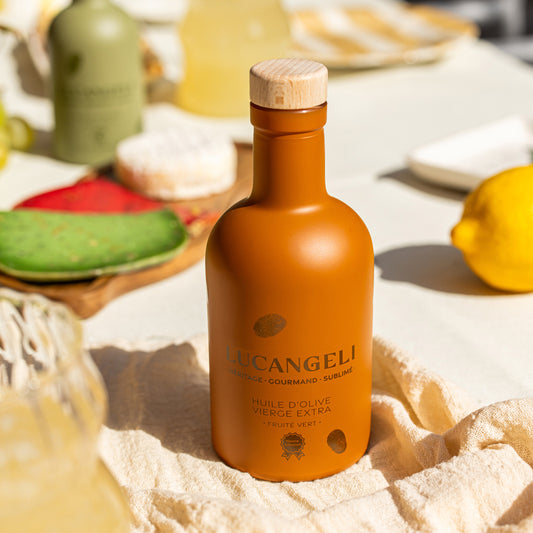
- Raw finishing — green fruity or ripe fruity profile, extra virgin — bottle format 200 ml to 1 L — indicative portion cost: €0.05 to €0.12 per plate.
- Everyday cooking — mild extra virgin or virgin profile — 5 L container format — indicative portion cost: €0.03 to €0.08 per serving.
- Flavored finishing — oil infused by co-crushing — 200 ml bottle format — indicative portion cost: €0.08 to €0.15 per plate.
Finishing oil: the choice that shows on the plate
The finishing oil is what the customer perceives directly: a drizzle on burrata, a few drops on carpaccio, a vinaigrette made à la minute. This is where the organoleptic profile matters most, and it's also the area where upgrading costs the least per cover — a few cents per plate.
For this role, an extra virgin olive oil with a green fruity profile offers a frank attack, a clean bitterness, and a pungency on the finish: it's ideal for grilled vegetables, seasonal salads, and red meats. A ripe fruity oil, rounder and less aggressive, is better suited for white fish, fresh cheeses, and savory desserts.
A differentiation element rarely exploited by French buyers: the Carolea variety, cultivated in Calabria, precisely yields this sweet ripe fruity profile, with moderate pungency that doesn't mask delicate flavors. It's an almost unknown variety on the French market, making it an authentic menu argument for a chef who wants to move beyond usual references.
Cooking oil: focus on ingredient cost, not prestige
In everyday cooking — pan, griddle, oven, stews — the subtle aromas of a premium oil largely disappear under the effect of heat. Dedicating a high-end reference to it makes no economic sense. The right compromise is to use a classic profile extra virgin, purchased in large format to reduce the cost per liter.
The 5-liter container is the standard format for this role: easy to handle, quick rotation, and significantly less expensive per liter than a bottle. The storage rule is simple: store away from the stove and fryer, re-seal after each use, practice first-in, first-out rotation.
Flavored oil: a third option for establishments that want to stand out
A flavored finishing oil sends a strong signal to the customer: it says that the kitchen treats its condiments with as much care as its main products. Two families coexist, and the distinction is important for the front-of-house team to master.
An infused oil is obtained by co-crushing the aromatic fruit with the olives at the time of milling: bergamot, basil, or lemon are pressed with the olives, and their aromas integrate into the oil permanently. A flavored oil is obtained by adding natural or artificial flavor after extraction: the result is less complex and less stable over time.
Bergamot olive oil, obtained by co-crushing and recognized at the Épicures d'Argent 2023, illustrates what this option can bring to a raw fish dish or a citrus-based dessert. Organic garlic and chili olive oil, on the other hand, is suitable for antipasti, pizzas, and bold dishes.
Table service: how to present and highlight olive oil

The quality of an oil is only perceived if it is well presented. Careful table service transforms a condiment into an experience and justifies to the customer the upscale move made in the kitchen.
The bottle on the table: labeled, sealed, identified
Several European countries — Italy, Spain, Portugal — have for several years required that olive oil bottles served at the table be labeled and equipped with a non-refillable tamper-evident cap. France does not currently have an equivalent obligation, but a sealed bottle with your brand remains the most professional choice: it guarantees traceability, prevents any substitution, and serves as a discreet but effective communication tool.
For establishments wishing to go further, a personalized bottle with your name or logo is possible from 24 units, with a design created using a configurator. It's a modest investment for a visible impact on the table.
Team training: three questions customers ask and the answers to have
A server who cannot answer a question about the oil they just placed on the table sends a negative signal. Three questions consistently come up:
- "What oil is this?" — Expected answer: the origin (region, appellation if possible), the variety if mentioned, and the profile in one sentence ("green fruity, slightly bitter and peppery" or "ripe fruity, mild, almond notes").
- "Is it organic?" — If yes, state it clearly. If no, explain why quality is otherwise guaranteed (DOP or IGP appellation, cold extraction, recent vintage).
- "Can we have more?" — Have a prepared answer: either a second bottle is available, or direct them to the supplier's shop or website.
A twenty-minute training session is sufficient to cover these three points. It can be based on a product sheet provided by the supplier or on an internal tasting organized at the beginning of the season.
Choosing your Italian olive oil supplier: the criteria that matter
The professional olive oil market is vast, and offers are heterogeneous. A few criteria allow you to distinguish a serious supplier from a simple reseller.
Origin, variety, vintage: what a serious product sheet should indicate
A professional product sheet must at least mention: the country and region of origin, the olive variety (or blend), the harvest date or vintage, the extraction method (cold, centrifugation), and free acidity. The absence of this information is a warning sign.
Italian appellations — Olio di Calabria IGP, Bruzio DOP, Lametia DOP for Calabria — guarantee a controlled origin and production specifications. They constitute a credible menu argument for an informed clientele. Lucangeli's range dedicated to professionals is entirely from Calabria, with traceability to the olive grove.
Formats and logistics: 5 L container, Jeroboam, personalized bottle
Three formats cover most of an establishment's needs:
- The 5-liter container for the kitchen: optimized cost per liter, fast rotation, easy storage.
- The Jeroboam for the dining room or events: it has the visual impact of a large wine bottle and can be presented on the table or at a buffet. The Jeroboam of organic extra virgin olive oil is a limited edition that works well as a centerpiece for a tasting service.
- The 1-liter bottle for high-volume finishing stations: more economical than 200 ml, more manageable than the container. The 1 L ripe fruity limited edition is suitable for this role.
For customization projects or bulk orders, the dedicated commercial service for hospitality professionals handles pricing and delivery times.
Frequently Asked Questions
How many olive oil references should a restaurant have? Two references are sufficient in most establishments: a characterful extra virgin for raw finishing, and a classic extra virgin in a large format for cooking. A third flavored reference is relevant for restaurants that want to offer an original pairing or a tasting service.
Which olive oil to choose for finishing in a gourmet restaurant? For finishing, prefer a monovarietal extra virgin with a clearly defined profile — green fruity for bold dishes, ripe fruity for delicate preparations. The Carolea variety from Calabria, little known in France, offers a mild ripe fruitiness and moderate pungency particularly suited to fish and fresh cheeses.
Can olive oil from a container be served directly at the table? No. At the table, oil must be presented in a labeled bottle, ideally sealed. Several European countries legally require this; in France, it is a good professional practice that guarantees traceability and strengthens customer trust.




 lucangeli.it