

Why offer an olive oil menu in your restaurant?
Offering an olive oil menu in your restaurant transforms a table condiment into a service highlight. A few well-chosen selections, presented thoughtfully, are enough to distinguish your establishment and justify a high-end positioning to your customers.
The wine list is now a standard in gastronomic restaurants. The olive oil menu, however, remains largely uncharted territory: few establishments offer one, and even fewer present it with the same rigor as a wine selection. This is precisely where the opportunity lies. A restaurateur who can explain the difference between a green fruit olive oil and a ripe fruit olive oil has a selling point that their competitors do not.
What the olive oil menu brings to your service
A well-designed olive oil menu fulfills three distinct functions:
- It enhances your product selection and justifies its cost to the customer.
- It provides your front-of-house team with a concrete sales tool, rooted in product knowledge.
- It creates a moment of exchange with the customer, comparable to presenting a wine or cheese.
In establishments that have adopted it, the olive oil menu consistently generates questions from customers. Questions are the first sign of buying interest. To further implement an olive oil service in your dining room, the professionals' section details the formats and conditions suitable for hospitality establishments.
The right time to introduce the olive oil menu
September is the ideal time to refresh your menu and introduce new service rituals. Customers return from vacation with taste memories, often Italian or Mediterranean, and are receptive to new offerings. It's also when teams are fully staffed and available for short training sessions.
How to select the oils for your menu

The number of selections: not too many, not too few
An effective olive oil menu does not require an exhaustive collection. Three to five selections are enough to cover the main uses and offer genuine choice without overwhelming the service. Beyond five selections, the presentation becomes complex, and the risk of opened bottles oxidizing increases.
Here is a basic structure that works in most establishments:
- Organic green fruit oil: fresh grass, artichoke, distinct bitterness, pronounced pungency. Recommended use: raw fish, carpaccio, grilled vegetables, bread at the start of the meal.
- Organic ripe fruit oil: ripe tomato, almond, sweetness, slight pungency. Recommended use: white meats, pasta, cheeses, desserts.
- Bergamot-flavored oil: fresh citrus, floral, delicate. Recommended use: fish, seafood, desserts, fresh cheese pairing.
- Garlic and chili-flavored oil: warmth, character, spicy. Recommended use: pizzas, grilled dishes, antipasti, southern dishes.
- Large format finishing oil: profile according to the specific blend. Recommended use: plating in the kitchen, finishing at the table.
For establishments wishing to offer a bergamot-flavored olive oil or an organic garlic and chili oil, these two selections cover very different uses and naturally complement each other on a menu.
Choose by variety and origin
The precision regarding the olive variety is what distinguishes an olive oil menu from a simple product list. The Carolea variety, cultivated in Calabria, yields an oil with a pronounced ripe fruitiness, with notes of ripe tomato and fresh almond, moderate bitterness, and slight pungency. It stands out clearly from the Coratina from Puglia, which is more intense and bitter, often used in blends for finishing oils in gastronomy. Mentioning the variety on your menu, even in one line, provides information that your customers won't find anywhere else and that your team can explain in a few words.
For kitchen volumes and large tables, the 5-liter container allows for separating cooking oil from dining room service oil, without impacting the raw material cost of premium selections.
Integrate balsamic vinegar into the menu
An olive oil menu benefits from including at least one PGI balsamic vinegar from Modena. The combination of olive oil and balsamic vinegar is a classic of Italian dining, and it naturally lends itself to a table presentation. The PGI Balsamic Vinegar Gold Collection offers a dense and balanced profile, suitable for both table service and plating.
Presenting and serving the olive oil menu in the dining room
The physical menu support
The olive oil menu can take several forms depending on your establishment's positioning:
- An insert in the main menu: the simplest solution, integrated into the existing menu. It suits establishments that want to test the concept without additional investment.
- A dedicated, small-format menu: placed on the table with the bottles, it gives visibility to the service and encourages discovery. Recommended format: A5 or postcard.
- An oral presentation by the server: in gastronomic establishments, verbal presentation is often more effective than written support. It requires short but rigorous training for the team.
Whatever form is chosen, each selection should at a minimum mention the geographical origin, the aromatic profile in two or three words, and the recommended use. These three pieces of information are enough to guide the customer and start a conversation.
Table presentation
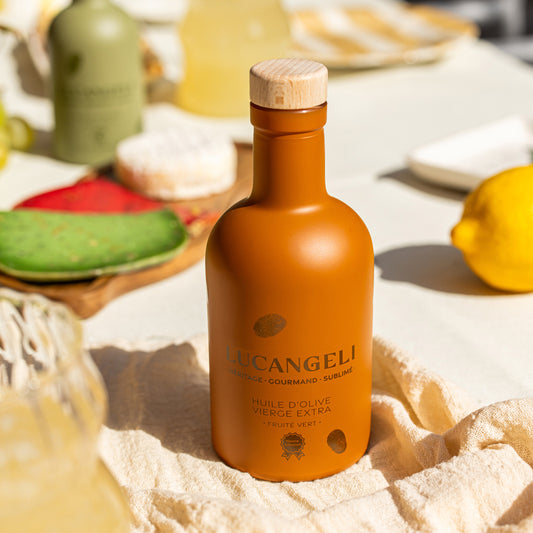
The bottle placed on the table is the first visual signal of your selection. A tinted glass bottle with a clear, neat label immediately communicates the quality of the product. For establishments wishing to go further, a customized bottle with the establishment's image reinforces the visual coherence of the table and becomes a communication element in its own right. Customization takes three to four weeks from design approval, for a minimum of 24 bottles.
For large service formats, buffets, banquets, and communal tables, the
 jeroboam of organic extra virgin olive oil constitutes a remarkable table centerpiece, which attracts attention and naturally prompts customer inquiries.
Train your front-of-house team in less than an hour
Training does not need to be long to be effective. A 45-minute session is enough to convey the basics:
- The difference between green fruit and ripe fruit, with a comparative tasting.
- Two or three concrete food-oil pairings, drawn from your current menu.
- The answer to the most frequent question: which oil do you recommend with this dish?
A server able to answer this question accurately and naturally transforms a condiment into an experience. This is the level of service that customers remember and mention in their reviews. Lucangeli offers formats adapted for professionals, with capacities and packaging designed for dining room rotation. For any specific request, the space dedicated to catering professionals is the entry point.
Frequently Asked Questions
How to present an olive oil menu without slowing down service?
The olive oil menu does not need to be exhaustive to be effective. Three well-chosen selections, presented in a few words by the server or on a simple insert, are enough to create a distinctive service moment without slowing down the pace of the dining room. The essential thing is that the team knows the products and is comfortable talking about them.
What capacity should you choose for bottles placed in the dining room?
For classic table service, a 200 ml capacity is ideal: it corresponds to approximately ten servings at 20 ml per cover, allowing for regular rotation and limiting oxidation. For buffets or large tables, a 500 ml capacity or a jeroboam format is more suitable. The 5-liter container is reserved for the kitchen and replenishment, never for dining room service.
How to justify the price of premium olive oil to customers?
Justification comes through information, not persuasion. Mentioning the geographical origin, the olive variety, the cold extraction method, and organic certification gives the customer the elements to understand the price difference. An informed customer is a convinced customer. This is precisely the role of the olive oil menu: to transform a menu item into a product story.



 lucangeli.it