


Calabrian bergamot, a unique citrus fruit from southern Italy
Calabrian bergamot is one of Europe's rarest citrus fruits: grown on a hundred-kilometre coastal strip in southern Italy, it is almost impossible to find outside its region of origin. In Bordeaux, though, home cooks and restaurateurs are starting to discover it, carried by a booming Italian fine-food scene and unexpected pairings with local Gironde produce.
A very precise geography
Calabrian PGI bergamot grows exclusively on a narrow coastal strip running along the Strait of Messina, between Reggio di Calabria and Brancaleone, below two hundred metres of altitude and facing due south. This combination — sea, sun, sea air — cannot be replicated. Nowhere else in the world does this citrus fruit give the same results in terms of aromatic intensity and balance between acidity and bitterness.
Its harvest season runs from November to March. So it is a deep-winter product, against the grain of the summer citrus you find everywhere. This seasonality partly explains why bergamot remains little known in France: the fine grocers who work with direct Italian sourcing are the first to offer processed versions of it all year round.
Juice, oil and spread: the three forms to know
Calabrian bergamot now comes in several forms you can use in the kitchen, without having to track down the fresh fruit — almost impossible outside Calabria.
| Column 1 | Column 2 | Column 3 |
|---|---|---|
| Data 1 | Data 2 | Data 3 |
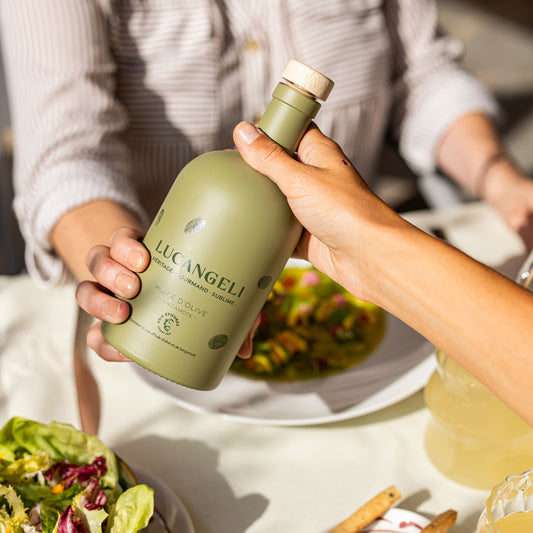
Bergamot olive oil deserves an important clarification: it is obtained by milling the fresh fruit together with the olives at the moment of extraction, not by adding flavouring afterwards. This technique gives a more integrated oil, with no artificial note, where bergamot and olive are in dialogue right from the pressing. It was awarded the Épicures d'Argent 2023. The bergamot spread, for its part, took the Épicures d'Or 2024.
---
Bordeaux and bergamot: natural pairings

Bordeaux is not the first city that comes to mind for Italian cooking, but its food scene is one of the most dynamic in France. Bordeaux chefs work readily with citrus in sauces, marinades and desserts, and a Mediterranean influence has been noticeable on many menus for several years now. Calabrian bergamot slips in naturally.
With oysters and seafood from the Bassin d'Arcachon
The most direct pairing in Bordeaux is with oysters. The Bassin d'Arcachon is less than an hour from the city, and oysters rule every brasserie and fine-dining menu there.
A few drops of organic bergamot juice on a fresh oyster are a real step up from the usual lemon: the acidity is finer, and the light bitterness underlines the briny note without crushing it. On prawns, moules marinières or a sea bass tartare, the effect is the same. For professional kitchens working with seafood platters, it is a simple differentiator at a controlled cost.
Bergamot olive oil as a finishing touch on a scallop carpaccio is another very Bordeaux pairing: the sweet, pearly flesh of the shellfish calls for a floral citrus rather than a sharp lemon.
With Bordeaux cheeses and desserts
Bergamot is floral, slightly bitter, with a silky acidity. It goes remarkably well with fresh goat's cheeses, soft cheeses and mild blues. A drizzle of bergamot oil on a fresh goat's cheese, a spoonful of bergamot conserve with a Bleu du Quercy or a young Roquefort: these are pairings that Bordeaux wine merchants have started offering at aperitif time.
For dessert, the bergamot spread works on a slice of sourdough toast, in whipped cream to fill choux buns, or simply by the spoonful with a cup of tea. Its profile — softer than lemon curd, more complex than marmalade — particularly appeals to bergamot lovers who had so far stuck to Earl Grey tea.
For an original gift to give in Bordeaux, the bergamot gift box brings juice, oil and spread together in a single case and makes a coherent introduction to this unique aromatic world.
---
Finding and using Calabrian bergamot in Bordeaux

For home cooks
Calabrian bergamot in processed form — juice, oil, spread, conserve — can be found at Italian fine grocers or shops specialising in southern Italian products. Ordering online with delivery to Bordeaux remains the most direct route to a full selection, especially for the pure juice and the oil made by co-milling.
Keep the juice in the fridge once opened and use it within a few weeks. Bergamot oil, like any olive oil, should be kept away from light and heat. The spread keeps for several weeks once opened, in the fridge.
A simple use to try tonight: one tablespoon of bergamot juice in your usual vinaigrette in place of the vinegar. The result is more delicate, more floral, and works particularly well with lamb's lettuce, rocket or autumn chicory salads — vegetables perfectly in season in Bordeaux right now.
For restaurants and fine grocers
If you supply an establishment in Bordeaux, Calabrian bergamot opens up real ways to stand out on three parts of the menu: starters (fish and seafood finishing), the cheese board (jam or conserve pairing), and desserts (fillings, inserts, coulis).
The pure juice, bottled in 200 ml or larger formats, can be used directly with no preparation. For professional volumes, the available formats and supply terms are best discussed directly through the professionals area, which sets out minimum orders, lead times and logistics for delivery to Bordeaux.
For a Bordeaux fine grocer looking to stock the bergamot range, the coffret solaire — which brings together bergamot juice, olive oil and spread — is an efficient entry point for putting the range on the shelf and offering customers a full discovery.
---
Frequently asked questions about Calabrian bergamot
What is the difference between a bergamot olive oil and a bergamot-flavoured oil?
A bergamot olive oil obtained by co-milling is pressed with the fresh fruit directly at the mill, at the moment of extraction. The aroma is built into the oil rather than added afterwards. A flavoured oil, on the other hand, is a neutral or virgin oil to which bergamot extract or flavouring has been added. The taste profile is different: co-milling gives a finer and more stable aromatic complexity.
Can Calabrian bergamot juice be used like lemon juice in every recipe?
In most uses — vinaigrette, marinade, fish finishing, desserts — yes, reducing the quantity slightly because bergamot is more aromatically concentrated than lemon. In pastry it works in creams, ganaches and glazes. Its light bitterness does set it apart from lemon, though, and can surprise in very sweet preparations where lemon is used for its straightforward acidity.
Where can you buy Calabrian bergamot in Bordeaux without travelling all the way to Italy?
Fine grocers specialising in Italian products and some Bordeaux wine bars serving food sometimes stock bergamot juice or jams. To reach a full range — pure juice, olive oil, spread, conserve — ordering online from direct producers or importers remains the most reliable option, with home delivery or pickup-point delivery in Bordeaux.




 lucangeli.it