
The free acidity of extra virgin olive oil must be less than 0.8%: you may have read this on a label or in a buying guide. But this figure says much more than that. It tells the story of the olives' condition at harvest, the speed at which they were pressed, and the care taken at every stage of production. Understanding free acidity means learning to read an olive oil like a professional.
What free acidity really is and what it isn't
A chemical, not a taste, measurement
Free acidity measures the proportion of free fatty acids in the oil, expressed in grams of oleic acid per 100 grams of oil. These fatty acids form when triglycerides, the basic molecular structure of the oil, break down in contact with the water contained in the olive pulp. This phenomenon is called hydrolysis.
Here's the most common misconception to correct: free acidity has no impact on the taste of the oil. You can't smell it, you can't taste it. What you perceive in your mouth—bitterness, pungency, sweetness—depends on the oil's aromatic and phenolic compounds, not its free acidity level. Two oils can have very different taste profiles with identical acidity levels.
Regulatory thresholds to know
The European regulation sets precise thresholds according to the oil category. Here are the four main categories and their characteristics:
1. Extra virgin: maximum free acidity of 0.8%, maximum peroxide value of 20 mEq O2/kg. Recommended use: finishing, seasoning, gentle cooking.
2. Virgin: maximum free acidity of 2%, maximum peroxide value of 20 mEq O2/kg. Recommended use: everyday cooking, seasoning.
3. Lampante: free acidity greater than 2%. Unfit for consumption as is, industrial use only.
4. Refined olive oil blended with virgin: maximum free acidity of 1%, maximum peroxide value of 15 mEq O2/kg. Recommended use: high-temperature cooking.
The "extra virgin" label therefore guarantees a level below 0.8%. But this threshold is a legal minimum, not a guarantee of absolute quality. An oil at 0.7% and an oil at 0.1% are both extra virgin. They are not equivalent for all that.
Why two extra virgin oils can be very different
The time before pressing: the most underestimated factor
A picked olive is a living fruit. As soon as it is separated from the tree, enzymatic reactions begin in the pulp. The longer the delay between picking and pressing, the more free acidity increases. In practice, every additional hour spent in a crate or truck before arriving at the mill drives this figure up.
Producers who show very low acidity levels, often below 0.2%, are those who press their olives within hours of harvest, sometimes even the same night. This is a considerable logistical constraint, which largely explains the price difference between supermarket oil and producer oil.
Olive variety and its role
Some varieties are naturally more stable than others against hydrolysis. The Carolea, an emblematic Calabrian variety, is renowned for producing low-acidity oils when harvested at optimal ripeness, i.e., at the beginning of veraison, when the olive turns from green to purple. If harvested too late, the same variety can yield an oil whose acidity exceeds 0.5%, without the gustatory quality necessarily being degraded, but with a reduced shelf life.
To compare two profiles on the same basis, the discovery duo in two 500 ml bottles allows you to compare a green fruity and a ripe fruity from the same Calabrian origin.
The condition of the olives at harvest
Olives damaged by mechanical shocks, olive fly attacks, or late harvesting show micro-lesions in the pulp. These lesions accelerate hydrolysis and increase acidity even before the olive is pressed. This is why manual harvesting, which preserves the integrity of the fruit, is systematically associated with very low acidity oils.
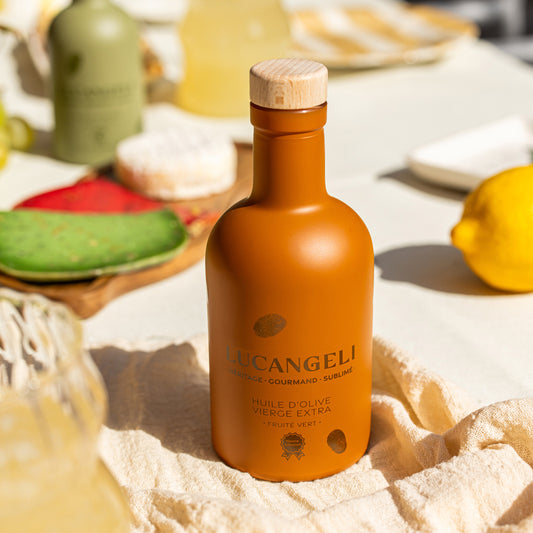
A organic green fruity oil from an early manual harvest concretely illustrates this principle: the olives are picked before full maturity, quickly transported, and cold-pressed within hours.
How to find this number and what to do with it
Why free acidity is often not displayed
European regulations do not oblige producers to indicate the free acidity level on the label. Only the category, extra virgin or virgin, is mandatory. As a result, the vast majority of bottles on shelves do not mention this figure.
Producers who voluntarily display it do so because it is low and constitutes an argument for quality. If you see "acidity 0.15%" or "acidity 0.2%" on a label, it's a positive sign. If the figure is absent, you can ask the producer directly or look for it in the product's technical sheet.
What you should look at first
When choosing an olive oil, here are the three pieces of information to look for in this order:
1. The category: extra virgin is the minimum for a quality oil.
2. The harvest date or vintage: a recent oil, from the last campaign, is always preferable to an oil whose best-before date is in two years but whose harvest dates back three years.
3. The free acidity level, if indicated: below 0.3%, you are looking at a very good quality oil.
For daily use in cooking, an organic ripe fruity oil offers a good balance between aromatic sweetness and heat resistance. For professionals seeking a regular supply with complete traceability, the professional area provides access to technical sheets and ordering conditions adapted to establishments.
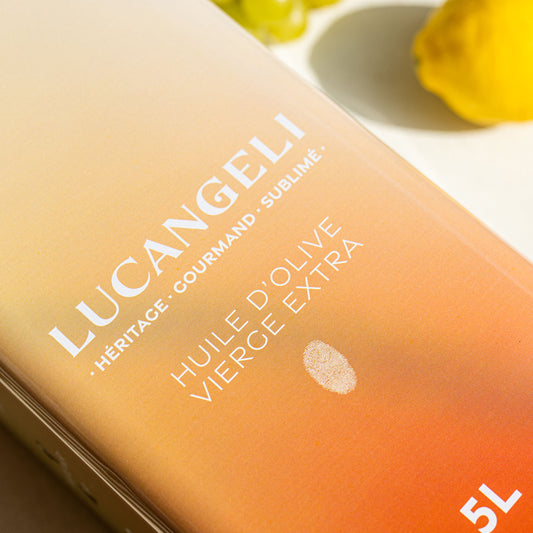
If you want to explore several profiles before choosing, the tasting trio in three 200 ml bottles is the ideal format to compare without committing to a large volume. And for intensive use in the kitchen, the 5-liter can remains the most economical format for use.
Frequently Asked Questions
Can free acidity be tasted in olive oil?
No. Free acidity is a chemical parameter that cannot be perceived by smell or taste. What you feel—bitterness, pungency in the throat, sweetness—depends on the oil's aromatic and phenolic compounds, not its free fatty acid level.
What free acidity for a quality extra virgin olive oil?
The legal threshold is a maximum of 0.8%. A superior quality oil generally displays a level below 0.3%. The best productions, resulting from pressing within hours of harvest, often go below 0.2%.
Why is the free acidity level not always indicated on the label?
European regulations do not require it. Only the extra virgin or virgin category is mandatory. Producers who display this figure do so voluntarily, usually because it is low and constitutes an argument for quality. You can always ask the producer directly or consult the product's technical sheet.





 lucangeli.it