


What the panel test actually assesses
An extra virgin olive oil has to meet two sets of cumulative criteria: chemical thresholds (free acidity, peroxide value, extinction coefficient) and a sensory examination carried out by an accredited jury. That second examination is what we call the panel test. If the oil fails either one, it is downgraded — no matter how well it performs on the other.
The official method and accredited juries
The panel test is governed by Commission Implementing Regulation (EU) 2022/2104, which updated the rules laid down back in 1991. The reference method is the one from the International Olive Council (IOC), document T.20/Doc. no. 15. In France, it corresponds to standard NF EN ISO 16657.
In practice, a jury is made up of eight to twelve trained tasters, selected and regularly assessed for the reliability of their perception. These are not well-informed amateurs: they are professionals trained to identify defects under standardised conditions, with opaque blue glasses that hide the colour and serving temperatures controlled at 28 °C. The colour of an oil plays no part in its classification — that is a common misconception.
The defects that get an oil rejected
The jury looks first for the presence of defects. The regulation lists several of them; the most frequent are:
- Rancid — advanced oxidation, a smell of old fat or cardboard.
- Fusty-muddy sediment — olives that fermented after sitting piled up too long before milling, with notes of mud or fermented cabbage.
- Metallic — prolonged contact with metal surfaces during extraction or storage.
- Winey-vinegary — acetic fermentation, a smell of vinegar or flat wine.
- Musty-humid — mould developing on fruit stored in poor conditions.
If the median intensity of a defect perceived by the jury is above zero, the oil cannot be classified as extra virgin. It moves into the "virgin" category if the defect intensity is low, or into lampante (not edible as it is) if it is high.
The mandatory positive attribute: fruitiness
An extra virgin oil not only has to be free of perceptible defects, it also has to show a mandatory positive attribute: fruitiness. The median for fruitiness must be above zero. Fruitiness is the whole set of aromas linked to the fresh olive, whether they lean grassy (green fruity) or softer and rounder (ripe fruity). It is the attribute you pick up when you smell a quality oil before you have even tasted it.
Bitterness and pungency — those slightly peppery sensations at the back of the throat — are not defects. They are markers of freshness and of polyphenols naturally present in the olive. Many people avoid them, wrongly. To understand where they come from and how they vary, read the article on bitterness and pungency as signs of quality.
---
Panel test and chemistry: two complementary examinations

Why chemical analysis is not enough
An oil can show chemical parameters that comply with the extra virgin category and still be rejected at the panel test — particularly if it has undergone a slight fermentation that has not yet changed its chemical values but is already perceptible on tasting. The reverse happens too: an oil whose chemical parameters have been slightly degraded by prolonged storage may have lost its sensory qualities before the figures show it clearly.
The two examinations therefore complement each other, and European regulation requires both of them for any oil sold under the "extra virgin" label.
The regulatory thresholds at a glance
The table shows that the gap between extra virgin and virgin is sometimes narrow in chemical terms, but clear-cut in sensory terms: zero perceptible defects, no exceptions.
If you want to go further on how to read a label, the article on free acidity in olive oil sets out what that figure really tells you.
---
What the panel test changes for you when you buy
Reading a label differently
Any bottle labelled "extra virgin" in a supermarket or a delicatessen has, in theory, passed this double examination. In practice, the checks are done by sampling and not on every batch produced. The real guarantee comes from the producer's traceability, from the harvest date (or vintage) shown, and from the batch number, which make it possible to trace the oil back to milling.
Look on the label for:
- The harvest date or vintage — more telling than the best-before date, which is calculated from bottling and can hide ageing.
- The batch number — it has to be there. If you have a doubt or a complaint, that number is what makes it possible to find the batch analyses.
- The precise geographical origin — a vague wording such as "blend of European Union olive oils" gives you no real traceability.
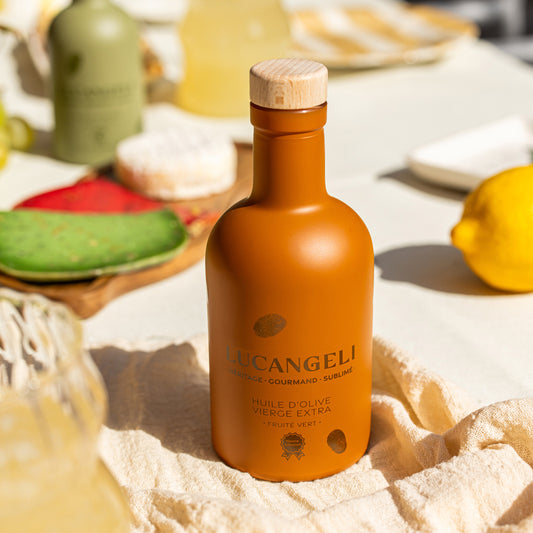
An oil such as the organic green fruity in 200 ml or the limited-edition ripe fruity in 1 L states a precise Calabrian origin, an identified variety and a vintage, which gives you the means to check.
The signs that give away a rejected oil
Even without a jury, you can spot the most common defects:
- A smell of old fat or wax → rancid. The oil has oxidised.
- A smell of cabbage or compost → fusty-muddy sediment. The olives fermented before milling.
- A flat taste, no sensation at all → the fruitiness is gone. The oil is too old or was badly stored.
- A metallic smell on the finish → contact with poorly maintained equipment.
- A slight vinegary sharpness → acetic fermentation.
If you are ordering for professional use or in large quantities — a 5-litre tin for everyday cooking, a jeroboam for table service — always ask for the batch's technical sheet with the chemical analysis results and, if possible, the panel test report. Lucangeli's professionals area is designed to handle that kind of request.
To build a small home cellar of oils with contrasting profiles, the 200 ml discovery trio lets you compare a green fruity and a ripe fruity side by side — good practice for training your perception before you even know what a panel test found.
---
Frequently asked questions
Is the panel test mandatory for every olive oil sold in France?
Yes. For any oil sold in the "extra virgin" or "virgin" category in the European Union, Regulation (EU) 2022/2104 requires the official sensory method. Checks are done by sampling batches, not systematically bottle by bottle. Responsibility for compliance lies with the producer and the bottler.
Is an organic olive oil automatically better at the panel test?
No. The organic label covers farming practices and the absence of pesticide residues, not sensory qualities. An organic oil can be rancid if it was badly stored or milled too late. Conversely, a conventional oil can score excellent results at the panel test. The two criteria are independent.
Can you run your own panel test at home?
You can get close. All you need is an opaque glass, or an ordinary one cupped in your palms to warm the oil gently to 28 °C, then inhale slowly before tasting. You identify any defects first (rancid, fermented, metallic), then you look for the fruitiness. What separates this from an official jury is training and repeatability: an accredited taster has worked through hundreds of reference samples to calibrate their perception. The exercise is still useful for developing your feel for quality.




 lucangeli.it