


Why are lentils an autumn staple in Italy?
Throughout southern Italy, lentils return to kitchens as early as October. They are prepared as soups, warm salads or simply braised with garlic, celery and tomato. This is hearty cooking, built around long-lasting ingredients that stand up to chilly nights and shortening days.
The most popular variety in the south is still the small green lentil, which holds its shape when cooked rather than turning to mush. It does not need to be soaked overnight; it cooks as is, and its thin skin gives it a tender texture without excess starch. In Calabria, it is served on special occasions as well as for everyday meals.
This is also one of the few dishes where olive oil is not used as a cooking fat, but as a finishing touch. It is this use of oil uncooked, added at the last moment, that truly brings out the qualities of a distinctive olive oil.

Italian-style lentils: a step-by-step recipe
Ingredients for 4 people
- 300 g small green lentils
- 1 celery stalk
- 1 medium carrot
- 1 yellow onion
- 2 cloves of garlic
- 200 g canned peeled tomatoes
- 1 bay leaf
- 1 sprig of fresh rosemary
- Salt, freshly ground black pepper
- 2 tablespoons of mature-fruited olive oil for finishing, plus a drizzle for sautéing the vegetables
Method
- Rinse the lentils under cold water and pick out any small stones. Set aside.
- Peel and finely dice the onion, carrot and celery. This is the aromatic base Italians call il soffritto, the foundation of most slow-cooked dishes in the south.
- Heat a drizzle of olive oil in a heavy-bottomed saucepan over medium heat. Sauté the onion, carrot and celery for five minutes, until translucent. Add the whole, lightly crushed garlic cloves.
- Add the lentils to the pan and stir well to coat them in the soffritto aromas. Add the roughly crumbled peeled tomatoes, bay leaf and rosemary.
- Cover with cold water, adding about two finger-widths extra. Bring to a boil, then lower the heat and simmer covered for twenty to twenty-five minutes. The lentils should be tender but hold their shape.
- Season with salt only at the end of cooking: salt added too early toughens the legumes' skins.
- Remove the bay leaf and rosemary. Off the heat, pour the two tablespoons of mature-fruited olive oil over the dish. Add plenty of pepper.
- Let stand for two minutes before serving, so the oil blends with the cooking juices without being heated.
Why add the oil off the heat?
Heating extra virgin olive oil after cooking means wasting its best qualities. The aromatic compounds that give mature-fruited oil its notes of almond, cooked artichoke and ripe tomato are volatile: they quickly disappear above 60 to 70°C. By pouring the mature-fruited olive oil directly into the hot dish off the heat, you preserve all those aromas, and the residual heat is enough to release them gradually.
The measure of two tablespoons for four people is no accident. It comes to about 20 ml, the amount needed to coat each serving without making the dish heavy. A smaller amount stays on the surface, while a larger one can unbalance the flavor, making the dish too oily.
Choosing the right olive oil for lentils
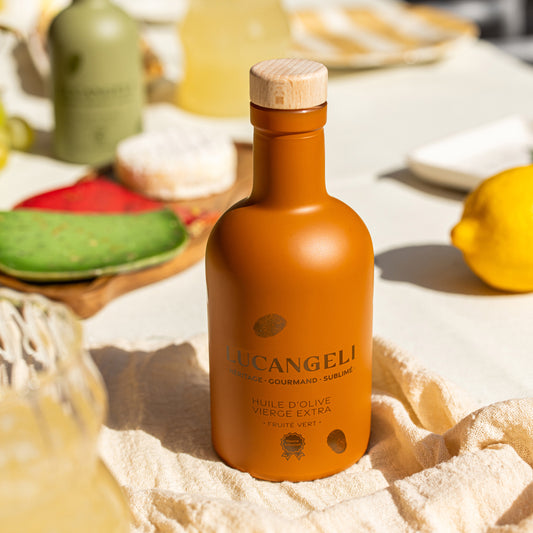
Mature-fruited rather than green-fruited
Lentils are mild and slightly earthy, without pronounced bitterness. An intensely green-fruited oil, with notes of fresh grass, raw artichoke and distinct bitterness, can compete with their natural flavor rather than enhance it. A mature-fruited oil, with rounder, sweeter notes, complements the legume's mildness and creates a harmonious whole.
In Calabria, the Carolea variety is one of the most widely grown for producing oils with a predominantly mature-fruited profile. It yields oils with notes of sweet almond, ripe tomato and cooked artichoke, with a slight peppery sensation on the finish but no excessive bitterness. This profile pairs perfectly with a slow-cooked legume dish, where roundness is exactly what you are looking for.
Extra virgin olive oil, not a generic oil
When using oil as a finishing touch, its quality matters more than it does in long cooking, where aromatic nuances evaporate anyway. Make sure the bottle is clearly labeled extra virgin, which guarantees free acidity below 0.8% and no sensory defects detected by a tasting panel. Below this threshold, the oil has the structure needed for finishing without adding rancid or fermented notes.
Variations and ideas to take it further
- With Calabrian sausage: sauté 200 g of sliced spicy Calabrian sausage in the soffritto before adding the lentils. Use the same finishing oil, but you can reduce the amount slightly because the sausage already adds fat.
- Cold the next day: reheated lentils, or lentils served at room temperature with an extra drizzle of organic mature-fruited olive oil in a 200 ml bottle, make an excellent warm salad served on a slice of toasted bread.
- For professional kitchens: food-service kitchens preparing this dish in large quantities often use a 5-liter can of organic olive oil for cooking and keep a separate bottle for finishing dishes at the table. If you run a restaurant, find the available formats and supply terms on our business customers page.
Frequently asked questions
Do green lentils need to be soaked before cooking?
No, small green lentils do not need to be soaked. Unlike dried beans, their thin skins allow them to cook directly in twenty to twenty-five minutes. Soaking them overnight does not significantly speed up cooking and can even make them more fragile and likely to fall apart.
Can lentils be prepared ahead of time?
Yes, and they are often even better reheated the next day, once the flavors have melded. Store them in a sealed container in the refrigerator for up to three days. Reheat over low heat with a little water if needed, and add another drizzle of finishing oil when serving: the first drizzle will have been absorbed as the lentils rested.
Which olive oil should I use if I want a spicier dish?
For a more intense version, you can replace the mature-fruited finishing oil with organic garlic and chili olive oil, made by co-crushing fresh fruit with the olives during extraction, rather than by adding flavoring. Keep the amount the same: two tablespoons off the heat. The result is bolder and more southern Italian in character, close to the traditional Calabrian version served with toasted bread rubbed with garlic.





 lucangeli.it