


A quality Italian spread isn't just for your morning bread. In autumn cooking it becomes a sauce, a filling, a cake glaze or a marinade. Here are six concrete uses to get the most out of it, with the right products and the right techniques.
Why Italian spreads deserve a real place in the kitchen

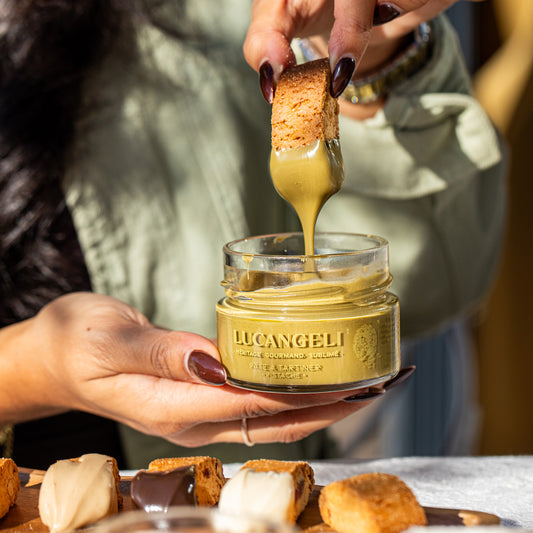
Most supermarket spreads are formulated to be spread on bread, full stop. Artisan Italian spreads — made with pure pistachio, PGI Piedmont hazelnut, almond or Calabrian bergamot — have a texture and a concentration of fruit that make them useful well beyond breakfast.
What changes with a quality spread
An artisan spread contains mainly the fruit it advertises: the pistachio spread is made of pistachios, with no palm oil and no artificial flavouring. The Piedmont hazelnut spread gets its taste from hazelnuts grown under a precise geographical designation, the Tonda Gentile of Piedmont, harvested when ripe. That level of concentration radically changes what you can do with it in the kitchen: one spoonful is enough to flavour an entire preparation, with no need to adjust the seasoning with flavourings.
Getting the quantity right is all it takes
The only thing to master is the dose. An artisan spread is denser in flavour than its industrial equivalent. For all the applications that follow, start with a small amount — one to two tablespoons for four people — and adjust. The aromatic power is there from the start.
6 ways to use them in autumn cooking
1. A warm cocoa and hazelnut sauce for pasta or gnocchi
The cocoa hazelnut spread isn't only for toast. Dilute two spoonfuls in a little hot single cream, add a pinch of fleur de sel and a few whole toasted hazelnuts. Pour over gnocchi cooked al dente or fresh tagliatelle. The result is a sweet-and-savoury sauce that works very well as a starter or as a dessert course: an idea borrowed from the kitchens of northern Italy, where the marriage of hazelnut and pasta has existed for centuries in the form of pasta con la nocciola.
2. A pistachio tart filling
The pistachio spread can be used directly as a tart base, spread over pre-baked shortcrust pastry before you add the fruit. In autumn it pairs with roasted figs, plums, pears or white grapes. Bake for ten minutes at 170 °C so the pistachio sets slightly without burning. The result is a very worthwhile alternative to a classic almond cream, with a far more pronounced aromatic signature.
3. A glaze or ganache for a chocolate fondant
Melt two spoonfuls of hazelnut spread in a pan with a dash of hot water, stirring until you get a fluid consistency. Pour over a warm chocolate fondant to create a glossy glaze. The aroma of PGI Piedmont hazelnut develops with the heat and coats the chocolate without overpowering it. This is the technique used in several pastry shops in northern Italy for the autumn torte da forno, those soft oven cakes brought out when work starts again after the holidays.
4. A bergamot cream for choux buns, éclairs or verrines
The bergamot spread — awarded at the Épicures d'Or 2024 — has a rare quality: its taste is both citrusy and floral, with no residual bitterness at all. Fold it into whipped cream (one spoonful per 200 ml of cream) or mix it in equal parts with fresh cheese to get a cream for filling choux buns or for layering in verrines with crumbled biscuits. The Calabrian bergamot aroma holds up well when cold and survives light baking, which also makes it usable as a filling for oven-baked biscuits.
5. A marinade for poultry or pork, Italian-Sicilian style
The almond spread dissolves easily in a dash of lemon juice or vinegar. Mix one spoonful with lemon juice, garlic, thyme and a little honey to get a sweet-and-sharp marinade. It suits chicken fillets or pork chops particularly well. This technique is known in Sicily as agrodolce alle mandorle: almond paste, a flagship ingredient of Sicilian pastry, migrates naturally into savoury dishes in the home cooking of the islands.
6. A topping for morning porridge or sweet polenta

In northern Italy, sweet polenta is an autumn and winter breakfast still common in households in the mountain regions. A spoonful of hazelnut spread or of cocoa hazelnut spread melted into a sweetened fine polenta, with a few dried fruits and a drizzle of honey, makes for a substantial, fragrant hot morning meal. The same principle works with oat porridge: add the spread off the heat to preserve the aromas.
Building a selection of spreads for autumn
If you want to explore several profiles in your kitchen, the set of 5 spreads brings together the hazelnut, pistachio, almond, cocoa hazelnut and bergamot references. It's a good starting point for testing the six uses described above with a single order, varying the preparations week by week and with the season.
To give a selection as a gift, the gourmet gift box with olive oil and pistachio and cocoa hazelnut spreads combines two registers — the sweetness of the spreads and the roundness of an olive oil — and works well as a gift idea for the back-to-work season or the start of autumn.
If your use is professional — pastry, restaurants, catering — you can turn to the 100% purees for professional use: 1 kg pistachio puree, 1 kg Piedmont hazelnut puree and 1 kg almond puree, with no added sugar, ready to go straight into a recipe.
Frequently asked questions
Can an Italian spread be heated without losing its aromas?
Yes, as long as you don't go above 50 to 60 °C and you heat it off the heat or over very low heat. Beyond that, the most volatile aromas disappear. For a warm sauce, first dilute it in a hot liquid (cream, water), then stir it in quickly.
Which spread should you choose for savoury cooking?
The almond spread is the most versatile in savoury cooking: its mild, slightly bitter taste fits easily into marinades, sauces and dressings. Pistachio works well as a savoury tart base or alongside fresh cheeses. Hazelnut and cocoa are better kept for sweet preparations.
How should you store an opened spread, and for how long?
Keep the jar closed at room temperature, away from light and heat. Once opened, use it within four to six weeks. If you notice the oil separating on the surface, that's normal for an artisan spread with no emulsifier: just stir before use.




 lucangeli.it