

Why Bordeaux restaurants are betting on exceptional Italian products
A dining scene open to Mediterranean influences
Bordeaux has changed profoundly in a decade. The city now counts several hundred active restaurants, with a notable concentration of bistronomy spots, contemporary trattorias and fine-dining establishments that lay claim to a clearly Mediterranean identity. Bordeaux diners, used to exceptional terroir wines, naturally carry that same demand over to what reaches the table: traceable origin, a named producer, consistent quality.
In that context, Italian products are taking up more and more space on autumn menus. Extra virgin olive oil, PGI balsamic vinegar from Modena, nut purees and artisan spreads answer a precise need: setting a dish apart without multiplying preparations, and bringing a depth of flavour you notice straight away.
The products that make the difference, front of house and in the kitchen
Bordeaux establishments that work with suppliers specialising in Italian fine food generally reach the same conclusion: it is the finishing products that draw the most comments from guests. A drizzle of lemon-pressed olive oil over a fish tartare, a few drops of PGI balsamic vinegar, Gold collection on a burrata, a quenelle of 100% pistachio puree alongside a dessert: these simple gestures create an experience your guest immediately associates with real attention to quality.
It is also what makes the investment add up economically: the food cost per portion stays very much under control, while the value the guest perceives is disproportionately high.
---
Which Italian products to source first for your establishment
Extra virgin olive oils and co-pressed oils
Olive oil is the first sourcing line to get organised. Two uses need to be kept clearly apart: cooking, which calls for large volumes and a consistent flavour profile, and finishing on the plate, which justifies a more elaborate product.
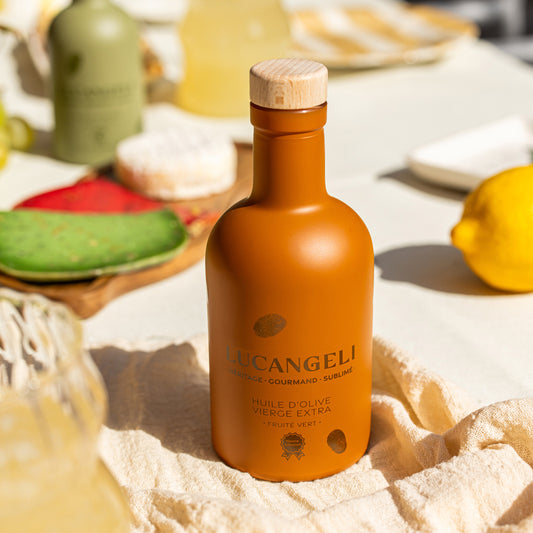
For cooking and everyday preparations, the 5-litre tin of organic olive oil offers a volume-to-quality ratio suited to weekly rotation. For finishing and table service, formats from 200 ml to 500 ml let you work with several profiles in parallel: green fruity for vegetables and fish, ripe fruity for white meats and mushrooms, or an oil pressed with organic garlic and chilli for pizzas, grilled dishes and spicier pasta. That last one is made by crushing the fresh fruit together with the olives at the moment of extraction, which gives it an aromatic intensity you simply cannot get by adding flavouring.
For restaurants that want a strong visual effect in the dining room, the jeroboam of organic extra virgin olive oil also makes a high-impact table object, while covering a useful volume across several services.
PGI balsamic vinegars from Modena

Balsamic vinegar is one of the most underused products in French restaurants. Reduced to the occasional salad, it can in fact transform an entire plate when it is chosen with care and used in the right dose.
The Épicures 2025 medal won by the red onion vinegar is a point of difference you can put to work directly in the dining room, on the menu or in staff training.
Nut purees and spreads for food service
Purees packed in 1 kg formats are designed for kitchen production. The 100% PGI Piedmont hazelnut puree and the 100% almond puree go straight into tart bases, ganaches, sweet-and-savoury sauces or compound butters. The 100% pistachio puree is especially versatile: house-made ice cream, panna cotta, poultry stuffing, a warm sauce over fresh pasta.
On the spreads and table condiments side, the black olive tapenade with extra virgin olive oil, the sun-dried tomato tapenade, the pitted black olives and the PDO basil pesto are references suited to plated service, service bread and antipasti boards.
---
Getting your Italian sourcing right in Bordeaux: logistics and criteria
Choosing a specialist supplier
The main mistake establishments make when sourcing Italian fine food is handing this line over to a generalist wholesaler. Those operators generally offer supermarket references, with no traceability of origin and no distinction between PGI, PDO and everyday standard qualities. The result is predictable: products that struggle to stand out on the menu and do not live up to the promises the restaurant has made to its guests.
A specialist supplier brings you three things a generalist wholesaler cannot guarantee:
- Full traceability of the product, from the producer through to your kitchen.
- A coherent range across every category, letting you build a consistent flavour identity on your menu.
- A contact able to answer technical questions about aromatic profiles, pairings and formats.
Formats, volumes and stock rotation
In Bordeaux as anywhere in France, restaurateurs can source directly from producers or specialist importers with nationwide delivery. Logistics are fluid enough today that a supplier's geographic location is no longer a deciding factor, as long as you plan orders a week ahead.
To optimise rotation and limit oxidation — a critical issue for olive oils — it is worth working with distinct formats according to use:
A professional starting out with a small range can build their listing on three or four lines: a tin of olive oil for cooking, two finishing references, and a balsamic vinegar. Moving upmarket happens gradually, guided by feedback from the team and from guests.
Personalisation as a lever for identity
Some Bordeaux establishments go further and have their olive oil bottle personalised: a label carrying the house name, a specific message, a design coordinated with the restaurant's visual identity. It has a strong impact on how guests see you, because they immediately connect the bottle to care and to an investment in quality. It also makes a guest gift or a table keepsake the restaurateur can put up for sale.
The personalised bottles service for trade customers starts at 24 bottles. For a bespoke project or a large volume, the trade area lets you get in touch directly with the foodservice sales team, who help establishments define their needs, select references and set a delivery schedule.
---
Frequently asked questions
Can an Italian food supplier deliver to Bordeaux without a high minimum order?
Suppliers specialising in Italian fine food generally offer nationwide delivery, with minimum orders that vary by range. It is worth grouping several references into a single order to optimise shipping costs. The foodservice sales team can tell you the exact terms for your establishment through the trade area.
What is the difference between a PGI balsamic vinegar and a PDO balsamic vinegar for restaurant use?
PGI balsamic vinegar from Modena is produced to a precise set of specifications, with a defined minimum ageing period. It suits finishing on the plate, marinades and hot preparations. Traditional PDO balsamic vinegar is aged for at least 12 years, with far greater density and complexity: it is used cold only, with a pipette, on high-value preparations. In everyday restaurant work, a carefully selected quality PGI covers most professional uses.
How do you justify the price of a premium Italian product to a Bordeaux guest?
The best justification is transparency: the precise geographic origin, the certification, the producer, the method. A guest who understands why their plate is different is a guest who comes back. Training your front-of-house team on two or three arguments per product — appellation, production method, use in the kitchen — is enough to turn a sourcing item into a point of difference.




 lucangeli.it