


Olive oil at hotel breakfasts meets a growing customer expectation: to find the hallmarks of Mediterranean gastronomy at the table from morning. Well-chosen and well-presented, it becomes a marker of identity for your establishment.
For a long time, olive oil at breakfast was a local Mediterranean tradition, reserved for hotels on the Greek coast or in the Tuscan hills. This is no longer the case. Guests at four-star hotels and French palaces now expect a morning table that tells a story: an origin, care, consistency with the restaurant's menu. Olive oil is one of the few condiments capable of fulfilling this role at a low logistical cost, provided you know how to choose it, present it, and refresh it.
Why olive oil has its place on the hotel breakfast table
A use rooted in Mediterranean culture
In Italy, Spain, Greece, and Lebanon, dipping a piece of bread into a small bowl of olive oil in the morning is as natural a gesture as buttering a slice of toast in France. For international guests, who represent a significant portion of urban and seaside hotel clientele, finding this ritual at the table is a immediately perceived sign of attention. It's not a detail: it's a signal of culinary culture.
A lever for buffet differentiation
On a hotel buffet, most condiments are interchangeable from one establishment to another. Olive oil is the exception: a green fruity olive oil from Calabria, made from the Carolea variety harvested at early maturity, presents herbaceous notes and a frank pungency that your guests will not find in a generic supermarket oil. It is this perceptible difference that justifies the product's presence on the table and generates questions — and sales in the hotel shop, if you have one.
Consistency with the restaurant's menu
If your restaurant uses quality olive oil as a finishing touch, offering it at breakfast also creates editorial consistency between the two services. Some hotels go further by mentioning the origin of the oil on a small card placed next to the bowl. This simple gesture, which costs nothing, transforms a condiment into an experience.
Choosing the right olive oil for morning service

Green fruity or ripe fruity: two profiles, two uses
The choice between a green fruity and a ripe fruity is not insignificant at breakfast. Green fruity, more intense, more herbaceous, with a slight bitterness and pungency at the end of the mouth, is perfect for country bread, toast, and raw vegetables. Ripe fruity, softer, with notes of ripe fruit and almond, pairs better with pastries, fresh cheeses, and fruits. If your buffet is sufficiently extensive, offering both profiles side-by-side with a short description is an elegant way to introduce your guests to tasting.
Formats suitable for hotel service
Four formats cover all the needs of a hotel:
- Individual 200 ml bottle — room service and breakfast trays: controlled portion, neat image, customizable with the establishment's colors.
- 500 ml service bottle — buffet and communal table: easy to refill, manageable format for staff.
- 3-liter Jeroboam — large volume buffet and visual presentation: strong visual impact, economical per liter, ideal for high-capacity establishments.
- 5-liter professional container — kitchen and repackaging for dining area: optimized material cost, suitable for large volumes.
For room service and breakfast trays, the 200 ml bottle is the most suitable format: it is easy to handle, does not oxidize too quickly once opened, and can be customized with your establishment's colors. For the buffet, the Jeroboam of organic extra virgin olive oil offers immediate visual impact and sufficient capacity for two to three hours of service without interruption. For the kitchen and repackaging into small bowls, the 5-liter professional container is the most economical solution.
The issue of rotation and oxidation
Opened olive oil oxidizes. In professional kitchens, this point is often overlooked at breakfast, where bowls can remain exposed to light and heat for two to three hours. A few simple rules can help avoid this problem:
- Only fill the bowls at the time of service, never the day before.
- Use tinted glass or opaque ceramic containers, which limit exposure to light.
- Close bottles between each service and store them away from heat.
- Replace opened bottles at least every two weeks, even if they are not empty.
These precautions ensure that the oil served to your guests is always at its best organoleptic level.
Presentation, personalization, and customer experience
The staging on the buffet
The presentation of olive oil on a hotel buffet follows the same rules as that of cheese or cold cuts: it must be visible, identified, and accessible. A bottle placed between two bread baskets without any indication of origin generates no curiosity. However, a bottle accompanied by a small card mentioning the region, variety, and harvest vintage immediately creates a talking point. Add a tasting cup and a small spoon, and you've transformed a condiment into a moment of discovery.
The personalized bottle: a discreet and effective communication tool

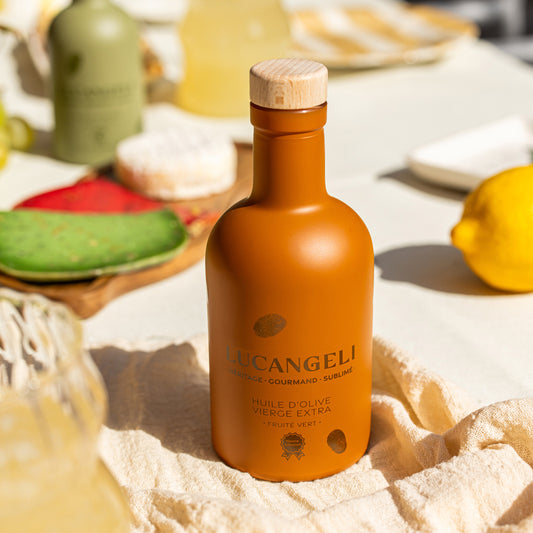
More and more hotels are choosing to personalize their olive oil bottles with the establishment's colors. This approach is consistent with brand policy: the bottle on the table becomes a communication medium, just like the menu or business card. The personalized bottles service allows you to create a design specific to your establishment, starting from 24 bottles, with a production time of two to three weeks depending on volumes. For hotels that wish to go further, a complete range can be created: olive oil, balsamic vinegar, and spreads like the Calabrian bergamot spread or the pistachio spread, which naturally integrate into a breakfast buffet or a room tray.
Training the morning team
The staff in charge of the buffet and room service are the primary ambassadors of your products. A short training, twenty to thirty minutes, is enough to give them the essential elements: the difference between a green fruity and a ripe fruity, how to answer the question "what oil is this?", and how to present the product without making it a commercial demonstration. The professional area offers tailored support to establishments wishing to structure this approach.
Frequently asked questions
What olive oil to choose for a hotel breakfast buffet?
For a buffet, favor a ripe fruity, which is more accessible and versatile: it pairs well with bread, pastries, fresh cheeses, and fruits. If your clientele is international and gastronomically knowledgeable, also offer a green fruity in a separate bowl, with a short description of its origin and variety.
What capacity is most suitable for room service?
The 200 ml bottle is the reference format for room service and breakfast trays. It is easy to handle, keeps well once opened for a short period, and can be customized with your establishment's colors. For suites or long stays, a 500 ml bottle can be considered.
How to prevent olive oil from oxidizing on the buffet during service?
Only fill the bowls at the time of service, use opaque containers, close bottles between each use, and replace opened bottles at least every two weeks. Oil exposed to light and heat for several hours loses its organoleptic qualities and can develop rancid notes perceptible by your guests.



 lucangeli.it