

Why integrate basil-infused olive oil into your establishment
Basil-infused olive oil, obtained by co-crushing fresh basil leaves with olives during extraction, offers an incomparable aromatic profile. It stands out significantly from oil merely flavored by adding extract. In the restaurant industry, it allows you to:
- Enhance summer dishes, fresh appetizers, and plant-based plates.
- Affirm an Italian or Mediterranean identity on the menu.
- Offer an original finish, without aromatic overload.
For an optimal customer experience, choose organic basil olive oil, in a format suitable for your turnover. The 5 L container allows for daily use in the kitchen, while the customized bottle at the table reinforces your establishment's identity.
Selection criteria and stock management in restaurants

Choosing the right basil-infused olive oil
- Guaranteed Italian origin: prioritize clear traceability and cold extraction.
- Authentic co-crushing: verify the mention, a guarantee of a true fresh basil scent.
- Adapted format: container for the kitchen, bottle for the table.
- Recent harvest date: ensure optimal freshness to preserve the aroma.
For professionals, the 5 L container format is ideal for managing material costs. For the table, the customized bottle is a differentiating asset.
Stock management and rotation
- Store olive oil away from light and heat.
- Plan for monthly rotation to guarantee the freshness of the basil.
- Use dark bottles for table service.
A restaurateur on the French Riviera renews their stocks every 3 to 4 weeks in summer, on average, to preserve the aromatic power of basil.
Menu and table enhancement: how to stand out

On the menu
- Explicitly mention basil-infused olive oil on signature dishes (pasta, mozzarella, cold soups).
- Offer a plate tasting, as a finishing touch, to pique customers' curiosity.
- Pair it with seasonal products: tomatoes, zucchini, burrata.
At the table
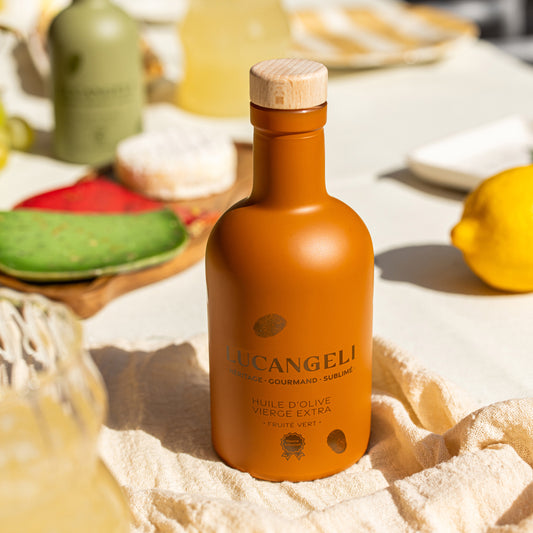
- Present the customized bottle or the trio of oils to enrich the customer experience.
- Train the waiting staff to describe the oil, its co-crushing manufacturing process, and its uses.
- Highlight the gesture of serving the oil, explaining why basil-infused oil is not just a simple flavoring.
Distinguishing element: the Carolea variety, widely used in Calabria for co-crushing with basil, yields an oil with a vegetal and slightly peppery profile, particularly appreciated on cold dishes.
Checklist for integrating basil olive oil into your offering
- Select an infused oil (co-crushing), Italian origin.
- Choose the right format (container for the kitchen, bottle for the table).
- Organize stock rotation to preserve aromas.
- Train the team for table enhancement.
- Showcase the oil on the menu and in the dining room.
To go further, the professionals area offers tailored advice and solutions.
Frequently Asked Questions
How to recognize true basil-infused olive oil in a restaurant?
Check for the "co-crushing" mention on the technical sheet and its Italian origin. The oil should have a fresh basil scent, not an artificial aroma.
What dishes can be enhanced with basil-infused olive oil?
Tomato dishes, fresh pasta, burrata, cold soups, and vegetable carpaccio are particularly suitable for this finish.
How to manage supply and stock rotation in summer?
Plan for monthly rotation, store away from light, and choose formats adapted to your restaurant's traffic.




 lucangeli.it